
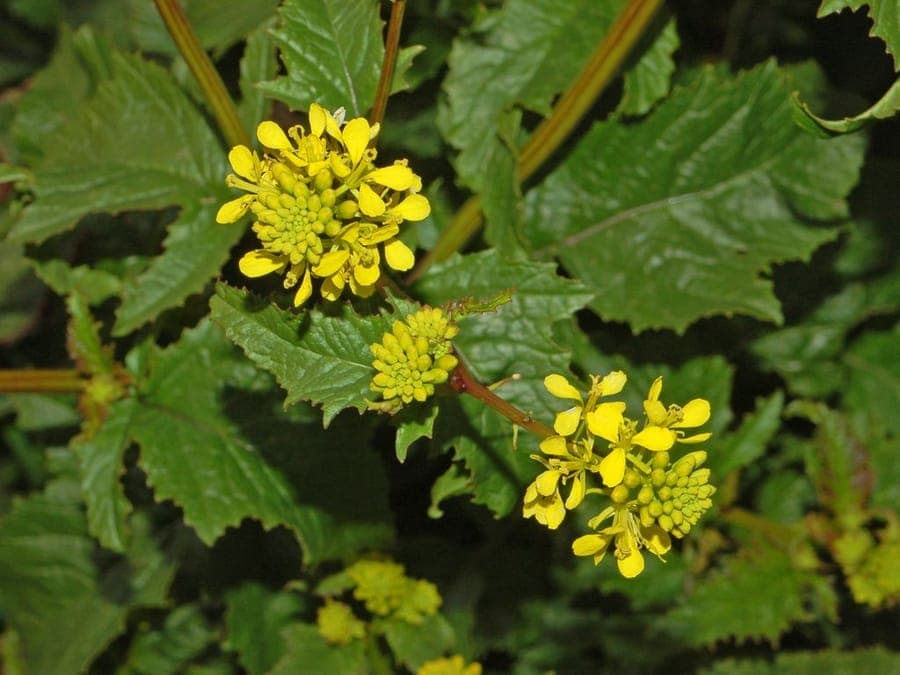
Hectonichus / CC BY-SA 3.0, via Wikimedia Commons
Wild mustard: complete guide
Sinapis arvensis
¿Quieres ver Wild mustard: complete guide en tu jardín?
1 minuto, sin tarjeta de crédito
Overview
Wild mustard (Sinapis arvensis), also known as charlock or field mustard, is a robust annual plant from the Brassicaceae or cabbage family. This plant is renowned for its upright growth habit, bright yellow flowers, and distinctive elongated seed pods that develop later. Originally from Europe, it typically reaches 40-80 cm height and is primarily considered a weed, though it possesses potential as culinary herb and nectar source in gardens.
Select this plant for naturalistic gardens, wildflower borders, and locations where you wish to explore culinary potential.
Appearance and Bloom
Wild mustard is a slender, upright plant with obvious branching in the upper half. Leaves are green, irregularly lobed, particularly at the base. Stems are relatively smooth and hairless.
Flowers are bright yellow, small, and four-petalled (characteristic of the Brassicaceae family) and appear in dense racemes at stem tips. Blooming occurs April through October, depending on sowing time. Following bloom, distinctive elongated seed pods (siliques) 3-4 cm long develop, significantly altering plant appearance.
Ideal Location
Select a sunny location receiving minimum six to eight hours direct sunlight daily. This plant tolerates moderately shaded conditions. It is remarkably adaptable regarding light.
The plant tolerates windy situations.
Soil
Wild mustard grows in virtually all soils, from poor to rich, acidic to alkaline. This is an unpretentious plant. However, well-draining soil is preferred. The plant even survives in compacted soils, though performance is diminished.
Diseño gratis
¿Quieres ver Wild mustard: complete guide en tu jardín? Crea un diseño gratis ahora.
Watering
Once established, this plant is extremely drought-tolerant. Water only when soil is very dry. The plant sustains itself with rainfall alone in most climates.
In exceptionally dry conditions, water once weekly.
Pruning
Minimal pruning required. You may pinch the plant to encourage branching and flower production, but this is optional. Remove seed pods when ripe if harvesting for seed.
Maintenance Calendar
- Spring: Sow seeds directly in garden after last frost
- Summer: Water during dry periods, await blooming
- Autumn: Harvest seeds when pods become brownish
- Winter: Plant dies in temperate climates
Winter Hardiness
This is an annual plant winter-dependent. In temperate climates, it typically grows as summer bloomer. In mild climates, it may overwinter as winter annual.
Companion Plants
Perfect partners are other wildflowers such as cornflower, poppy, and other naturally blooming plants. This plant works well in mixed green borders for structure.
Closing
Wild mustard deserves more recognition as a valuable component of naturalistic gardens and wildflower borders. Its yellow flowers and distinctive seed pods make this a botanically interesting plant. For those wishing to experiment with culinary herbs and naturalistic planting, wild mustard offers numerous possibilities.
Consult wildflower suppliers or visit gardenworld.app/nl and gardenworld.app/en for more information about cultivating this intriguing plant!
¿Quieres ver Wild mustard: complete guide en tu jardín? Crea un diseño gratis ahora.
Sube una foto, elige un estilo y obtén un diseño fotorrealista con lista de plantas en menos de un minuto.
Más de 10.000 jardines diseñados
Sin tarjeta de crédito


Plantas similares
Brassica cretica: complete guide
Brassica cretica
Brassica cretica, the Cretan cabbage, grows wild on Aegean cliffs. Discover how to grow this drought-tolerant, yellow-flowered Mediterranean perennial.
Corsican cabbage: complete guide
Brassica insularis
Corsican cabbage is a rare Mediterranean rock cabbage with white flowers and blue-green leaves. Location, soil and winter protection.
Prostrate cabbage: complete guide
Brassica procumbens
Prostrate cabbage is a creeping North African cliff plant with yellow flowers. Discover location, soil type and winter protection.