
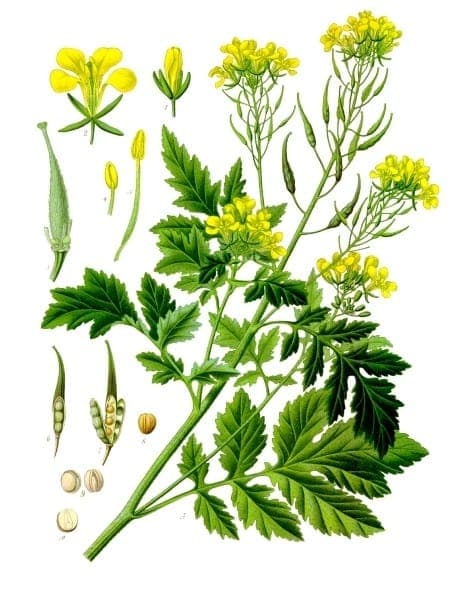
Franz Eugen Köhler, Köhler's Medizinal-Pflanzen / Public domain, via Wikimedia Commons
White mustard: complete guide
Sinapis alba
¿Quieres ver White mustard: complete guide en tu jardín?
1 minuto, sin tarjeta de crédito
Overview
White mustard, botanically known as Sinapis alba, is a fast-growing plant from the Brassicaceae family. This annual plant is renowned for its yellow flowers, rapid growth, and valuable agronomic benefits. The plant is widely used as green manure, ground cover, and forage crop. At gardenworld.app, you can perfectly integrate this useful plant into sustainable gardens and permaculture designs.
White mustard grows very quickly, can flower in 4-8 weeks, and is therefore ideal for rapid soil coverage and nutrient cycling improvement. The seeds are also edible and can be processed into mustard.
Appearance & bloom cycle
White mustard grows as an annual plant that typically reaches 60-100 cm in height. The stems are green, upright, somewhat branched, and have a hairy texture. The leaves are dark green, slightly lobed, approximately 10-15 cm long, and also have a hairy surface.
The flowers are yellow, approximately 1.5-2 cm in diameter, and grow in dense, long racemes at the tops of branches. They appear typically 4-6 weeks after sowing, depending on temperature and daylight. The flowers are very attractive to bees and other pollinators.
After pollination, characteristic seed pods form, approximately 2-3 cm long, each containing 6-8 large yellow seeds. These seeds are approximately 2-3 mm in diameter, yellow to yellowish-brown in color.
Ideal location
White mustard grows best in full sun to partial shade. The plant can even grow in more shaded situations, although growth will be slower and more branched. For maximum growth, place it in full sun with at least 6 hours of direct sunlight per day.
The plant is extremely fast-growing and can be cultivated almost year-round in temperate climates. In hot climates, it grows better in the cooler seasons.
Soil & underground requirements
White mustard makes very low demands on soil. It grows well on extremely nutrient-poor, heavy clay, sand, loam, and even contaminated soils. The plant can grow on pH values of approximately 4.5 to 8.5 and is not particular.
However, it is important that the soil is well-drained. Very wet, boggy soils can lead to slower growth. On well-worked soils, white mustard grows much faster. Extra nutrition helps with faster growth but is not essential.
Diseño gratis
¿Quieres ver White mustard: complete guide en tu jardín? Crea un diseño gratis ahora.
Watering
White mustard requires regular watering for rapid growth. Ensure evenly moist but not waterlogged soil. In dry periods, the plant will grow more slowly and flowering may be delayed.
For rapid growth as green manure, water regularly until the plant is fully grown and the crop can be plowed.
Pruning & maintenance
White mustard requires no pruning. The plant grows naturally well. If you use it as green manure, you plow the crop under before the seed ripens to prevent self-seeding.
If you want to harvest seeds, allow the plant to grow to maturity and harvest the seed pods as they turn brown.
Maintenance calendar
- January - February (Winter): In mild climates, seed can still be sown. In severe climates, wait.
- March (Early spring): Begin sowing white mustard.
- April - May (Spring): Continue sowing. Plants grow rapidly.
- June (Early summer): Flowering begins 4-6 weeks after sowing. Plow under as green manure.
- July - August (Summer): In cooler environments, sowing still possible. Seeds ripen on mature plants.
- September - October (Fall): Harvest seeds. Fall sowing possible.
- November - December (Fall - Winter): In very mild climates, sowing still possible.
Winter hardiness
White mustard is not hardy in severe winters. It is a heat-loving plant and dies with frost. In temperate climates, it can be cultivated in fall and early winter. In very mild winters, young plants can survive and continue growing.
In much warmer climates, white mustard can behave as a perennial, especially in ideal growing conditions.
Companion plants & applications
White mustard grows well in intercropping situations with other vegetables. It can be used as ground cover between other crops. It is also suitable for intercropping with other brassicas, although brassica diseases can spread between related species.
The plant attracts many pollinators and can therefore be useful near fruits that require pollination. In permaculture systems, it is widely used for nutrient cycling and soil protection.
The seeds can be processed into mustard, and in many countries they are used for medicinal purposes.
Conclusion
White mustard is a valuable and versatile crop for sustainable gardens. With its rapid growth and agronomic benefits, it is an ideal choice for permaculture and organic gardens. For more inspiration and professional garden design, you can always consult gardenworld.app, where you can get expert help in planning your garden.
¿Quieres ver White mustard: complete guide en tu jardín? Crea un diseño gratis ahora.
Sube una foto, elige un estilo y obtén un diseño fotorrealista con lista de plantas en menos de un minuto.
Más de 10.000 jardines diseñados
Sin tarjeta de crédito


Plantas similares
Brassica cretica: complete guide
Brassica cretica
Brassica cretica, the Cretan cabbage, grows wild on Aegean cliffs. Discover how to grow this drought-tolerant, yellow-flowered Mediterranean perennial.
Corsican cabbage: complete guide
Brassica insularis
Corsican cabbage is a rare Mediterranean rock cabbage with white flowers and blue-green leaves. Location, soil and winter protection.
Prostrate cabbage: complete guide
Brassica procumbens
Prostrate cabbage is a creeping North African cliff plant with yellow flowers. Discover location, soil type and winter protection.