
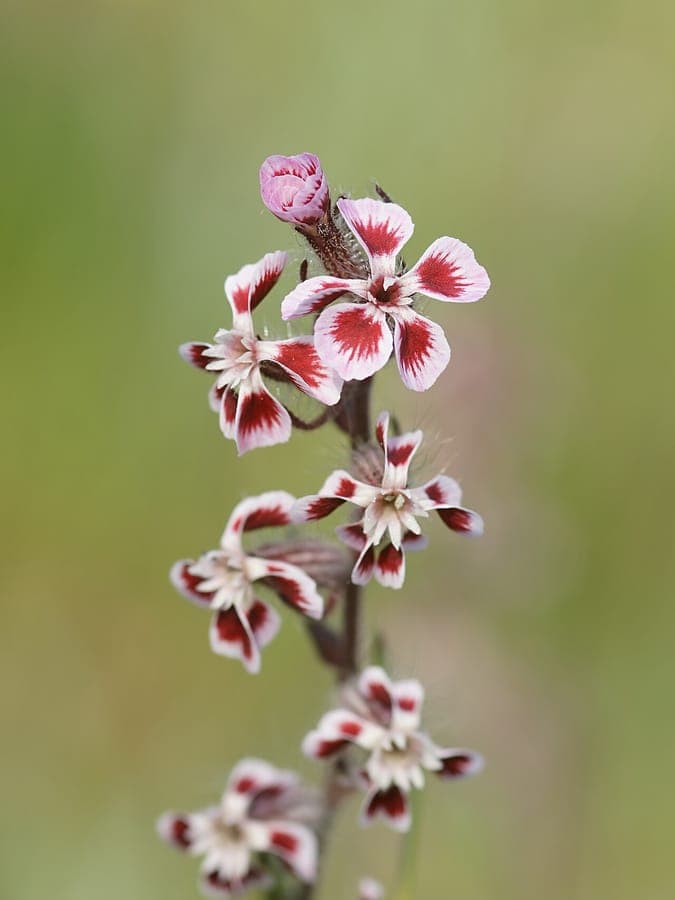
(Hans Hillewaert) / CC BY-SA 3.0, via Wikimedia Commons
Silene gallica: complete guide
Silene gallica
¿Quieres ver Silene gallica: complete guide en tu jardín?
1 minuto, sin tarjeta de crédito
Overview
Silene gallica, commonly known as French catchfly or five-wound catchfly, is a charming annual plant from the carnation family (Caryophyllaceae). The plant grows naturally in Macaronesia and from western Europe to the Mediterranean and Caucasus. French catchfly is prized for its delicate pink-white flowers with five characteristic red markings. The plant typically reaches 20-40 cm in height and forms a compact, bushy specimen.
French catchfly is popular in cottage gardens, wildflower mixes and dry borders. The plant attracts many small insects and pollen-gatherers. It is an easy-to-grow annual that self-seeds readily in suitable climates.
Appearance and bloom
The flowers of Silene gallica are very distinctive, approximately 1 cm in diameter, with five pink to red petals and five clearly red-purple veins creating a "five wounds" pattern, hence the English name. Leaves are small, oblong and greyish-green. The plant produces numerous seed capsules.
Floering occurs from May to August. Growth is compact and bushy with much branching. This makes the plant excellent for rockeries, crevice gardens and dry borders.
Ideal location
French catchfly thrives in full sun with at least 6 hours of direct sunlight. The plant tolerates hot, dry conditions very well due to its greyish-green foliage.
The plant is not winter hardy and dies when temperatures drop below freezing. In mild climates, however, it can overwinter as a winter annual.
Soil
French catchfly grows best in well-draining, dry soil. The plant tolerates poor, sandy soils much better than rich garden soil. Heavy clay should be improved with sand.
A pH between 6.5 and 7.5 is ideal. The plant also grows on slightly acidic soils. Manuring is not necessary and can even be detrimental.
Diseño gratis
¿Quieres ver Silene gallica: complete guide en tu jardín? Crea un diseño gratis ahora.
Watering
French catchfly is very drought-tolerant once established. Young seedlings should be kept consistently moist until strong roots develop.
After establishment (3 weeks), watering can be substantially reduced. The plant thrives much better with dry feet. Excess water can lead to rot.
Pruning
French catchfly requires no pruning. The natural, compact growth is very charming. Faded flowers can be removed to prevent self-seeding.
Allow seed capsules to mature for self-seeding. Remove the entire plant in autumn when it has died.
Maintenance calendar
Spring: Sow directly into ground in March-April or indoors in February. Thin seedlings to 15-20 cm spacing.
Summer: Water minimally. Monitor flowering. Plant grows quickly and fills in easily.
Autumn: Allow seed capsules to mature. Leave dead plants standing if you want them to self-seed.
Winter: Plant is dead in cold climates. In mild areas, it may overwinter.
Winter hardiness
French catchfly is not winter hardy and cannot tolerate severe frost. The plant dies when temperatures drop below freezing. In mild Mediterranean climates, it can overwinter as a winter annual.
Resow annually for continuous bloom.
Companion plants
French catchfly combines beautifully with other dry-ground annuals. Try it with lavender, thyme, roses and Dianthus. Also effective with Linum, Salvia and other Mediterranean plants.
In rockeries and crevice gardens, French catchfly fits perfectly. Group in large numbers for best effect.
Conclusion
Silene gallica is a charming, easy annual with distinctive five-wound flowers. With its preference for dry, sunny locations, it is ideal for Mediterranean gardens. The plant thrives on lean soils and readily self-seeds.
Discover more plant choices at gardenworld.app/en for complete garden inspiration!
¿Quieres ver Silene gallica: complete guide en tu jardín? Crea un diseño gratis ahora.
Sube una foto, elige un estilo y obtén un diseño fotorrealista con lista de plantas en menos de un minuto.
Más de 10.000 jardines diseñados
Sin tarjeta de crédito


Plantas similares
Dianthus karami: complete guide
Dianthus karami
Dianthus karami is a rare Lebanese mountain pink with fringed pink blooms on limestone cliffs, ideal for rock gardens and troughs.
Sicilian pink: complete guide
Dianthus siculus
Discover Dianthus siculus, an elegant purple bloomer from Sicily. Cultivation, June-September flowering and garden combinations.
Alpine mouse-ear chickweed: complete guide
Cerastium pedunculatum
Full growing guide for Cerastium pedunculatum: ideal location, soil, watering, winter hardiness, and companion plants for rock gardens.