
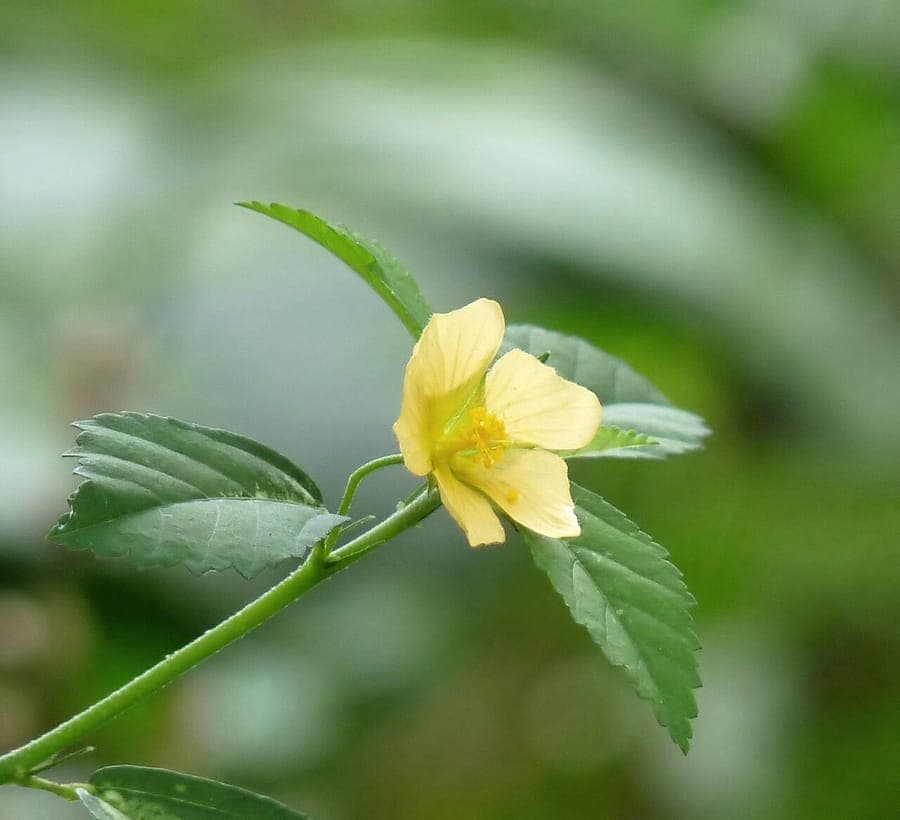
Jeevan Jose, Kerala, India / CC BY-SA 4.0, via Wikimedia Commons
Cuban-jute (Sida rhombifolia): complete guide
Sida rhombifolia
¿Quieres ver Cuban-jute (Sida rhombifolia): complete guide en tu jardín?
1 minuto, sin tarjeta de crédito
Overview
Cuban-jute (Sida rhombifolia), also known as Fanpetals or Flapjacks, is a shrubby plant native to tropical and subtropical regions of Africa and Asia. This vigorous grower is valued for its yellow flowers and dense foliage of paired leaves. Though frost-tender in nature, in warm climates and protected locations this plant thrives.
Appearance & blooming
Cuban-jute is a compact shrub reaching 1 to 2 meters tall. The leaves are small, oblong to diamond-shaped (hence the species name rhombifolia) and arranged in opposite pairs. The plant develops dense, attractive foliage.
From May to October, numerous small, bright yellow flowers appear at the shoot tips. Each flower lasts only one day, but the abundance of blooms ensures continuous display. Flowers are followed by small seed pods.
Ideal location
Cuban-jute thrives in warm, sunny locations. At least 6 to 8 hours of direct sunlight daily is ideal. In warm Mediterranean climates, partial shade is acceptable. The plant tolerates wind well but may experience leaf drop in strong wind. Plant in a sheltered, warm spot.
Soil
The soil must be well-draining. Heavy clay is undesirable; add sand and compost for better structure. A pH between 6 and 7.5 suits it well. The plant tolerates moderate fertility, though rich soil promotes better growth. Ensure good drainage to prevent waterlogging.
Watering
During the growing season (May to October), water regularly. The plant tolerates some drought but blooms better with consistent moisture. Water from below to prevent leaf diseases. In winter, when growth slows, water much less frequently.
Diseño gratis
¿Quieres ver Cuban-jute (Sida rhombifolia): complete guide en tu jardín? Crea un diseño gratis ahora.
Pruning
Cuban-jute responds well to pruning. In spring (April/May), remove dead branches and shape the plant. The plant can be cut back moderately, stimulating more compact, flower-rich growth. After blooming, faded flower clusters can be carefully removed.
Maintenance calendar
Spring (April to May): Remove dead branches from winter. Prune for shape. Apply first slow-release fertilizer.
Summer (June to August): Water regularly. Inspect for pests. Remove dead material.
Fall (September to October): Continue enjoying flowers. Reduce watering as temperatures fall.
Winter (November to March): Bring indoors in cold climates. Minimal water. No fertilization.
Winter hardiness
Cuban-jute is frost-tender and cannot tolerate temperatures below 0 degrees Celsius. In northern Europe, this plant can only survive outdoors in protected microclimates or must be brought inside for winter. In warmer parts of southern France or Spain, it may overwinter outdoors. Consider it a container plant requiring winter protection.
Companion plants
Cuban-jute combines nicely with other tropical plants in containers: Nerium oleander (Oleander), Plumbago auriculata (Leadwort), and Lantana camara (Lantana) form attractive groupings. In warm zones, it works well in mixed borders with other frost-tender material.
Conclusion
Cuban-jute is an attractive choice for warm, protected locations or as a container plant brought inside for winter. The yellow flowers and vigorous growth make it appealing. Plant in fertile, well-draining soil. Water regularly during the growing season. Enjoy this plant on the patio in summer, moving it indoors for winter in cooler climates. A tropical accent for Mediterranean and warm gardens.
¿Quieres ver Cuban-jute (Sida rhombifolia): complete guide en tu jardín? Crea un diseño gratis ahora.
Sube una foto, elige un estilo y obtén un diseño fotorrealista con lista de plantas en menos de un minuto.
Más de 10.000 jardines diseñados
Sin tarjeta de crédito


Plantas similares
Crimean linden: complete guide
Tilia × euchlora
Crimean linden is an elegant, fast-growing shade tree ideal for large gardens. Discover cultivars, spacing, maintenance tips and winter hardiness.
California flannelbush: complete guide
Fremontodendron californicum
Everything about California flannelbush (Fremontodendron californicum): sunny placement, drainage, pruning and care for this spectacular yellow-flowering shrub.
Hairy rose mallow: complete guide
Hibiscus moscheutos subsp. lasiocarpos
Full growing guide for hairy rose mallow (Hibiscus moscheutos subsp. lasiocarpos): location, soil, watering, winter hardiness and garden design tips.