
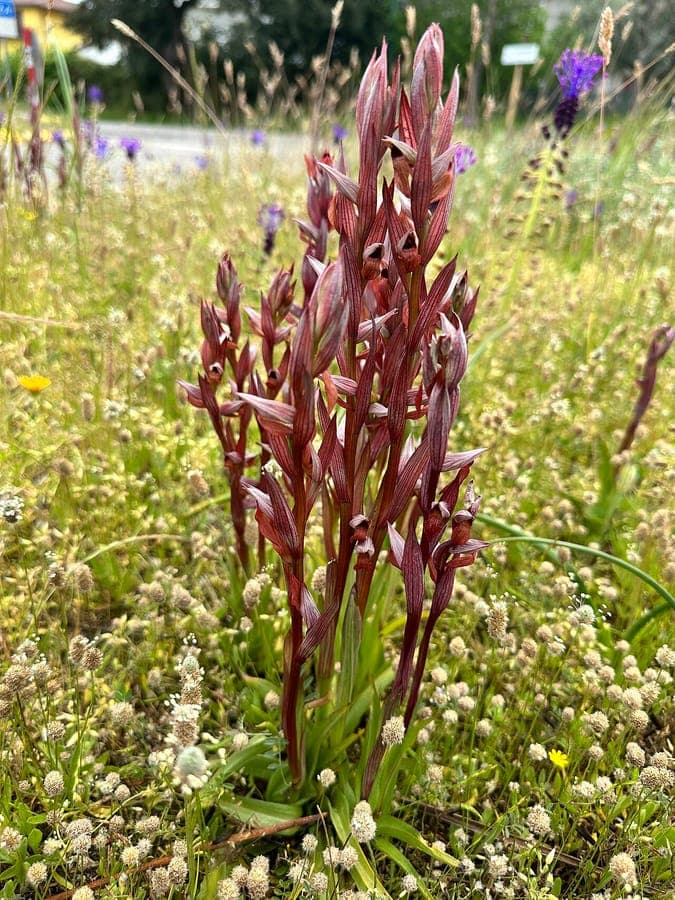
User:SnoopyBentschi / CC BY-SA 4.0, via Wikimedia Commons
Tongue Orchid: complete guide
Serapias vomeracea
¿Quieres ver Tongue Orchid: complete guide en tu jardín?
1 minuto, sin tarjeta de crédito
Overview
Tongue Orchid (Serapias vomeracea) is an exceptional wild orchid from the Mediterranean mountains. This plant distinguishes itself through its unique flower structure in which the labellum (lip) is used for insect attraction. It is a special choice for Mediterranean flora enthusiasts and lovers of natural gardens.
Appearance and Bloom
The plant grows as a low to medium-height herb with narrow, olive-green leaves. The flowers are dark red to purple-red in color with contrasting markings. The characteristic labellum is long and narrow, giving the plant its name "Tongue Orchid".
Blooming time is April to June, when the plant forms elegant flower spikes. The flowers are very fragrant and attract insects for pollination.
Ideal Location
This plant prefers locations with plenty of sunlight, at least 6 hours direct sunlight daily. The plant grows best on slopes with southern or southeastern orientation. Wind is no problem; the plant tolerates windy mountain regions well.
Perfect for edge planting in natural gardens with Mediterranean character.
Soil
Tongue Orchid grows best on poor, well-draining soil. Calcareous soil is highly appreciated. Very heavy, water-retaining soils must be avoided. The plant prefers sites where soil remains relatively dry except during growing season.
Optimal is a mixture of stone, gravel, and some humus-rich soil.
Watering
The plant prefers moderately dry soils. During growing season (March-May), water regularly, but prevention of waterlogging is critical. After blooming and during rest period (summer), water is almost unnecessary.
Overwatering is far worse than underwatering for this plant species.
Diseño gratis
¿Quieres ver Tongue Orchid: complete guide en tu jardín? Crea un diseño gratis ahora.
Pruning
No pruning needed. After bloom, the plant can be left to dry completely. The plant dies back above ground in summer and rests underground as a tuber.
Remove only completely dead plant parts.
Maintenance Calendar
Winter: tuber sleeps in soil; no maintenance. Spring: resume watering as growth begins; follow flower formation. Summer: reduce water; plant dies back and rests. Autumn: preparation for winter rest; no maintenance.
Winter Hardiness
Tongue Orchid is fully winter hardy in the Netherlands and grows underground as a tuber during severe winters. The plant tolerates temperatures down to -20 °C without problem. Underground tubers are protected by the earth itself.
Frosting and snow cause no damage.
Companion Plants
Tongue Orchid combines beautifully with other Mediterranean mountain plants like Iris, Tulipa, and Antirrhinum species. Gravel surface forms natural partner. For wildlife-friendly combinations, add Dianthus or Thymus.
The plant fits well in wild-flowering prairies with other showy flowers.
Closing Thoughts
Tongue Orchid is a unique choice for gardeners with love for Mediterranean flora and native ecosystems. The plant asks for minimal care and gives maximum natural elegance. With its striking flowers, this orchid gives wildlife gardens graceful grandeur.
Find tubers at specialized wild orchid suppliers or garden catalogs.
¿Quieres ver Tongue Orchid: complete guide en tu jardín? Crea un diseño gratis ahora.
Sube una foto, elige un estilo y obtén un diseño fotorrealista con lista de plantas en menos de un minuto.
Más de 10.000 jardines diseñados
Sin tarjeta de crédito


Plantas similares
Ram's-head lady's slipper: complete guide
Cypripedium arietinum
Everything you need to know about growing Cypripedium arietinum, a rare woodland orchid for cool, moist garden settings. Soil, care and planting tips.
Sparrow's-egg lady's slipper: complete guide
Cypripedium passerinum
Everything about growing Cypripedium passerinum, a cold-hardy subarctic orchid suited to cool, moist, shaded garden spots. Soil, care and companion plants.
Algerian Butterfly-orchid: complete guide
Platanthera algeriensis
Everything about Platanthera algeriensis, the rare Mediterranean orchid with greenish flowers native to Algeria, Morocco, Corsica and Spain.