
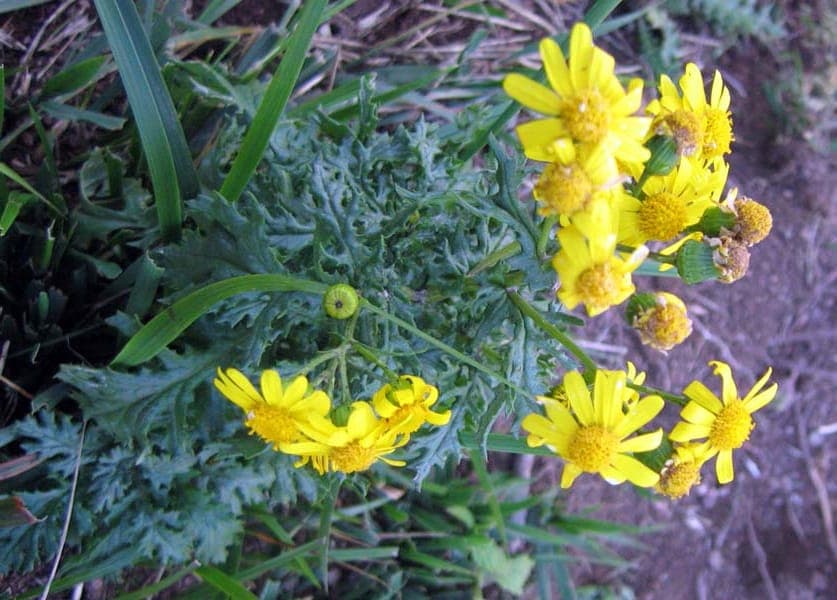
Snežana Trifunović / CC BY-SA 3.0, via Wikimedia Commons
Senecio squalidus: complete guide
Senecio squalidus
¿Quieres ver Senecio squalidus: complete guide en tu jardín?
1 minuto, sin tarjeta de crédito
Overview
Senecio squalidus, commonly known as Oxford ragwort or shiny groundsel, is a frost-tender annual to biennial plant originally from southern Europe. This striking Asteraceae family member now establishes itself across much of Europe and North America, where it naturalizes along walls, on hard surfaces, and in dry, inhospitable growing areas.
The plant grows as a slender annual to biennial reaching thirty to sixty centimeters height. The leaves characteristically divide finely, displaying an almost feathery appearance. From April through October, numerous yellow flowers form in small clusters, making the plant exceptionally attractive to insects and birds.
Appearance and Bloom
Oxford ragwort distinguishes itself through characteristically finely divided, almost feathery leaves that impart an elegant, delicate appearance. The leaves display green coloration, sometimes with purplish tones, and grow along thin, slender stems. The plant exhibits a natural tendency to grow along vertical surfaces.
Flowers appear from April through October in yellow, solitary daisy-like clusters. Each bloom features ten to twelve ray florets arranged radiately around a yellow disc. The flower production proves extremely abundant and highly attractive to honeybees, hoverflies, and other pollinators. Following blooming, fluffy seeds form, enabling natural seed dispersal.
Ideal Location
Senecio squalidus is a true sun-worshipper and thrives optimally in full sun providing at least six hours daily. The plant naturally grows on sun-exposed walls, rock outcrops, and hard surfaces. Ideal locations include south-facing facades, roof edges, stone walls, and gravel areas.
The plant tolerates shade poorly and will become etiolated and produce fewer flowers. Partial shade may be tolerated, but full sun remains essential for compact plant form and abundant flowering.
Soil Requirements
Oxford ragwort makes remarkably minimal soil demands. The plant grows perfectly in poor, well-drained soils. Sandy, gravelly, or stony soils prove ideal. The plant even grows in the absence of soil, such as on stone or masonry surfaces.
Heavy clay or waterlogged soils prove unsuitable. The plant prefers neutral to slightly alkaline soils, pH seven to seven point five. No fertilizing becomes necessary.
Diseño gratis
¿Quieres ver Senecio squalidus: complete guide en tu jardín? Crea un diseño gratis ahora.
Watering and Moisture Needs
Once established, Senecio squalidus exhibits remarkable drought tolerance. After the first growing season, the plant can grow without supplemental water, depending on rainfall. During the initial year, regular water becomes necessary until roots establish thoroughly.
During warm, dry periods, water rarely becomes necessary even for established plants. Overwatering presents a much larger concern than underwatering. Winter requires minimal water.
Pruning Methods
Senecio squalidus requires very minimal pruning. The plant may be cut back to ground level after flowering if desired. Remove dead stems in spring. The plant may naturally be allowed self-seeding, with seeds falling to ground and new plants forming the following season.
Old, spent portions may be removed throughout the year as needed.
Maintenance Calendar
March-May: Seed sowing or planting of young seedlings. Water regularly during first growing season. Germination occurs within two to three weeks.
June-July: Water only during extreme drought. Plant grows very compactly with minimal care. Remove spent flowers optionally.
August-October: Blooming accelerates. Extremely drought tolerant. Self-seeding may occur for next season.
November-February: Plant may die from frost or may survive as biennial. Minimal care needed.
Winter Hardiness
Senecio squalidus lacks true hardiness in most European climates. The plant usually grows as annual or biennial. In milder climates, it may survive as a biennial. Frost typically kills it.
In very mild regions, the plant may be treated as a half-hardy biennial and protected with straw mulch. The plant may be sown indoors for spring planting.
Companion Plants
Oxford ragwort combines beautifully in dry, sunny combinations:
- Lavender (Lavandula)
- Fleece flower (Persicaria)
- Stonecrops (Sedum)
- Achillea
- Sunflowers (Helianthus)
Conclusion
Senecio squalidus represents a fascinating plant for dry, sunny locations with calcareous hard surfaces. The extended flowering from April through October and minimalist maintenance requirements make it suitable for neglected corners. Discover inspiration for dry gardens at gardenworld.app/en.
Visit gardenworld.app/en to plan sunny, dry areas perfectly using our garden design tool.
¿Quieres ver Senecio squalidus: complete guide en tu jardín? Crea un diseño gratis ahora.
Sube una foto, elige un estilo y obtén un diseño fotorrealista con lista de plantas en menos de un minuto.
Más de 10.000 jardines diseñados
Sin tarjeta de crédito


Plantas similares
Calendula stellata: complete guide
Calendula stellata
Complete guide to Calendula stellata, the star-flowered marigold from Sicily: location, soil, watering and companion planting tips.
Korean chrysanthemum: complete guide
Chrysanthemum x rubellum
Chrysanthemum x rubellum is a hardy autumn perennial with single pink to copper flowers from August to November. Care and combinations.
Helianthus divaricatus: complete guide
Helianthus divaricatus
Helianthus divaricatus is a North American woodland sunflower with yellow summer blooms, ideal for naturalistic borders and shady edges.