
Pieter Pelser / CC BY 3.0, via Wikimedia Commons
Senecio inaequidens: complete guide
Senecio inaequidens
¿Quieres ver Senecio inaequidens: complete guide en tu jardín?
1 minuto, sin tarjeta de crédito
Overview
Senecio inaequidens, commonly known as South African ragwort or narrow-leaved ragwort, is a striking perennial subshrub native to southern Africa that has naturalized throughout much of Europe. Belonging to the Asteraceae family, this robust plant is celebrated for its prolific golden-yellow flowers and distinctive fine, linear foliage. It represents an excellent choice for contemporary garden design, requiring minimal maintenance while delivering maximum visual impact and texture.
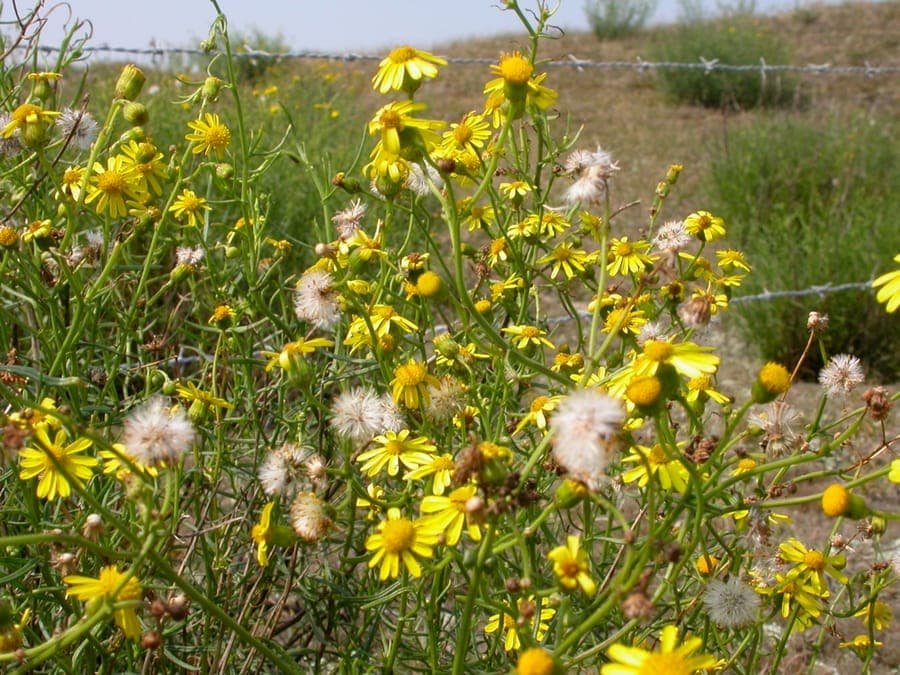
The plant grows as an open subshrub reaching approximately sixty centimeters in height with a spread of thirty to fifty centimeters. Its exceptionally thin, thread-like leaves create an airy, delicate appearance that provides sophisticated contrast to heavier foliage forms. From August through October, this species produces abundant single flowers in cheerful yellow, daisy-form clusters that seem to defy the approaching autumn.
Appearance and Bloom
The South African ragwort distinguishes itself through exceptionally narrow, linear leaves that clothe slender stems in an almost feathery fashion. The leaves measure roughly two to three millimeters wide and display a soft grey-green tone, contributing to the plant's filigreed aesthetic without compromising robustness.
Flowers emerge from late August through October in golden-yellow, umbel-like clusters. Each bloom features ten to twelve ray florets arranged around a central yellow disc. The flowering display is abundantly generous and highly attractive to beneficial insects, particularly honeybees and hoverflies. Following the bloom period, distinctive downy seeds develop, enabling natural seed dispersal and successive generations.
The plant naturally develops into a compact, somewhat mounding form that maintains visual appeal even without regular pruning.
Ideal Location
Senecio inaequidens is a sun-worshipping plant that flowers optimally only in locations receiving at least six hours of direct sunlight daily. South-facing walls, west-facing aspects, and elevated positions prove ideal. The plant demonstrates exceptional tolerance for windy situations, making it particularly suitable for exposed gardens, coastal locations, and elevated terrain.
While the plant tolerates partial shade, flowering becomes diminished and growth becomes leggy. Full sun produces the most compact, floriferous specimens. This species is unsuitable for shaded woodland gardens where it will languish and produce fewer flowers.
Soil Requirements
The South African ragwort makes remarkably modest soil demands. Excellent drainage ranks as the paramount requirement. Heavy clay soils require amendment with coarse sand, gravel, or organic compost to ensure proper drainage. A soil pH between seven and seven point five proves ideal, though the plant demonstrates good tolerance across a wider pH range.
Overwatering causes more problems than nutrient deficiency. The plant flourishes better in somewhat lean soils than in rich, heavily fertilized ground, where excessive vegetative growth occurs at the expense of flowers. No supplemental fertilizing is needed. Organic matter such as leaf mold may be incorporated once yearly in early spring.
Diseño gratis
¿Quieres ver Senecio inaequidens: complete guide en tu jardín? Crea un diseño gratis ahora.
Watering and Moisture Needs
Once established (after the first growing season), Senecio inaequidens displays remarkable drought tolerance. During the initial year following planting, regular water becomes necessary until roots establish thoroughly. Provided the soil drains well, overwatering remains the primary concern to avoid.
During the normal growing season from spring through early autumn, water only when soil becomes genuinely dry to the touch. During extended warm, dry periods, more frequent watering may become necessary. Autumn and winter require minimal watering for in-ground specimens. Container-grown plants require more frequent watering during dry seasons.
Pruning Methods
Senecio inaequidens requires no mandatory pruning, though light cutting back following the flowering period promotes compact form. Prune from January onward once hard frosts have passed. Remove dead stems completely and reduce approximately one-third of new growth to healthy buds.
Withered and desiccated leaves may be removed throughout the year. Excessively long or ungainly growth stems may be modestly cut back, but never remove more than one-third of the foliage mass simultaneously.
Maintenance Calendar
March-May: Plant new specimens or repot existing container plants. Lightly incorporate compost or leaf mold. Monitor soil moisture requirements.
June-July: Water regularly during warm periods. Monitor for any pest presence (usually minimal). Remove spent flowers.
August-October: Peak flowering season. Water only during genuine drought conditions. Provide more frequent watering for potted specimens.
November-February: Minimize watering. Provide frost protection in severe climates (only necessary in very cold regions).
Winter Hardiness
Senecio inaequidens proves winter hardy throughout most of northern and central Europe down to approximately minus ten degrees Celsius. In regions experiencing temperatures below minus fifteen degrees, protection becomes advisable. The plant may suffer wind damage or severe frost die-back in extremely exposed locations.
In very cold climates, container cultivation with indoor overwintering becomes possible. An unheated shed or cool greenhouse with minimal light (at least three hours daily) suffices for maintenance. Minimal water proves necessary during winter.
Companion Plants
The South African ragwort combines beautifully with other drought and sun-loving species:
- Lavender (Lavandula)
- Roses (Rosa)
- Sunflowers (Helianthus)
- Sage (Salvia officinalis)
- Sea holly (Eryngium)
- Thrift (Armeria)
Conclusion
Senecio inaequidens represents a phenomenal plant for contemporary garden styles where it provides flowers and structure with minimal intervention. For sunny, dry locations, it constitutes an ideal choice. The extended flowering period from August through October makes this species particularly valuable for supporting insect populations late in the season. Available at major garden centers.
Visit gardenworld.app/en for additional garden design inspiration and plant selection guidance. Discover how to optimize this stunning plant in your landscape using our garden design tool at gardenworld.app/en.
¿Quieres ver Senecio inaequidens: complete guide en tu jardín? Crea un diseño gratis ahora.
Sube una foto, elige un estilo y obtén un diseño fotorrealista con lista de plantas en menos de un minuto.
Más de 10.000 jardines diseñados
Sin tarjeta de crédito


Plantas similares
Calendula stellata: complete guide
Calendula stellata
Complete guide to Calendula stellata, the star-flowered marigold from Sicily: location, soil, watering and companion planting tips.
Korean chrysanthemum: complete guide
Chrysanthemum x rubellum
Chrysanthemum x rubellum is a hardy autumn perennial with single pink to copper flowers from August to November. Care and combinations.
Helianthus divaricatus: complete guide
Helianthus divaricatus
Helianthus divaricatus is a North American woodland sunflower with yellow summer blooms, ideal for naturalistic borders and shady edges.