
Bouba / CC BY-SA 3.0, via Wikimedia Commons
Mountain house-leek: complete guide
Sempervivum montanum
¿Quieres ver Mountain house-leek: complete guide en tu jardín?
1 minuto, sin tarjeta de crédito
Overview
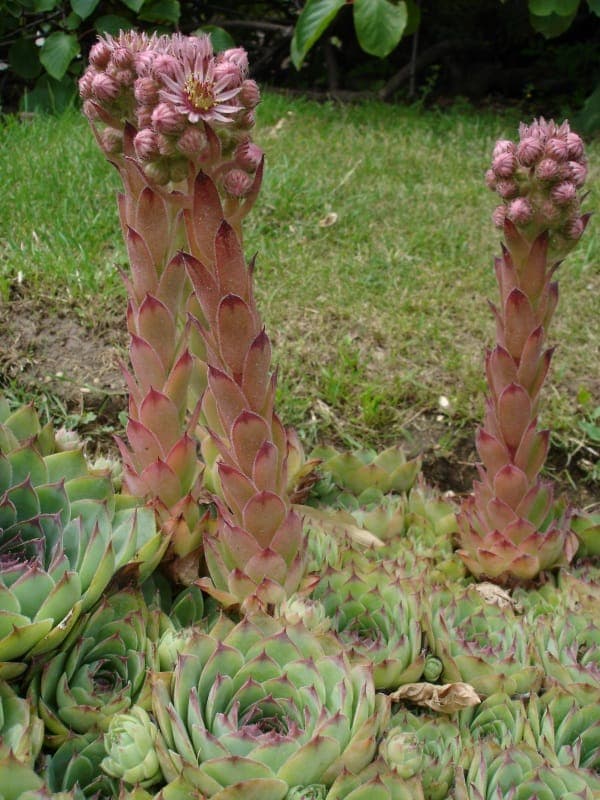
The Mountain house-leek (Sempervivum montanum) is a winter-hardy succulent native to the Pyrenees and Carpathians. This compact plant forms dense rosettes of 2-4 cm diameter with thick, fleshy blue-green leaves that often develop deep purple winter tones. In summer, tall flower stems emerge bearing striking purple blooms. It's one of Europe's most reliable alpine succulents for rock gardens and extensive green roofs.
Appearance and bloom cycle
Leaves are narrow, reddish-tinged, and succulent with a waxy coating. Winter coloration deepens to rich plum tones, adding visual interest during dormancy. The flowering period runs from June through August. Blooming rosettes produce 15-25 cm tall flower stems with dense clusters of pink-purple star-shaped flowers. After flowering, the blooming rosette dies (monocarpic), but numerous offsets ensure plant continuity.
Ideal location
Position in full sun with at least 6 hours of direct sunlight daily. Mountain house-leek thrives in open, exposed locations with good air circulation. Completely hardy to -30°C (USDA zones 4-5) and tolerates wind exposure. Perfect for alpine troughs, rock gardens, green roofs, and drought-tolerant borders.
Soil requirements
Excellent drainage is critical. Use poor, gritty loam with added grit or perlite. Mix 60% stone chips, 20% garden soil, and 20% coconut fiber for optimal results. Heavy clay soils must be amended or avoided entirely. Acidic to neutral pH (4.0-6.0) is ideal. Container growing benefits from specialized succulent mix enhanced with extra mineral grit.
Watering
Minimal water needed. Water only when soil is completely dry. Overwatering causes root rot. During the growing season (April-September), water once or twice monthly depending on rainfall. Winter requires almost no water. These plants tolerate extended drought with ease.
Diseño gratis
¿Quieres ver Mountain house-leek: complete guide en tu jardín? Crea un diseño gratis ahora.
Pruning and maintenance
Pruning is rarely needed. Remove dead flower stems after bloom. Old spent rosettes can be gently removed, but always retain young offsets. Growth is slow and the plant maintains attractive form with minimal intervention.
Maintenance calendar
April-May: Growth begins. Check drainage of containers. Propagate offsets for increased coverage.
June-August: Flowering period. Water only during extreme drought. Enjoy the distinctive purple blooms.
September-October: Growth slows. Reduce watering. No feeding required.
November-March: Winter dormancy. Minimal water. Completely frost-hardy with no protection needed.
Winter hardiness
Fully hardy to -30°C (USDA zones 4-5). Requires no winter protection. Leaf discoloration to deep purple is temporary. Ensure excellent drainage to prevent ice accumulation. Mountain house-leek survives cold UK, German, and Scandinavian winters without coddling.
Companion plants
Pair with other Sempervivum species (S. tectorum, S. arachnoideum) for color contrast. Combines beautifully with Sedum, Jovibarba, hardy Heuchera, and alpine phlox. Grouping multiple species increases visual impact in small spaces.
Closing
Mountain house-leek is a bulletproof choice for serious rock gardeners. Winter hardiness, minimal care, and beautiful seasonal coloring make it indispensable for alpine schemes. Garden centers stock quality specimens, and online garden design tools help visualize complete plantings. Using gardenworld.app, you can explore how Mountain house-leek works within broader landscape plans and companion plantings. For alpine gardens, this succulent is a true foundation plant that delivers year-round interest.
¿Quieres ver Mountain house-leek: complete guide en tu jardín? Crea un diseño gratis ahora.
Sube una foto, elige un estilo y obtén un diseño fotorrealista con lista de plantas en menos de un minuto.
Más de 10.000 jardines diseñados
Sin tarjeta de crédito


Plantas similares
Sedum nevadense: complete guide
Sedum nevadense
Discover Sedum nevadense, the stunning alpine stonecrop from the Pyrenees. Expert care tips, growing requirements, and design ideas for rock gardens.
Aizoon stonecrop: complete guide
Phedimus aizoon
Everything about Phedimus aizoon - the frost-tolerant aizoon stonecrop from Siberia with bright yellow flowers. Planting, care and garden use.
Roseroot: complete guide
Rhodiola rosea
Everything about roseroot (Rhodiola rosea): a tough hardy succulent ideal for rock gardens, green roofs, and dry sunny positions.