
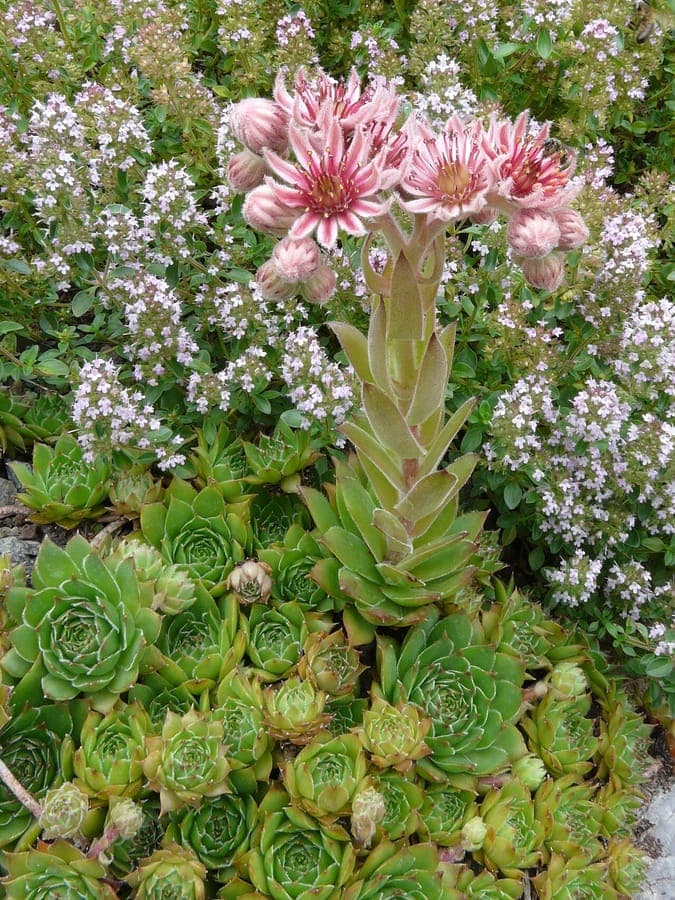
Pethan / CC BY-SA 3.0, via Wikimedia Commons
Marble Houseleek: complete guide
Sempervivum marmoreum
¿Quieres ver Marble Houseleek: complete guide en tu jardín?
1 minuto, sin tarjeta de crédito
Overview
Marble Houseleek (Sempervivum marmoreum) is a fascinating succulent originating from the mountain ranges of central and southern Europe. This plant distinguishes itself through its characteristic leaf rosettes with marble-like pattern and color marking. It is an ideal choice for gardeners seeking extremely low-maintenance plants with architectural impact.
Appearance and Bloom
The plant forms dense leaf rosettes with a diameter of 5-10 centimeters. The leaves are blue-green with dark purple to black markings reminiscent of marble patterns. The plant grows as a colony with numerous offsets creating this tortoiseshell-like effect.
In summer-July, yellow flowers appear on short flower spikes. After blooming, the flowering rosette dies (monocarpic), but numerous offsets ensure continuity.
Ideal Location
Marble Houseleek prefers fully sunny to very bright locations. Place in a spot with minimum 6 hours direct sunlight daily. Wind is no problem; the plant actually prefers well-enclosed spaces.
Perfect for roofs, living walls, containers on balconies, and for use in rock gardens with minimal moisture.
Soil
The plant makes almost no soil demands. Very well-draining, even poor gravel or sandy soil is ideal. Prevention of moist, heavy humus-rich soils is essential. A layer of sand or gravel under the plant helps secure drainage.
Optimal is a mixture of 70% mineral material with 30% nutrient-rich humus.
Watering
Marble Houseleek is extremely drought-tolerant and requires virtually no water after establishment. Even in extreme dry periods, water is rarely needed. Overwatering is the most common cause of failure in gardens.
In pot culture, water only if soil is completely dry. In winter, water is almost unnecessary.
Diseño gratis
¿Quieres ver Marble Houseleek: complete guide en tu jardín? Crea un diseño gratis ahora.
Pruning
No pruning needed. Remove sucker offshoots only if you want to limit colony size. Dead leaves allow the plant to recover nutrients; leave these until they naturally detach.
Dead flower spikes can be broken off, but this is optional.
Maintenance Calendar
Spring: check for aphid or spider mite infestation; adding water is practically unnecessary. Summer: follow bloom and offset formation; ensure good drainage. Autumn: remove faded flowering rosettes after fruiting. Winter: no maintenance; plant sleeps.
Winter Hardiness
Marble Houseleek is fully winter hardy in Dutch winters and tolerates temperatures down to -20 °C without problem. The plant grows best in full sun, even in extremely cold winters. In mountain regions of origin, this plant grows at high altitude where temperatures become much colder.
Snow and ice formation cause no damage.
Companion Plants
Marble Houseleek harmonizes beautifully with other succulents like Jovibarba and Sedum. Gravel and stone are natural partners in rock gardens. For architectural effects, combine with Foeniculum (fennel herb) or minimal grass species.
The purple-gray tint fits well in grey gardens with Artemisia and Stachis.
Closing Thoughts
Marble Houseleek is the ultimate choice for neglect-tolerant gardens and landscape design. The plant literally asks for no care after planting and establishment. With its artistic leaf patterns, this succulent gives sober elegance to any garden design.
Find this plant at Intratuin or Gamma or at specialized succulent suppliers.
¿Quieres ver Marble Houseleek: complete guide en tu jardín? Crea un diseño gratis ahora.
Sube una foto, elige un estilo y obtén un diseño fotorrealista con lista de plantas en menos de un minuto.
Más de 10.000 jardines diseñados
Sin tarjeta de crédito


Plantas similares
Sedum nevadense: complete guide
Sedum nevadense
Discover Sedum nevadense, the stunning alpine stonecrop from the Pyrenees. Expert care tips, growing requirements, and design ideas for rock gardens.
Aizoon stonecrop: complete guide
Phedimus aizoon
Everything about Phedimus aizoon - the frost-tolerant aizoon stonecrop from Siberia with bright yellow flowers. Planting, care and garden use.
Roseroot: complete guide
Rhodiola rosea
Everything about roseroot (Rhodiola rosea): a tough hardy succulent ideal for rock gardens, green roofs, and dry sunny positions.