
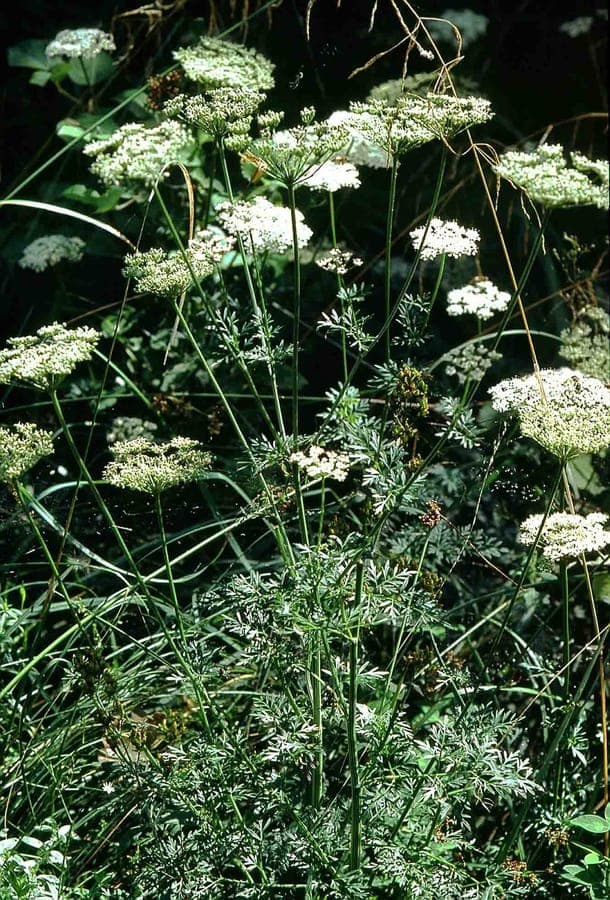
Wikimedia Commons / CC BY-SA 3.0, via Wikimedia Commons
Cambridge milk-parsley: complete guide
Selinum carvifolia
¿Quieres ver Cambridge milk-parsley: complete guide en tu jardín?
1 minuto, sin tarjeta de crédito
Overview
Cambridge milk-parsley (Selinum carvifolia), known in its native regions as caraway-leaved milk-parsley, is an elegant perennial herbaceous plant in the Apiaceae family. This refined plant is prized for its feathery, caraway-like foliage and delicate white flower clusters that bloom throughout summer. Native to Europe, particularly temperate regions, it typically reaches 60 cm in height, adding a sophisticated textural element to modern and traditional garden designs.
Choose this plant when you want to introduce fine, graceful foliage to partially shaded areas, or when seeking bee-friendly species for pollinator gardens.
Appearance and Bloom
Cambridge milk-parsley distinguishes itself through exceptionally fine, deeply divided leaves resembling caraway seeds, hence its scientific epithet. The foliage is two to three-pinnate, creating an airy, fern-like texture that appears light and delicate against darker garden backgrounds.
Bloom occurs from July through September with tiny white flowers arranged in characteristic umbrella-shaped clusters (umbels) typical of the carrot family. While individual flowers are modest, their collective abundance and soft coloring create striking visual appeal for bees and other pollinators. Following bloom, small pale-tan seeds develop.
Ideal Location
This plant thrives in full sun to partial shade conditions. In very hot regions, afternoon shade provides welcomed relief. Ensure the plant receives a minimum of four to six hours of direct sunlight daily for optimal flowering.
Avoid placing beneath trees where water competition is intense, and eliminate deeply shaded corners where growth stagnates.
Soil
Select well-draining, humus-rich soil conditions. The plant prefers slightly acidic to neutral pH ranges (5.5-6.5). Heavy clay soils require amendment with sand or horticultural peat to improve drainage and structure.
Excellent drainage is critical; waterlogging causes root rot. When in doubt, incorporate sand and organic matter to enhance soil composition.
Diseño gratis
¿Quieres ver Cambridge milk-parsley: complete guide en tu jardín? Crea un diseño gratis ahora.
Watering
Once established, this species is relatively drought-tolerant. During growth and flowering, water moderately and regularly, keeping soil lightly moist but never waterlogged. During hot, dry periods, increase frequency. Avoid wetting foliage; water at the base instead.
As the plant matures, natural precipitation supplies most water needs.
Pruning
Deadhead spent flowers regularly to encourage repeat blooming and maintain neat appearance. When the plant withdraws in autumn and winter, cut back dead foliage and stems to ground level.
Major pruning is unnecessary; this plant requires only basic maintenance.
Maintenance Calendar
- Spring: Remove winter debris, apply layer of compost or organic fertilizer
- Summer: Encourage blooming by removing faded flowers
- Autumn: Prepare plant for winter by clearing fallen leaves
- Winter: Minimal intervention needed; plant is hardy and dormant
Winter Hardiness
This species possesses full winter hardiness in temperate climates (USDA Zones 4-8). The plant survives temperatures down to -15 degrees Celsius.
Companion Plants
Pair Cambridge milk-parsley with other shade-tolerant companions like ferns, columbine, or fine-textured grasses. It works beautifully with blue columbine (Aquilegia) or white Astilbe. For structural contrast, position adjacent to Heuchera or other bold-leaved foliage plants.
Closing
Cambridge milk-parsley is an exceptional selection for gardeners seeking refined, undervalued plants with genuine garden merit. Its delicate texture and summer blooming make it an excellent choice for mixed borders and partially shaded plantings.
Find Cambridge milk-parsley at reputable garden centers. Visit gardenworld.app/nl and gardenworld.app/en for more inspiration incorporating this elegant plant into your garden design!
¿Quieres ver Cambridge milk-parsley: complete guide en tu jardín? Crea un diseño gratis ahora.
Sube una foto, elige un estilo y obtén un diseño fotorrealista con lista de plantas en menos de un minuto.
Más de 10.000 jardines diseñados
Sin tarjeta de crédito


Plantas similares
Whorled carrot: complete guide
Daucus involucratus
Daucus involucratus is a Mediterranean umbellifer with white flower heads framed by lacy bracts. Growing this gravel garden gem.
Daucus muricatus: complete guide
Daucus muricatus
Daucus muricatus, the spiny wild carrot, grows wild on Mediterranean coasts. Discover sowing, June-July bloom, and wildflower meadow use.
Daucus pumilus: complete guide
Daucus pumilus
Daucus pumilus is a dwarf wild carrot relative with white lacy umbels, thriving on dunes and coastal rock in poor, fast-draining soil.