
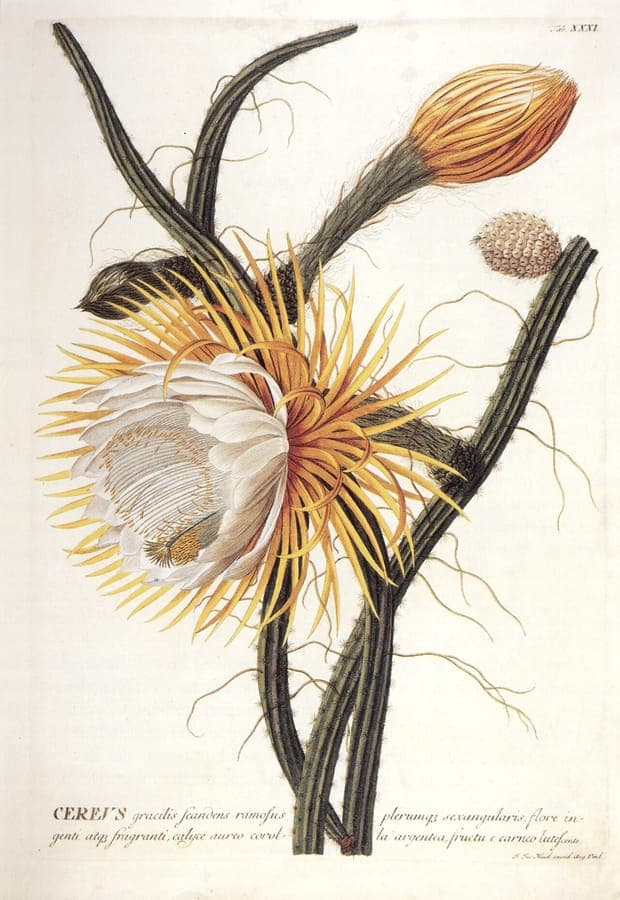
Johann Jakob Haid / Public domain, via Wikimedia Commons
Night-blooming cereus: complete guide
Selenicereus grandiflorus
¿Quieres ver Night-blooming cereus: complete guide en tu jardín?
1 minuto, sin tarjeta de crédito
Overview
The night-blooming cereus (Selenicereus grandiflorus) is one of the world's most spectacular cacti. This epiphytic succulent comes naturally from Mexico and the Caribbean, where it grows on trees in tropical forest canopies. What makes it extraordinary is that it flowers only once per year, and exclusively at night. The blooms are impressively large, snow-white, and intensely fragrant, attracting nocturnal pollinators.
Waiting for that single magical night of bloom makes cultivating a night-blooming cereus a truly unique experience. When the flower opens just after midnight, it delivers an unforgettable display - for a few hours only, you witness one of nature's most enchanting performances.
Appearance and Bloom
The night-blooming cereus grows as a climbing vine with thin, flat green stems. In nature, it clambers up trees to reach dappled forest light. The stems carry small spines that are barely noticeable.
The flowers are remarkably large, sometimes reaching 30 centimeters across. They are pure white and emit a strong, sweet fragrance. They open around midnight and close again by early morning. Blooming typically occurs in June and July, though timing varies by individual plant.
After flowering, greenish fruits develop. These are technically edible but are most easily appreciated when you have multiple plants that can cross-pollinate.
Ideal Location
As an epiphytic cactus, the night-blooming cereus naturally grows high on tree branches. It therefore needs less direct intense sunlight than desert cacti. A location with filtered, dappled light is ideal - such as under tree canopy or behind greenhouse glass.
In temperate climates, grow this species in a greenhouse or conservatory, as its tropical origin means it cannot tolerate frost. Ensure good air circulation without drafts.
The plant must be allowed to climb or hang - not grown upright. This matches its natural growth habit perfectly.
Soil Mix
Use a highly draining soil mixture. A blend of cactus compost, orchid bark, and perlite works excellently. Try: 50% cactus potting mix, 30% fine bark chips, and 20% perlite.
The plant absolutely cannot tolerate waterlogging, so excellent drainage is essential. Pots must have multiple drainage holes.
Light feeding helps. A dilute cactus feed during the growing season is sufficient - no heavy fertilizers needed.
Diseño gratis
¿Quieres ver Night-blooming cereus: complete guide en tu jardín? Crea un diseño gratis ahora.
Watering
Because of its epiphytic nature, the night-blooming cereus requires different watering than desert cacti. During the growing season (spring and summer), water regularly but allow the surface to dry between waterings.
In autumn and winter, reduce watering significantly. The plant needs a rest period - this actually encourages flowering the following year. Water only when the soil clearly feels dry.
The plant appreciates higher humidity than desert cacti. Regular misting can be beneficial, especially during dry winter months.
Pruning
Pruning is rarely necessary, but you can cut back long growth to encourage branching and a fuller shape.
Remove any dead or damaged sections. Always use clean tools to prevent infection.
If the plant becomes too large, cut sections can be propagated to create new specimens.
Maintenance Calendar
Spring: Resume regular watering and feeding. Watch for pests. Growing season begins.
Summer: Water regularly. Ensure proper light conditions. Anticipate flowers, usually June-July.
Autumn: Gradually reduce watering. Stop feeding. Begin preparing for dormancy.
Winter: Minimal watering. Keep temperatures around 10-15C to encourage next year's blooms.
Winter Hardiness
The night-blooming cereus is not hardy in European winters. It cannot tolerate freezing. Minimum temperature should be 10-15 degrees Celsius.
In very mild climates, it may spend summers outdoors but must return indoors before the first frost. In colder regions, it stays in a greenhouse year-round.
Protect from cold drafts. Position away from cold windows in winter.
Companion Plants
The night-blooming cereus fits well in tropical greenhouse collections. Other epiphytic cacti and orchids are excellent companions, sharing similar moisture and light needs.
Other epiphytes with similar habits can share growing space, provided they receive equal water and nutrition.
Conclusion
The night-blooming cereus is not for beginners, but absolutely worth the effort for patient, experienced growers. Cultivating this plant brings a piece of tropical wonder into your home or greenhouse. With proper care, it rewards you annually with a moment you'll never forget.
For purchasing: Specialty nurseries and online botanical suppliers stock this species. Ensure you have suitable growing space before buying. Visit gardenworld.app for plant sourcing guidance.
¿Quieres ver Night-blooming cereus: complete guide en tu jardín? Crea un diseño gratis ahora.
Sube una foto, elige un estilo y obtén un diseño fotorrealista con lista de plantas en menos de un minuto.
Más de 10.000 jardines diseñados
Sin tarjeta de crédito


Plantas similares
Plains prickly pear: complete guide
Opuntia polyacantha
All about plains prickly pear cactus: hardiness, soil, placement and care. One of the most cold-tolerant cacti for temperate gardens.
Saguaro: complete guide
Carnegiea gigantea
Everything about growing saguaro cactus: container care, watering, overwintering, and companion plants for this iconic desert giant.
Cylindropuntia imbricata: complete guide
Cylindropuntia imbricata
The Tree Cholla offers distinctive segmented stems and vibrant red flowers. A unique ornamental succulent perfect for sunny, dry gardens and large containers.