
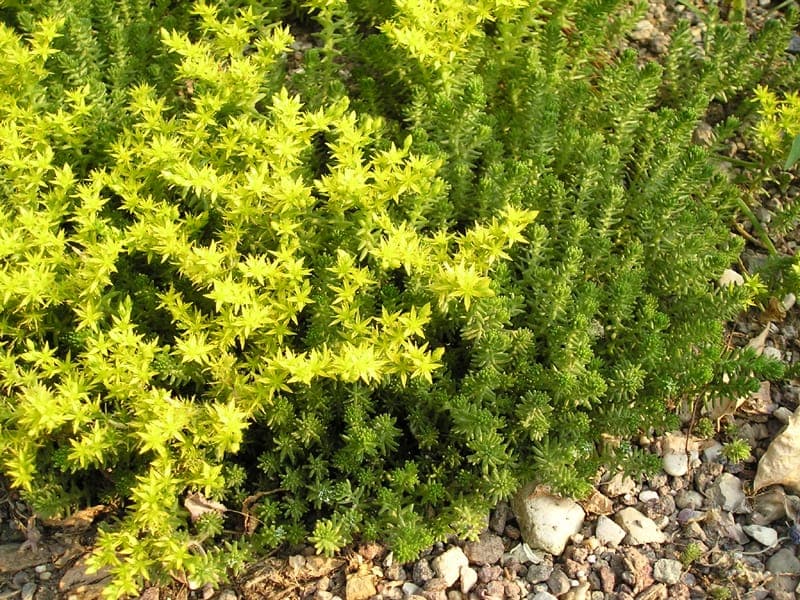
No machine-readable author provided. Semolo75 assumed (based on copyright claims). / Public domain, via Wikimedia Commons
Tasteless stonecrop: complete guide
Sedum sexangulare
¿Quieres ver Tasteless stonecrop: complete guide en tu jardín?
1 minuto, sin tarjeta de crédito
Overview
Tasteless stonecrop (Sedum sexangulare), sometimes called milder stonecrop, is a slender, elegant succulent from the Crassulaceae family, native to Europe. This plant distinguishes itself through its upright, columnar growth habit and narrow leaves arranged in distinctive hexagonal symmetry. With pale yellow flowers and refined appearance, tasteless stonecrop excels in rock gardens, crevices, and underplanting in dry areas.
Appearance and bloom cycle
Tasteless stonecrop grows as a dense, upright succulent reaching 10-15 cm in height. Stems are thin and rigid, clothed with narrow, needle-like leaves arranged in striking hexagonal symmetry. This unusual leaf arrangement gives the plant a remarkably ordered, almost geometric appearance. Foliage is grey-green in color. In June and July, pale yellow flowers appear in star-shaped clusters. The flowering period lasts 4-6 weeks and attracts bees.
Ideal location
Tasteless stonecrop performs best in full sun. At least 5-6 hours of direct sunlight daily is needed for compact growth. In partial shade, the plant becomes lax and loses its characteristic upright form. The plant is excellent for green roofs, sunny ledges, and intensely sun-baked ground surfaces. Wind causes no problems.
Soil requirements
Tasteless stonecrop demands excellent drainage and is indifferent to soil fertility. Sandy, gravelly soils are perfect. Heavy clay soils must be substantially improved with sand and gravel. The plant thrives even in extremely nutrient-poor soils. A soil pH between 6.0 and 7.5 is acceptable.
Watering
Tasteless stonecrop is very drought-tolerant once established. Water is only needed in exceptional dry periods or in the first year after planting. Regular overwatering causes root rot. In wet winters, good drainage is critical. Less water is always better than too much.
Diseño gratis
¿Quieres ver Tasteless stonecrop: complete guide en tu jardín? Crea un diseño gratis ahora.
Pruning
Pruning is practically unnecessary. Spent flowers can be gently removed. Damaged or dead stems may be trimmed out. The plant naturally maintains its compact form. Excessive density can be carefully thinned, but generally this plant grows tidily without intervention.
Maintenance calendar
Spring (April-May): Plant carefully, give very light watering, apply mulch lightly. Summer (June-July): Remove spent flowers, water only if exceptionally dry. Autumn (August-September): No care needed, enjoy autumn leaf tones. Winter (October-March): Check drainage, never water.
Winter hardiness
Tasteless stonecrop is hardy in USDA zones 4-8, surviving temperatures to -20°C. The plant is evergreen and decorative in winter. Greater threat comes from waterlogged conditions than from frost. Good drainage matters more than frost protection.
Companion plants
Tasteless stonecrop pairs beautifully with other slender succulents and alpine plants. Lovely alongside lavender, helianthemum, and other drought-tolerant species. In green roofs, combine with creeping alpine strawberry and other low groundcovers. Moisture-loving plants are entirely unsuitable.
Closing
Tasteless stonecrop is an elegant addition to rock gardens and alpine troughs. Its upright columnar form and geometric leaf arrangement provide unique ornamental value. Visit gardenworld.app to discover more inspiration for dry, sunny garden designs featuring fine-textured alpines. With minimal care and decades of reliability, this refined succulent deserves prominent space in every sun-baked garden.
¿Quieres ver Tasteless stonecrop: complete guide en tu jardín? Crea un diseño gratis ahora.
Sube una foto, elige un estilo y obtén un diseño fotorrealista con lista de plantas en menos de un minuto.
Más de 10.000 jardines diseñados
Sin tarjeta de crédito


Plantas similares
Sedum nevadense: complete guide
Sedum nevadense
Discover Sedum nevadense, the stunning alpine stonecrop from the Pyrenees. Expert care tips, growing requirements, and design ideas for rock gardens.
Aizoon stonecrop: complete guide
Phedimus aizoon
Everything about Phedimus aizoon - the frost-tolerant aizoon stonecrop from Siberia with bright yellow flowers. Planting, care and garden use.
Roseroot: complete guide
Rhodiola rosea
Everything about roseroot (Rhodiola rosea): a tough hardy succulent ideal for rock gardens, green roofs, and dry sunny positions.