
Mason Brock (Masebrock) / Public domain, via Wikimedia Commons
Sedum pulchellum: complete guide
Sedum pulchellum
¿Quieres ver Sedum pulchellum: complete guide en tu jardín?
1 minuto, sin tarjeta de crédito
Overview
Sedum pulchellum, better known as Widowscross or Widow's-Cross, is a delightful American succulent from the central and east-central United States. This plant naturally grows in rocky mountain areas where it endures many drought periods. It's a small but very elegantly growing plant, highly suitable for gardens in temperate climates.
This little plant deserves more attention in European gardens. It's not only structurally beautiful with its red flowers, but also very easy to cultivate. Perfect for rock gardens, stone gardens, and green roofs.
Appearance & Bloom
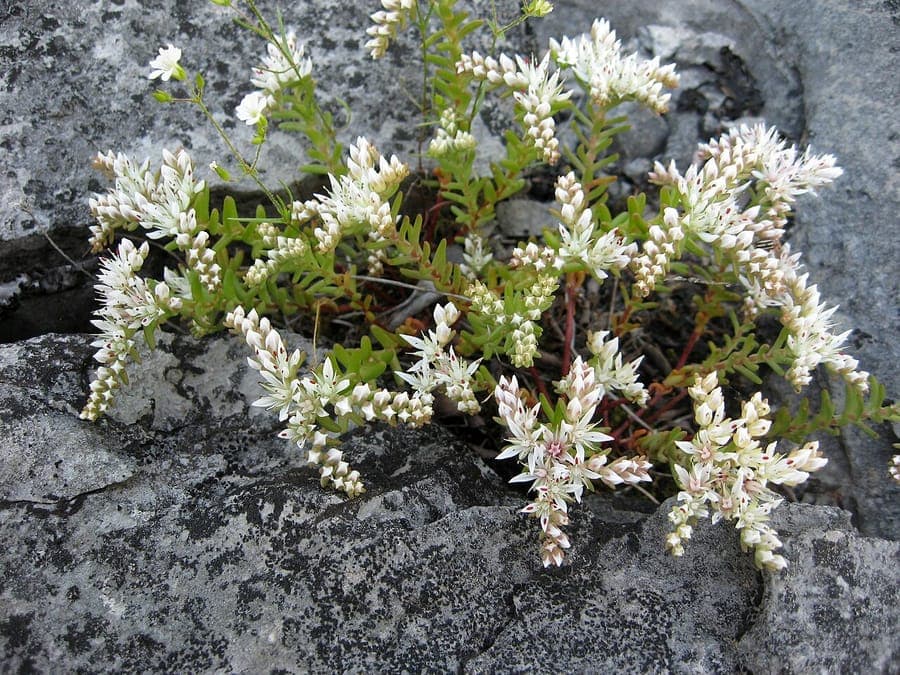
Sedum pulchellum forms low, wide, flat mats of greenish stems with tiny, densely packed leaves. The plant grows strongly horizontally, creating beautiful carpets in rock gardens. Under good sunny conditions, the foliage takes on a slightly reddish tint.
The flowers are undoubtedly the highlight of this plant. They appear in May to June as small, delicate red flowers gathered in tightly packed inflorescences. These red crosses (the name 'Widowscross' refers to this) are particularly beautiful against the green foliage. The bloom lasts several weeks and attracts many beneficial insects.
Ideal Location
Sedum pulchellum thrives best on fully sunny, open spots. The plant requires at least 6 hours of direct sunlight daily. The more sun, the stronger the red color of the flowers and the more compact the growth.
Give it an airy spot where rain drains easily and wind circulates well. In very hot, dry summers, some afternoon shade can prevent the plant from drying out excessively. The plant is excellent for pergolas, green roofs, and flower pots.
Soil
Like all Sedum species, Sedum pulchellum isn't fussy about nutrients, but soil structure is very important. Ensure optimal drainage: a mix of roughly 70% coarse sand, 20% garden soil, and 10% peat is ideal. Avoid heavy clay soils.
The plant also grows well in poor soils, since it originates from dry mountain areas. For pot growing, use specialized succulent potting mix. The plant prefers a pH of 6 to 7.
Diseño gratis
¿Quieres ver Sedum pulchellum: complete guide en tu jardín? Crea un diseño gratis ahora.
Watering
Sedum pulchellum ranks among the most drought-tolerant plants. Water only when soil feels completely dry. During the growing period (May to August), water once every two to three weeks. In winter, water little to not at all.
Be careful not to overwater. This is the main cause of plant death with succulents. It's better to wait a week longer than to water a day too early.
Pruning
Sedum pulchellum barely needs pruning. The plant grows compact and naturally forms beautiful shapes. However, do remove dead flowers and leaves after blooming, and remove damaged parts.
If the plant becomes too densely overgrown, gently prune back some stems in early spring for propagation. The plant recovers quickly.
Maintenance Calendar
January to March: Deep dormancy. No water. Monitor health.
April to May: Preparation for growing season. Start watering cautiously. No fertilizer.
June to August: Peak of growth and flowering. Water when soil is dry. Plant flourishes.
September to October: Cooling. Reduce water. Plant prepares for winter.
November to December: Deep winter dormancy. No water. Keep completely dry.
Winter Hardiness
Sedum pulchellum is highly cold-hardy and can survive frost down to minus 20 degrees Celsius without any protection. This plant grows in US regions with harsh winters, so it's very well adapted to cold.
Even in northern Netherlands, this plant will overwinter outdoors. The only thing you must do is ensure it doesn't sit in winter water. This can cause root rot, which is much more serious than cold.
Companion Plants
Sedum pulchellum is perfect for rock gardens, alpine troughs, green roofs, and stone gardens. Combine it with other succulents like Sedum album, Sedum sexangulare, and Sempervivum. Also lovely with alpine grasses and other mountain plants.
In borders, it creates beautiful color accents thanks to its red flowers. Especially in June, this plant is absolutely an eye-catcher.
Closing Thoughts
Sedum pulchellum is probably the easiest Sedum for beginners in succulent gardening. No water, no worries - the plant grows, blooms, and survives winters on its own. Very suitable for anyone seeking a drought-resistant plant without much maintenance. Gardenworld.app helps you design low-maintenance gardens with succulents. Gardenworld.app makes garden design simple!
¿Quieres ver Sedum pulchellum: complete guide en tu jardín? Crea un diseño gratis ahora.
Sube una foto, elige un estilo y obtén un diseño fotorrealista con lista de plantas en menos de un minuto.
Más de 10.000 jardines diseñados
Sin tarjeta de crédito


Plantas similares
Sedum nevadense: complete guide
Sedum nevadense
Discover Sedum nevadense, the stunning alpine stonecrop from the Pyrenees. Expert care tips, growing requirements, and design ideas for rock gardens.
Aizoon stonecrop: complete guide
Phedimus aizoon
Everything about Phedimus aizoon - the frost-tolerant aizoon stonecrop from Siberia with bright yellow flowers. Planting, care and garden use.
Roseroot: complete guide
Rhodiola rosea
Everything about roseroot (Rhodiola rosea): a tough hardy succulent ideal for rock gardens, green roofs, and dry sunny positions.