
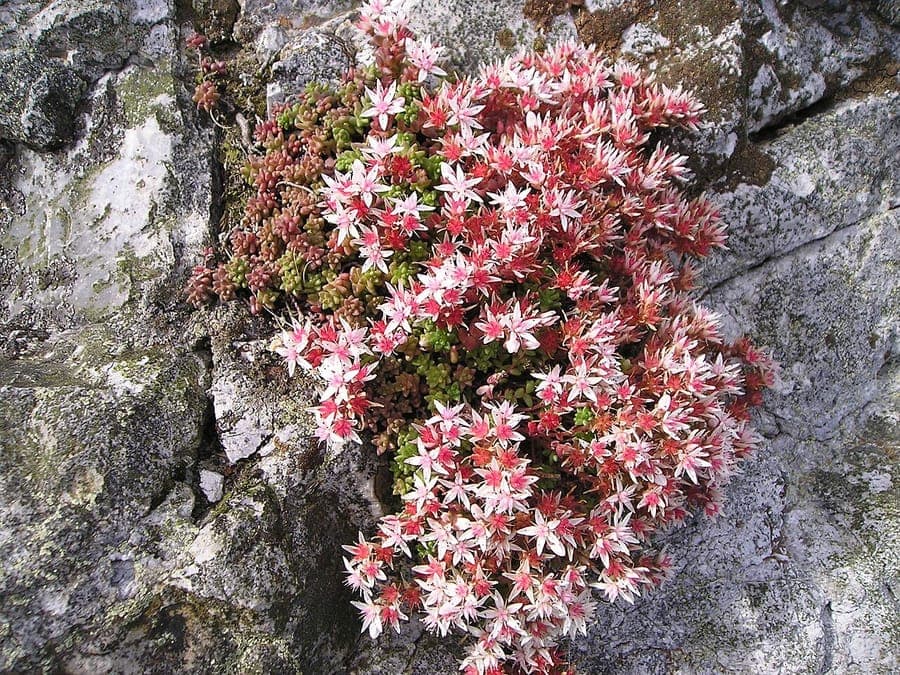
Cwmhiraeth / CC BY-SA 3.0, via Wikimedia Commons
English stonecrop: complete guide
Sedum anglicum
¿Quieres ver English stonecrop: complete guide en tu jardín?
1 minuto, sin tarjeta de crédito
Overview
English stonecrop (Sedum anglicum) is a tiny, extremely hardy succulent native from Western Norway to Northern Spain. This plant forms dense, green carpets of about 5-10 cm tall and blooms in June to August with tiny white flowers. It's perfect for rockeries, stones, green roofs, and dry borders where minimal maintenance is needed.
Appearance & Bloom Cycle
English stonecrop grows as a very compact, low cluster of thin, fleshy stems. The leaves are small, cylindrical, and green, which can turn red in cold or drought conditions. This gives the plant an attractive two-color look. The plant rarely exceeds 10 cm in height. The flowers are tiny white stars that appear in June to August in dense clusters on top of the stems. These flowers attract bees and other pollinators.
Ideal Location
English stonecrop thrives best on very sunny spots. Ensure at least 8 hours of direct sunlight daily. In full sun, the foliage becomes more attractive and redder. The plant can also grow in light shade but becomes more green and less compact. Ensure good ventilation to prevent fungal issues, though this is less likely with this species.
Soil Requirements
Good drainage is absolutely essential. English stonecrop grows best in very lean, sandy soil. Heavy clay soil leads to water retention and root rot. Sand, gravel, or volcanic soil are ideal. The plant accepts very low-nutrient soils and actually grows better in poor soil. The plant is indifferent to pH and grows in acidic soils (pH 4.5) to alkaline (pH 8+).
Watering
Once established, English stonecrop is very drought-tolerant. Water is only needed after planting (first month). After that, the plant rarely needs supplemental water, even in dry periods. Overwatering is the most common cause of death. On green roofs or gravel beds, no watering is needed at all. In pots and containers, water only when the substrate is completely dry.
Diseño gratis
¿Quieres ver English stonecrop: complete guide en tu jardín? Crea un diseño gratis ahora.
Pruning
Minimal pruning is needed. The plant maintains itself and never becomes unruly. Only dead flower stalks can be removed after blooming (August) for a neater look. The plant gradually spreads, so you can occasionally remove some extensions to prevent spread into other areas.
Maintenance Calendar
January-March: Winter dormancy. Plant is semi-evergreen, so still visible.
April-May: Start of growing season. Rarely need feeding, normal maintenance.
June-August: Bloom period. Water only in extreme drought.
August: Remove dead flower stalks after blooming.
September-October: Plant prepares for dormancy.
November-December: Winter dormancy. Check good drainage.
Winter Hardiness
English stonecrop is very winter hardy and can tolerate temperatures down to -20°C (USDA zones 4-8). The plant retains its leaves in winter and does not go completely dormant. This provides winter interest in the garden. Snow and ice do not harm the plant, as it grows very flat and is thus protected.
Companion Plants
English stonecrop works perfectly in groups with other compact succulents such as sedum species, sempervivum species, and other alpine plants. Plant together with saxifraga, armeria, and other rock plants for a natural look. On green roofs, combine with other sedums for beautiful texture effects.
Closing
English stonecrop is indispensable for gardeners who want to fill small spaces with beautiful plants without maintenance. The plant is perfect for rockeries, green roofs, dry borders, and containers. With practically no water needed, it's ideal for sustainable, low-maintenance gardens. Check gardenworld.app for more succulent information. Find out at gardenworld.app which other compact plants work well with your rockery or roof.
¿Quieres ver English stonecrop: complete guide en tu jardín? Crea un diseño gratis ahora.
Sube una foto, elige un estilo y obtén un diseño fotorrealista con lista de plantas en menos de un minuto.
Más de 10.000 jardines diseñados
Sin tarjeta de crédito


Plantas similares
Sedum nevadense: complete guide
Sedum nevadense
Discover Sedum nevadense, the stunning alpine stonecrop from the Pyrenees. Expert care tips, growing requirements, and design ideas for rock gardens.
Aizoon stonecrop: complete guide
Phedimus aizoon
Everything about Phedimus aizoon - the frost-tolerant aizoon stonecrop from Siberia with bright yellow flowers. Planting, care and garden use.
Roseroot: complete guide
Rhodiola rosea
Everything about roseroot (Rhodiola rosea): a tough hardy succulent ideal for rock gardens, green roofs, and dry sunny positions.