
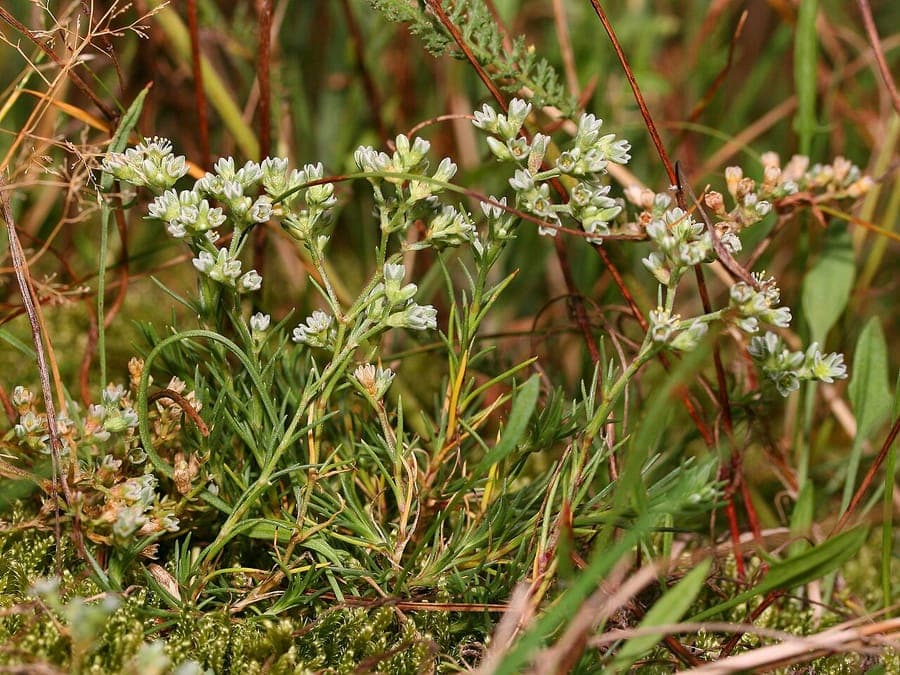
Kristian Peters -- Fabelfroh 15:15, 28 September 2007 (UTC) / CC BY-SA 3.0, via Wikimedia Commons
Perennial knawel: complete guide
Scleranthus perennis
¿Quieres ver Perennial knawel: complete guide en tu jardín?
1 minuto, sin tarjeta de crédito
Perennial Knawel: Complete Guide to This Delightful Perennial
Scleranthus perennis, commonly known as perennial knawel, is a small perennial plant from the pink family (Caryophyllaceae). This interesting plant occurs naturally from Madeira and Europe to Transcaucasus. In British and European gardens, this plant is increasingly used as underplanting in rock gardens and dry borders.
Overview
Perennial knawel is an attractive, compact plant that occupies the same position in the garden year after year. Unlike its annual relative Scleranthus annuus, it makes a more permanent impression in gardens. The plant forms attractive, densely clothed rosettes with fine, linear foliage.
The plant is particularly valuable for rock gardens, alpine troughs, and dry borders where minimal nutrients are available. Its continuous fine texture makes it indispensable for gardeners seeking year-round structure and interest in dry garden spaces.
Appearance and Bloom
Perennial knawel forms a compact rosette of fine, linear leaves. The plant grows very low to the ground, typically no more than 5 to 15 centimeters tall. The leaves are thin, ribbon-like, and very densely packed. This arrangement gives the plant an interesting, very fine texture.
Flowering occurs from May to August. The flowers are small, inconspicuous, and have white or slightly yellowish tint. They appear at the ends of short branchlets. Although subtle, these flowers appear profusely and give the plant a pleasant, delicate appearance. After flowering, they produce small seed capsules.
Ideal Location
Perennial knawel grows best in dry to moderately dry locations with full sun. The plant is adapted to mountainous and alpine conditions and performs well in European climates, including Britain and continental areas. It is very frost-hardy.
The plant performs well in rock gardens, scree gardens, alpine troughs, and between gravel layers. Shade is poorly tolerated and can lead to weak growth.
Diseño gratis
¿Quieres ver Perennial knawel: complete guide en tu jardín? Crea un diseño gratis ahora.
Soil
Perennial knawel makes minimal soil demands. The plant grows best in very well-drained, lean soils. Heavy, wet soils can be fatal to this plant. Alpine-type soils with gravel, sand, and small amounts of organic material are ideal.
Soil pH can range from slightly acidic to neutral (pH 5.5-6.5). Fertilization is not needed; indeed, the plant thrives better in poor soils. For pot culture, alpine gritty mix works well.
Watering
Once established, perennial knawel requires very little water. The plant is drought-tolerant and grows well in dry to moderately dry conditions. Regular watering is only necessary during the first growing season after planting.
In very wet winters, drainage can be problematic. Ensure water does not stagnate around the plant. Excessive moisture can cause root rot.
Pruning
Perennial knawel requires minimal pruning. The plant grows naturally compact and forms natural, attractive shapes. Remove only dead or damaged material in spring.
It may be useful to remove old flower stems after blooming to keep the plant tidy. This also stimulates new growth from underground parts.
Maintenance Calendar
Here is a typical maintenance calendar for perennial knawel:
April-May: Check for frost damage. Remove dead parts. Begin watering if dry.
June-August: Enjoy flowering. No intervention needed.
September-October: Seeds can be collected for propagation.
November-March: Minimal activity. Check drainage.
Winter Hardiness
Perennial knawel is very frost-hardy and occurs naturally from Madeira, through Europe, to Transcaucasus. This demonstrates its adaptation to diverse winters. The plant can withstand severe frosts in alpine regions. In Britain and continental Europe, winter protection is not necessary.
¿Quieres ver Perennial knawel: complete guide en tu jardín? Crea un diseño gratis ahora.
Sube una foto, elige un estilo y obtén un diseño fotorrealista con lista de plantas en menos de un minuto.
Más de 10.000 jardines diseñados
Sin tarjeta de crédito


Plantas similares
Dianthus karami: complete guide
Dianthus karami
Dianthus karami is a rare Lebanese mountain pink with fringed pink blooms on limestone cliffs, ideal for rock gardens and troughs.
Sicilian pink: complete guide
Dianthus siculus
Discover Dianthus siculus, an elegant purple bloomer from Sicily. Cultivation, June-September flowering and garden combinations.
Alpine mouse-ear chickweed: complete guide
Cerastium pedunculatum
Full growing guide for Cerastium pedunculatum: ideal location, soil, watering, winter hardiness, and companion plants for rock gardens.