
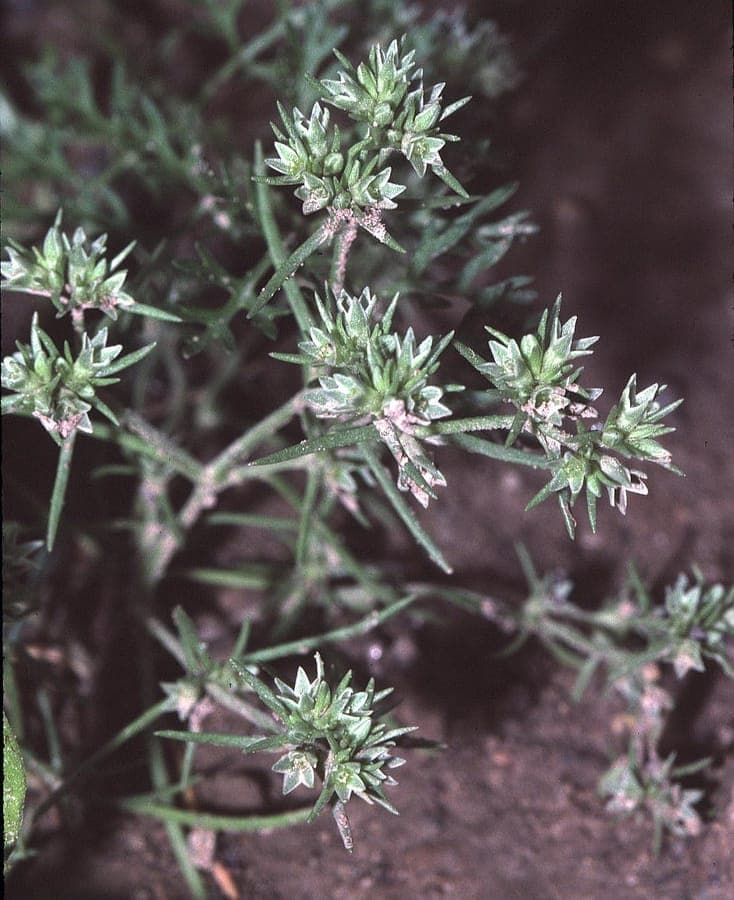
Fornax at German Wikipedia / Public domain, via Wikimedia Commons
Annual knawel: complete guide
Scleranthus annuus
¿Quieres ver Annual knawel: complete guide en tu jardín?
1 minuto, sin tarjeta de crédito
Annual Knawel: Complete Guide to This Modest Garden Plant
Scleranthus annuus, commonly known as annual knawel or German-knotweed, is a small annual plant from the pink family (Caryophyllaceae). This cosmopolitan plant occurs naturally from Macaronesia and Europe to Central Siberia and the Mediterranean region. In British gardens, this plant is less commonly used but is recognized as a hardy and low-maintenance specimen.
Overview
Annual knawel is an impressively small plant distinguished by its compact growth and fine texture. As an annual, it completes its life cycle in one growing season, making it interesting for annual bedding or as a filler plant in gardens. Despite its modest size, annual knawel contributes garden beauty through its delicate flower structure and fine foliage.
The plant is often used as ground cover in dry areas or as filler in rock gardens. With its very compact growth habit and prolonged flowering, annual knawel offers valuable contribution to gardens with full sun and dry soil conditions.
Appearance and Bloom
Annual knawel is a very small plant, typically no more than 15 to 30 centimeters tall. The plant grows very compactly and forms fine, densely clothed mats. The leaves are very small, linear, and group around thin stems. The plant has a light, greyish-green color.
Flowering occurs from May to September with very small, greenish or yellowish flowers. These blooms are not conspicuous, but appear abundantly along the fine stems. After flowering, the plant forms small seed capsules that open to release seed. Seed dispersal occurs mainly by wind and gravity.
Ideal Location
Annual knawel grows best in situations with full sun and well-draining soil. The plant is adaptable and grows in many different circumstances, but performs optimally in dry to moderately dry locations. This makes the plant ideal for gravel gardens, roof gardens, and dry margin situations.
The plant is not very sensitive to shade, though it grows most densely in full sun. Annual knawel is also very frost-hardy and can grow in almost all European climates, including those of Britain, continental Europe, and Scandinavia.
Soil
Annual knawel grows well in only moderately fertile soils. The plant is adaptable to many different soil types, but grows best in light, well-draining soils. Heavy, wet soils can cause the plant to rot.
For optimal growth, soil is recommended to be kept loose and moderately low in nutrients. Peat addition or heavy composting is generally not needed. A pH between 5.0 and 7.0 is suitable. Because annual knawel naturally grows in nutrient-poor soils, it requires no fertilizer.
Diseño gratis
¿Quieres ver Annual knawel: complete guide en tu jardín? Crea un diseño gratis ahora.
Watering
Annual knawel has minimal water requirements and grows well in dry to moderately dry soils. Once established, this plant needs little water. Regular watering is only necessary during the establishment period after sowing or transplanting.
During very dry periods, supplemental water may be beneficial, but this is not essential. Excessive moisture can be problematic as the plant is sensitive to rot in wet conditions. This makes annual knawel ideal for dry gardens and Mediterranean garden styles.
Pruning
Annual knawel requires no pruning as it is a very compact grower. The plant completes its cycle as an annual and dies after seed production. If you want more flowers, you can remove spent blooms to encourage further flower development.
Since the plant naturally disappears after one growing season, you need only remove old plant material in autumn or early winter.
Maintenance Calendar
Here is a typical maintenance calendar for annual knawel:
April-May: Sow seeds directly in the ground or plant out seedlings. Provide regular moisture during germination.
June-September: Enjoy flowering. Remove spent flowers if you want prolonged blooms. Minimal watering needed.
October-November: Collect seed. Allow seed to ripen and collect for next year. Remove old plants after seed production.
Winter Hardiness
While Scleranthus annuus is an annual plant and does not survive winter in the traditional sense, it is very frost-tolerant. It grows in the Alps and other mountain areas of Europe, proving its frost resistance. Seedlings can even tolerate frost temperatures.
By allowing seed from mature plants to fall in autumn, the plant can re-establish itself in the following spring as a self-sowing plant.
Companion Plants
Annual knawel forms attractive combinations with other dry-ground plants:
- Thrift (Armeria maritima): With pink flowers
- Summer Cypress (Kochia scoparia): For textural contrast
- Helichrysum (Helichrysum italicum): For silvery foliage tones
- Scarlet Wallflower (Erysimum cheiri): For additional color
- Thyme (Thymus vulgaris): For aromatic additions
In wetter areas, annual knawel is not recommended.
¿Quieres ver Annual knawel: complete guide en tu jardín? Crea un diseño gratis ahora.
Sube una foto, elige un estilo y obtén un diseño fotorrealista con lista de plantas en menos de un minuto.
Más de 10.000 jardines diseñados
Sin tarjeta de crédito


Plantas similares
Dianthus karami: complete guide
Dianthus karami
Dianthus karami is a rare Lebanese mountain pink with fringed pink blooms on limestone cliffs, ideal for rock gardens and troughs.
Sicilian pink: complete guide
Dianthus siculus
Discover Dianthus siculus, an elegant purple bloomer from Sicily. Cultivation, June-September flowering and garden combinations.
Alpine mouse-ear chickweed: complete guide
Cerastium pedunculatum
Full growing guide for Cerastium pedunculatum: ideal location, soil, watering, winter hardiness, and companion plants for rock gardens.