
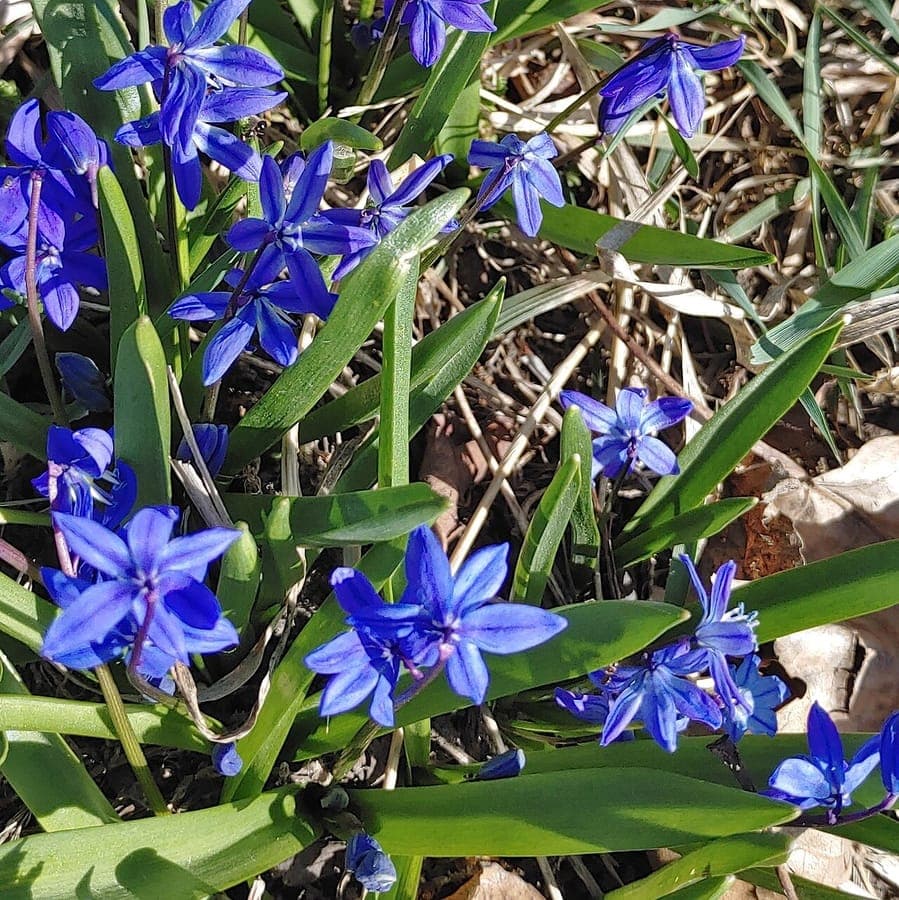
Oceanflynn / CC BY-SA 4.0, via Wikimedia Commons
Scilla siberica: complete guide
Scilla siberica
¿Quieres ver Scilla siberica: complete guide en tu jardín?
1 minuto, sin tarjeta de crédito
Scilla siberica, commonly called Siberian squill or Wood squill, ranks as the most versatile and prolific spring bulb for gardens. Known for ready self-multiplication and abundant flowering, this species transforms entire garden sections into dazzling blue drifts. Native to the Crimea through northwestern Iran, it grows wild on mountain meadows and open woodlands where it forms extensive naturalized populations.
Scilla siberica reaches 10 to 20 centimeters in height and produces 5 to 8 vivid blue to violet-blue flowers in nodding, bell-like sprays. The intensity of blue color is captivating and dominates in garden combinations. This plant flowers far more prolifically than other Scilla species, especially when well-established.
Flowering typically occurs from March through April, though mild winters can push bloom into February. Flowers open gradually over three to four weeks, providing extended color displays. The intensity of color remains consistent throughout the flowering period.
After flowering, foliage yellows and disappears rapidly, clearing space for summer bloomers. The plant forms numerous bulblets that quickly develop into clusters, making Scilla siberica ideal for natural increase. Plant 50 bulbs in year one and you may have several hundred blooming plants within three years.
Culture is remarkably simple and forgiving. This species thrives in virtually any condition. Full sun to partial shade, dry to moderately moist soil, heavy clay to light sand all support excellent growth. Well-draining soil is preferred but not essential. Full sun produces the best flowering.
Plant in October through November, setting bulbs 2 to 4 centimeters deep and spacing them 2 to 4 centimeters apart. Dense planting creates maximum impact. No fertilizer is necessary. Allow foliage to mature fully after flowering, returning energy to the bulbs. Remove only when completely dead and withered. Maintenance is essentially zero.
Absolutely winter-hardy to minus 25 degrees Celsius. Flowers normally withstand frost spells without damage. Even in severe winters, plants survive easily. Bulbs remain safely underground, escaping extreme freezing.
Companion planting is straightforward. Combine with Crocus, Galanthus, Anemone, Helleborus and other early bulbs. Low-growing groundcovers between bulbs create textural interest. Stagger planting depths for extended seasonal color.
Bulbs are widely available at garden centers and online from October through November at modest cost. This is among the most economical spring bulbs available. For maximum effect, plant at least 50 to 100 bulbs per grouping. Natural increase eventually provides drifts of hundreds of flowers.
Visit gardenworld.app to design mass plantings of Scilla siberica. The garden designer creates impressive early spring effects with generous drifts of these prolific bloomers. Explore all possibilities at gardenworld.app/en and create a spring garden that dazzles with abundant blue color from these economical bulbs.
¿Quieres ver Scilla siberica: complete guide en tu jardín? Crea un diseño gratis ahora.
Sube una foto, elige un estilo y obtén un diseño fotorrealista con lista de plantas en menos de un minuto.
Más de 10.000 jardines diseñados
Sin tarjeta de crédito


Plantas similares
Narrow-leaved dracaena: complete guide
Dracaena angustifolia
Everything about Dracaena angustifolia - the narrow-leaved dracaena: location, care, overwintering and use as a houseplant or patio plant.
Chaparral yucca: complete guide to Hesperoyucca whipplei
Hesperoyucca whipplei
Hesperoyucca whipplei (Our Lord's candle) is a dramatic rosette-forming plant from California that produces a towering flower spike, ideal for dry and gravel gardens.
False lily-of-the-valley: complete guide
Maianthemum dilatatum
Everything about Maianthemum dilatatum, the false lily-of-the-valley. Care, shade location, propagation and garden combinations for this popular shade ground cover.