
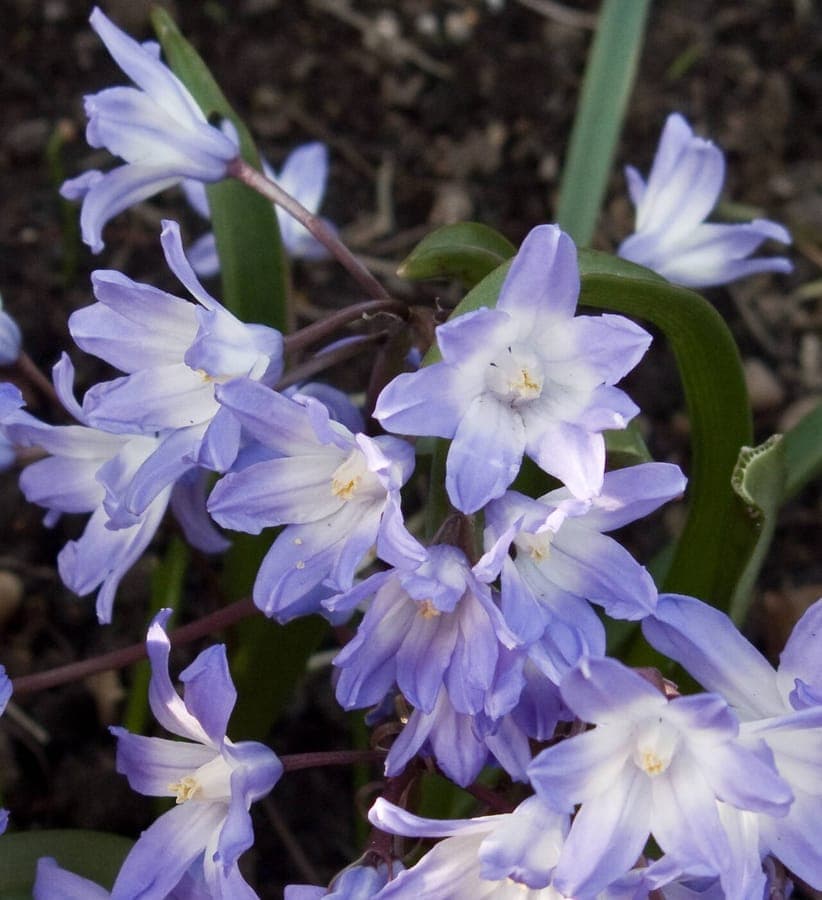
Peter coxhead (talk) / CC BY-SA 3.0, via Wikimedia Commons
Scilla forbesii: complete guide
Scilla forbesii
¿Quieres ver Scilla forbesii: complete guide en tu jardín?
1 minuto, sin tarjeta de crédito
Scilla forbesii, known as Forbes' squill or Glory-of-the-snow, ranks among the most impressive small bulbs for early spring gardens. This Turkish species offers larger flowers and stronger color than its cousin Scilla bifolia, creating more robust displays when planted in quantity. Native to western and southwestern Turkey, it grows wild on mountain meadows and slopes where it forms extensive naturalized populations.
This robust plant reaches 15 to 25 centimeters in height and bears comparatively large blue to violet-blue flowers arranged in clusters of 5 to 12 blooms. Some cultivars produce pure cobalt blue flowers, while others feature darker centers or red markings that add subtlety to the display. The flowers are substantially larger than S. bifolia, delivering dramatically stronger visual impact.
Scilla forbesii blooms from March through April, though mild winters can push flowering into February. Each cluster opens gradually over three to four weeks, providing extended color without intervention. The dark foliage creates striking contrasts with the intense flower color, making even small plantings visible from a distance.
This plant naturally forms clusters of three to five bulbs, making mass plantings simpler than dealing with individual bulbs. The grouped growth habit ensures full, coherent displays of color. After flowering, foliage yellows and disappears by June, clearing space for summer bloomers without unsightly dying leaves.
Culture mirrors that of S. bifolia: straightforward and forgiving. Nearly any garden situation works well. Sunny to partly shaded locations with ordinary garden soil support excellent growth. Heavy clay benefits from amendment with sand and organic matter to prevent waterlogging, which is the main enemy of bulb success.
Plant in October through November, setting bulbs 3 to 4 centimeters deep and spacing them 5 to 7 centimeters apart. The slightly larger spacing accommodates the grouping habit of these bulbs. No fertilizer is necessary. Simply plant and enjoy the spring show. Maintenance consists of removing dead foliage after May.
Scilla forbesii is completely winter-hardy to minus 25 degrees Celsius, with both bulbs and flowers resisting severe frost. Late spring frosts occasionally damage some flowers, but serious injury is rare. A winter mulch provides excellent protection if conditions prove extreme.
Companion planting options abound for spring gardens. Combine with Crocus, particularly dark purple varieties, Galanthus, Iris reticulata, Pushkinia and hyacinths. Varying heights create visual depth and interest. Stagger planting depths to extend the flowering display across several weeks.
Bulbs are widely available at garden centers and online from October through November at modest prices. Large quantities offer excellent value for the impact they create. Self-seeding occurs naturally, creating new plantings over time, though seedlings may take several years to reach flowering size.
Visit gardenworld.app to design a complete front yard scheme incorporating Scilla forbesii and complementary plants. The designer tool helps create the perfect planting plan for maximum spring impact. Discover all possibilities at gardenworld.app/en and transform your front garden with these stunning early bloomers.
¿Quieres ver Scilla forbesii: complete guide en tu jardín? Crea un diseño gratis ahora.
Sube una foto, elige un estilo y obtén un diseño fotorrealista con lista de plantas en menos de un minuto.
Más de 10.000 jardines diseñados
Sin tarjeta de crédito


Plantas similares
Narrow-leaved dracaena: complete guide
Dracaena angustifolia
Everything about Dracaena angustifolia - the narrow-leaved dracaena: location, care, overwintering and use as a houseplant or patio plant.
Chaparral yucca: complete guide to Hesperoyucca whipplei
Hesperoyucca whipplei
Hesperoyucca whipplei (Our Lord's candle) is a dramatic rosette-forming plant from California that produces a towering flower spike, ideal for dry and gravel gardens.
False lily-of-the-valley: complete guide
Maianthemum dilatatum
Everything about Maianthemum dilatatum, the false lily-of-the-valley. Care, shade location, propagation and garden combinations for this popular shade ground cover.