
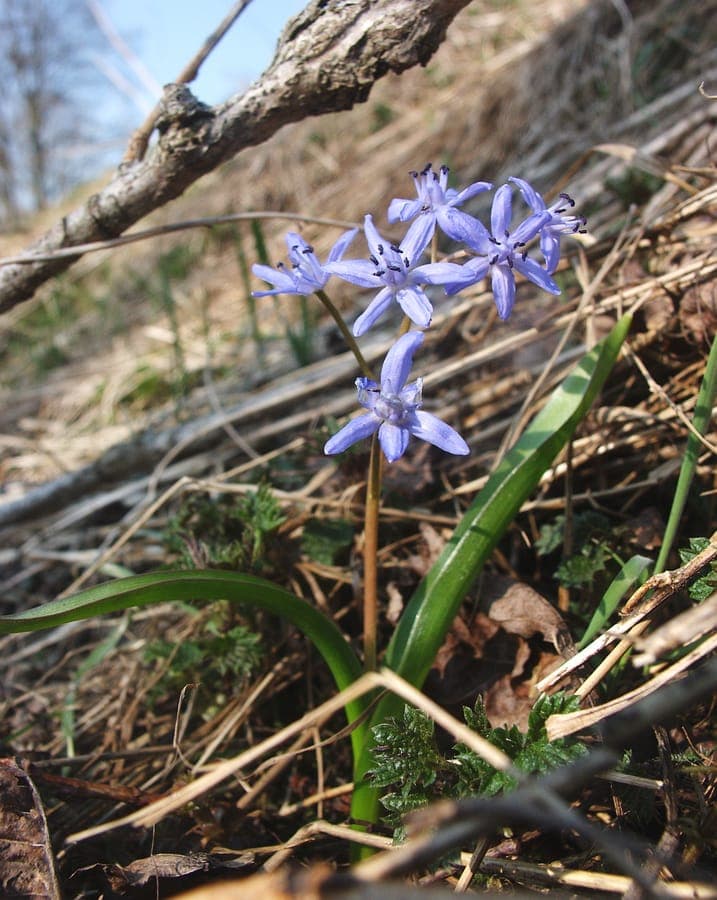
Bernd Haynold / CC BY 2.5, via Wikimedia Commons
Scilla bifolia: complete guide
Scilla bifolia
¿Quieres ver Scilla bifolia: complete guide en tu jardín?
1 minuto, sin tarjeta de crédito
Scilla bifolia, commonly called Alpine squill or Two-leaf squill, stands as one of Europe's most reliable and charming early spring bulbs. This small but impactful plant emerges when winter's grip still holds the garden, delivering intense blue color before most plants have even sprouted. The botanical name refers to the two distinctive leaves that emerge around the flowering stem.
Native to Central and Western Europe through the Balkans, this diminutive bulb reaches only 10 to 20 centimeters in height but produces far more visual impact than its size suggests. The flowers are arranged in loose, star-shaped clusters of 5 to 12 blooms in brilliant sky blue, sometimes with rosy or white varieties adding variety to the palette.
In its natural habitat, Scilla bifolia grows on alpine meadows, in deciduous forests and on steep slopes of low and medium mountains, often forming vast flowering carpets across entire hillsides. The plant thrives in temperate continental climates and has become naturalized in many regions including the British Isles and North America.
Flowering typically begins in early March and continues through April, though warm winters can push bloom time into February. The blue flowers with darker centers are utterly enchanting and provide essential early season color for pollinators emerging from winter dormancy. After blooming, foliage quickly yellows and the plant retreats underground, leaving space for summer-blooming plants.
Scilla bifolia excels as a ground cover beneath deciduous trees and shrubs. The foliage finishes before summer plants take off, and bulbs multiply readily to create dense flowering carpets. Rock gardens, borders, lawns and beneath hedgerows all welcome these charming flowers. Naturalize them in quantity for maximum spring impact.
Culture is remarkably straightforward. These bulbs accept almost any soil and light condition from full sun to partial shade. Well-draining soil is preferable since the bulbs dislike waterlogging, but ordinary garden soil works fine. Heavy clay benefits from amendment with sand and organic matter.
Plant in October through November, inserting bulbs 3 to 4 centimeters deep and spacing them 3 to 5 centimeters apart. Dense planting creates the fullest effect. No fertilizing or special care is necessary. After flowering, allow foliage to mature and die back naturally, returning energy to the bulbs for next season's display. Remove dead leaves only when completely brown and withered.
Scilla bifolia is utterly winter-hardy to minus 20 degrees Celsius and breezed through the coldest conditions without damage. Late spring frosts occasionally nip the flowers but rarely cause serious harm.
Companion plants abound in early spring gardens. Pair with Crocus, Galanthus (snowdrops), Iris reticulata or Helleborus (winter rose). Tulips and daffodils planted at different depths extend the flowering season. White-flowered varieties create striking combinations with dark purple crocuses.
Bulbs are readily available online and at garden centers from September through November at modest prices. Large quantities offer excellent value and deliver the most impressive displays. Plant generously for maximum spring impact and swift naturalization. Visit gardenworld.app to design a spring garden where Scilla bifolia plays its starring role. Discover all possibilities at gardenworld.app/en and create your perfect spring sanctuary.
¿Quieres ver Scilla bifolia: complete guide en tu jardín? Crea un diseño gratis ahora.
Sube una foto, elige un estilo y obtén un diseño fotorrealista con lista de plantas en menos de un minuto.
Más de 10.000 jardines diseñados
Sin tarjeta de crédito


Plantas similares
Narrow-leaved dracaena: complete guide
Dracaena angustifolia
Everything about Dracaena angustifolia - the narrow-leaved dracaena: location, care, overwintering and use as a houseplant or patio plant.
Chaparral yucca: complete guide to Hesperoyucca whipplei
Hesperoyucca whipplei
Hesperoyucca whipplei (Our Lord's candle) is a dramatic rosette-forming plant from California that produces a towering flower spike, ideal for dry and gravel gardens.
False lily-of-the-valley: complete guide
Maianthemum dilatatum
Everything about Maianthemum dilatatum, the false lily-of-the-valley. Care, shade location, propagation and garden combinations for this popular shade ground cover.