
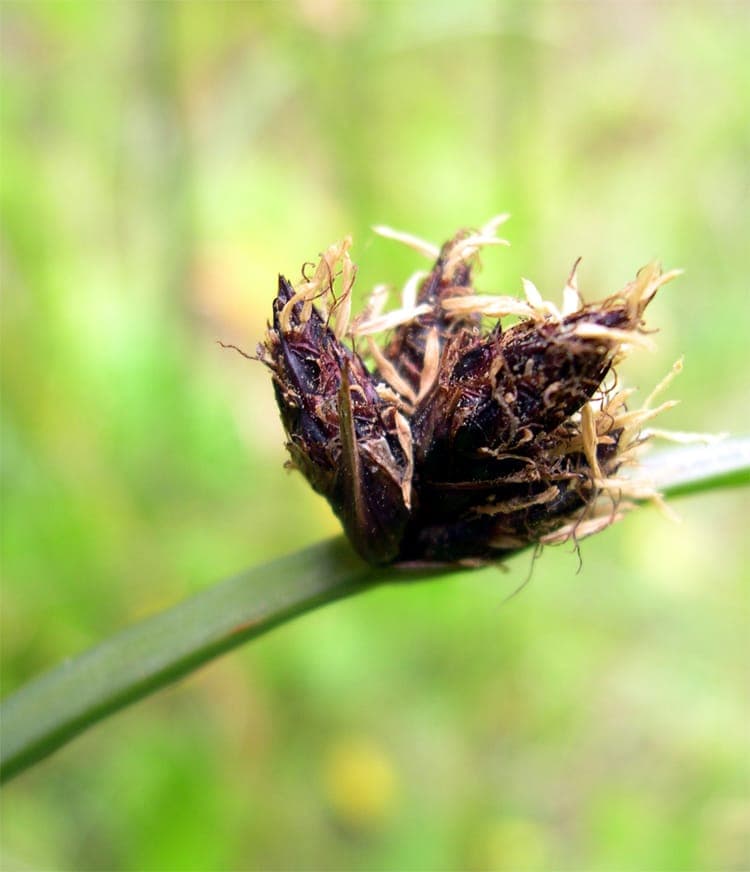
Gordon Leppig & Andrea J. Pickart / Public domain, via Wikimedia Commons
Chairmaker's-rush: complete guide
Schoenoplectus pungens
¿Quieres ver Chairmaker's-rush: complete guide en tu jardín?
1 minuto, sin tarjeta de crédito
Overview
Chairmaker's-rush (Schoenoplectus pungens) is a graceful marginal plant naturally occurring along shores and in wetlands throughout Europe and beyond. This versatile plant is extensively used in water gardens, for bank stabilization, and in constructed wetland filtration systems. Its characteristic sharp, triangular stems give the plant its common name.
Appearance and Bloom
The plant forms dense blue-green tufts reaching 30-60 cm in height with rigid, triangular stems standing upright. Small brown flowers appear at stem tips during June-August. The fibrous root system effectively prevents erosion along water edges.
Ideal Location
Chairmaker's-rush thrives along water edges, in shallow water (to 30 cm depth), or in consistently moist soil. The plant tolerates full sun and partial shade equally well. Position it where its sharp stems will not cause physical obstruction.
Soil
The plant grows in almost any soil provided it remains sufficiently moist. From sandy to heavy clay soils, with pH range 6.5-7. When establishing, add organic matter to improve nutrient retention.
Watering
As a water plant, Chairmaker's-rush requires constantly moist or wet conditions. In water gardens, regularly top up water to compensate for evaporation. In containers, maintain permanent water level through regular additions.
Diseño gratis
¿Quieres ver Chairmaker's-rush: complete guide en tu jardín? Crea un diseño gratis ahora.
Pruning
In spring, remove dead plant material. If desired, cut plants back by half in midsummer to encourage denser growth. Cut completely to soil level in late autumn or winter for sanitation purposes.
Maintenance Calendar
April: Add mulch and remove dead foliage. May-June: Apply nitrogen fertilizer to encourage growth. July-August: Monitor water management consistently. October: Clear dead leaves. November-March: Protect from freeze-thaw cycles.
Winter Hardiness
Chairmaker's-rush is extremely hardy to -30 degrees Celsius. The plant continues growing in shallow water thanks to its submerged root system. In very cold winters, above-ground parts may freeze but new shoots emerge from the root system.
Companion Plants
Combine Chairmaker's-rush with other marginal plants such as Acorus, Iris, and water lilies. This plant provides bank stability and creates habitat for aquatic fauna. Also suitable as a filter in constructed wetlands. Visit gardenworld.app/en for design ideas.
Closing
Chairmaker's-rush is a dependable marginal plant for water gardens and natural water features. With minimal care, this plant thrives along water edges and in wetland zones. Available from specialized nurseries and garden centers throughout northern Europe.
¿Quieres ver Chairmaker's-rush: complete guide en tu jardín? Crea un diseño gratis ahora.
Sube una foto, elige un estilo y obtén un diseño fotorrealista con lista de plantas en menos de un minuto.
Más de 10.000 jardines diseñados
Sin tarjeta de crédito


Plantas similares
Flat-stemmed club-rush: complete guide
Bolboschoenus planiculmis
Everything about Bolboschoenus planiculmis: growing conditions, watering, care, and use as a pond margin or wetland plant in garden design.
Great Plains flatsedge: complete guide
Cyperus lupulinus
Everything about Great Plains flatsedge (Cyperus lupulinus): growing conditions, care, garden uses, and ecological value. Tips for pond margins and dry sandy soils.
Golden beak sedge: complete guide
Rhynchospora corymbosa
Everything about golden beak sedge (Rhynchospora corymbosa): a dramatic tropical marginal for pond edges, bog gardens, and wet habitats.