
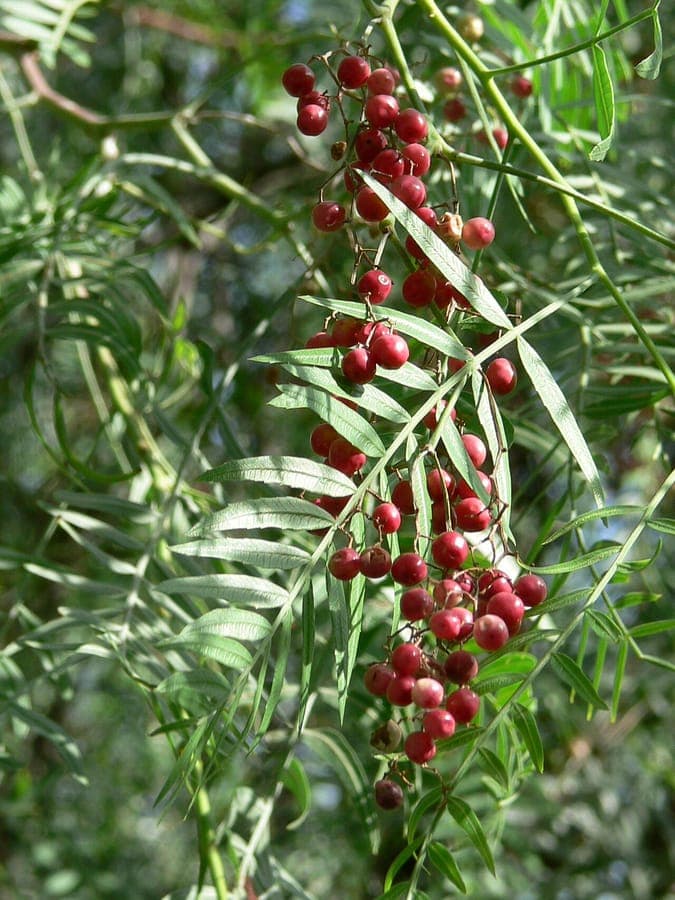
Squeezeweasel at en.wikipedia / CC BY 2.5, via Wikimedia Commons
Peruvian peppertree: complete guide
Schinus molle
¿Quieres ver Peruvian peppertree: complete guide en tu jardín?
1 minuto, sin tarjeta de crédito
Schinus molle, commonly known as Peruvian peppertree or California peppertree, is a fascinating subtropical tree from the Anacardiaceae family. This tree is native to Peru, Chile, and adjacent parts of South America. The plant is widely planted in Mediterranean and subtropical climates throughout the world. The tree is known for its elegant, weeping branches, fine, feathery leaves, and bright red berries. As a lover of exotic trees, you will greatly appreciate the Peruvian peppertree.
The Peruvian peppertree is a fast-growing tree that thrives with easy cultivation and can adapt to various growing conditions. The tree grows best in warm, dry climate and tolerates drought well. With its characteristic shape, beautiful foliage, and colorful fruit, it is an excellent choice for ornamental gardens and landscape projects.
Overview
Schinus molle is a semi-deciduous to deciduous tree that can grow 12 to 15 meters tall, although many specimens remain smaller around 6 to 8 meters. The tree grows quickly under favorable conditions. It is a solitary tree perfectly suited for yard planting or as an accent in the landscape. The tree typically reaches full size within 10 to 15 years.
Appearance and bloom
The leaves of the Peruvian peppertree are beautiful, compound leaves (feathery) that can reach up to 30 centimeters long. The leaves are elegantly curved and drooping, giving them a graceful, airy appearance. The leaf color is bright green, turning yellow-orange in autumn.
The flowers are small, yellowish-green, and appear in panicles. They are not particularly spectacular but attractive to pollinators. The flowers appear in spring and summer. The fruit, however, is the most striking feature. These are small, red to pink berries, about 6 millimeters in diameter, growing in dense clusters. The berries are highly decorative and remain on the tree for a long time.
Ideal location
The Peruvian peppertree grows best in warm, sunny climate with minimal frost threat. The tree prefers dry locations and tolerates drought better than moist conditions. Place the tree in a sheltered, sunny spot where it gets full sun. In cooler climates, it may be necessary to protect the tree or grow it in containers.
Soil
The Peruvian peppertree is not fussy about soil and grows in almost any soil type. It prefers well-draining soils and tolerates both acidic and basic soils well. The tree is robust and can be planted without much preparation. Avoid water stagnation, however, as this can cause root rot.
Watering
Once established, the Peruvian peppertree tolerates drought very well. The tree requires minimal water once established. During very dry periods, supplemental watering can be helpful but is not essential. In the first growing season, regular watering is important for developing a strong root system.
Pruning
Pruning is optional and can be used to manage the tree's shape. The tree naturally grows in an attractive form, so pruning is not always necessary. If desired, overgrowth branches can be removed after flowering. Remove dead or damaged wood each season.
Maintenance calendar
Spring: New growth begins. Provide regular watering during dry periods. Summer: Plant grows quickly. Monitor for pests and diseases. Pruning can be done. Autumn: Fruit formation peaks. Leaf fall begins. Minimal maintenance requirements. Winter: Tree is dormant in cooler climates. Provide watering. Protection may be needed in frost areas.
Winter hardiness
The Peruvian peppertree is not truly cold-hardy and thrives best in warm, frost-free climates. In areas with temperatures below zero degrees Celsius, the tree may die. In temperate climates, it can be grown as a container plant that is brought indoors in winter.
Companion plants
The Peruvian peppertree combines beautifully with other Mediterranean and subtropical plants. Combine it with oleanders, bougainvillea, and other heat-loving ornamental trees. The tree also works well as a solitary specimen tree in the landscape. Many garden experts recommend this beautiful specimen for warmer regions.
Closing
The Peruvian peppertree is a beautiful and practical tree choice for warm climates. With its elegant form, beautiful foliage, and colorful fruit, it will certainly add much beauty to your garden. Once established, it requires minimal maintenance and will provide many years of enjoyment. Discover more garden inspiration and advice on gardenworld.app/en. Enjoy growing this exotic tree in your garden on gardenworld.app/en!
¿Quieres ver Peruvian peppertree: complete guide en tu jardín? Crea un diseño gratis ahora.
Sube una foto, elige un estilo y obtén un diseño fotorrealista con lista de plantas en menos de un minuto.
Más de 10.000 jardines diseñados
Sin tarjeta de crédito


Plantas similares
Skunkbush sumac: complete guide
Rhus trilobata
Everything about Rhus trilobata: siting, soil, autumn colour, pruning, and how this tough ornamental shrub earns a place in any garden.
Winged sumac: complete guide
Rhus copallinum
Everything about Rhus copallinum, the winged sumac with spectacular autumn colour. Location, pruning and garden value in full detail.
Aromatic sumac: complete guide
Rhus aromatica
Full guide to aromatic sumac (Rhus aromatica): planting, soil, care, pruning and companion plants for dry, sunny gardens and slope stabilisation.