
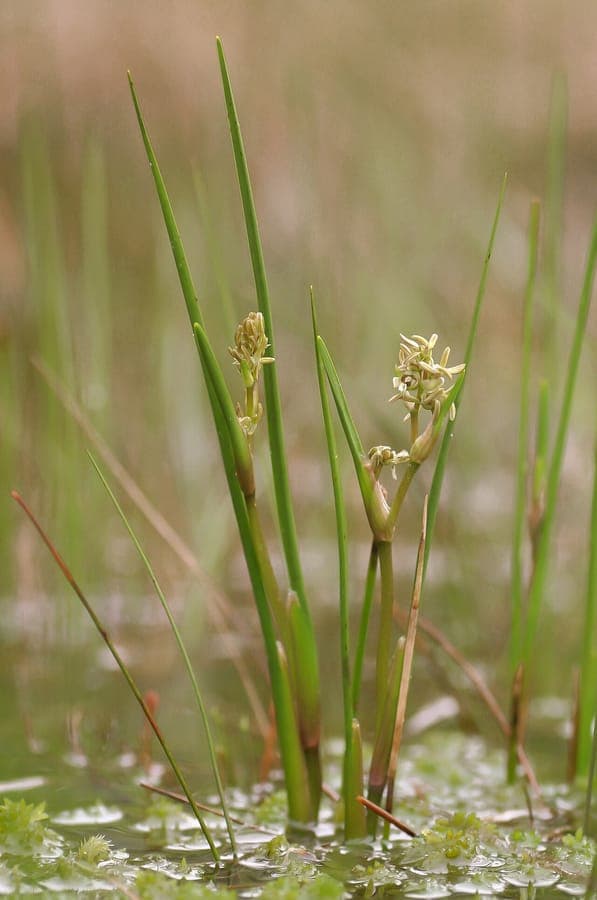
Bertblok / CC BY-SA 3.0, via Wikimedia Commons
Rannoch-rush: complete guide
Scheuchzeria palustris
¿Quieres ver Rannoch-rush: complete guide en tu jardín?
1 minuto, sin tarjeta de crédito
Scheuchzeria palustris, commonly known as Rannoch-rush or marsh scheuchzeria, is a quirky little plant from the Scheuchzeriaceae family. This unique herb is widespread in the temperate northern hemisphere and prefers to grow in wet, acidic soils of peatland areas. The plant has become relatively rare due to agricultural and climate changes. As an enthusiast of marsh planting and water plants, this article will help you better understand this interesting plant.
Rannoch-rush is a compact, low-growing plant that has adapted to very moist, wet growing conditions. The plant thrives in acidic soils of marshes and peatbogs. With its small, discrete flowers and fine structure, it offers much for gardeners who want to experiment with marsh and water gardens.
Overview
Scheuchzeria palustris is a perennial plant that reproduces via short underground stems (rhizomes) and seeds. The plant usually reaches a height of 10 to 40 centimeters, depending on growing conditions. It is a pioneer species that likes to colonize acidic soils. The plant blooms from May to June.
Appearance and bloom
The leaves of Rannoch-rush are linear and strikingly tubular. They are thin-walled, about 2 to 4 millimeters wide and very characteristic of the plant. The leaves are dark green and stiff. The plant does not form distinct rosettes but rather loose tufts of leaves.
The flowers are very small and discreet, about 2-3 millimeters in diameter. They are greenish to yellowish and appear in small panicles. The flower spikes are not particularly spectacular, but they have a delicate beauty. The flowering period is short, from May to June. After blooming, small fruits form that are dispersed by water.
Ideal location
Rannoch-rush grows best in very wet, acidic marsh and peat landscapes. The plant prefers organic-rich, wet soils with plenty of rotted plant material. In the garden, it is best to use a special marsh or bog area. The plant does not perform well in dry areas.
Soil
Rannoch-rush is very particular about soil: it grows best in acidic (pH 4.5-6.5), wet, organic-rich soils. A mix of black peat soil and sand is ideal. The plant does not like average garden soils. For successful cultivation, you must prepare special bog soils.
Watering
Rannoch-rush must be kept permanently wet. This is a plant for very wet environments. It must never dry out. In fact, it survives better in submerged conditions than in normally wet circumstances. Ensure the soil remains constantly saturated.
Pruning
Pruning is not needed. The plant is small and does not grow aggressively. Dead parts can be carefully removed.
Maintenance calendar
March-April: New growth begins. Ensure good water status. May-June: Plant blooms. Let seed ripen for dispersal. July-September: Plant rests, soil remains wet. October-February: Plant is dormant. Maintenance minimal, but keep soil wet.
Winter hardiness
Rannoch-rush is cold-hardy and can tolerate winter conditions well. In very cold regions, some mulching can help, but is not necessary. The plant survives under snow.
Companion plants
Rannoch-rush combines beautifully with other marsh plants such as sundew, bog myrtle, and other bog plants. Use it in special marsh surfaces alongside other similar water plants. This plant is ideal for lovers of rare and native water plants.
Closing
Rannoch-rush is a fascinating and rare plant for specialized gardeners who want to create water and marsh ecosystems. Although it makes many moisture demands, it will grow without problems with the right conditions. This plant fits perfectly in bog gardens and moisture gardens. More information and inspiration for marsh and water plants can be found on gardenworld.app/en. Enjoy growing this interesting and unique plant on gardenworld.app/en!
¿Quieres ver Rannoch-rush: complete guide en tu jardín? Crea un diseño gratis ahora.
Sube una foto, elige un estilo y obtén un diseño fotorrealista con lista de plantas en menos de un minuto.
Más de 10.000 jardines diseñados
Sin tarjeta de crédito


Plantas similares
Acer pycnanthum: complete guide
Acer pycnanthum
Acer pycnanthum, the Japanese swamp maple, is a fast-growing tree with early red flowers and brilliant autumn color, ideal for damp garden settings.
Freeman maple: complete guide
Acer × freemanii
Everything about the Freeman maple (Acer x freemanii): a fast-growing shade tree with spectacular autumn colour for large gardens.
Silver vine: complete guide
Actinidia polygama
Discover silver vine (Actinidia polygama): a hardy climbing plant with silvery foliage, loved by gardeners and cats alike.