
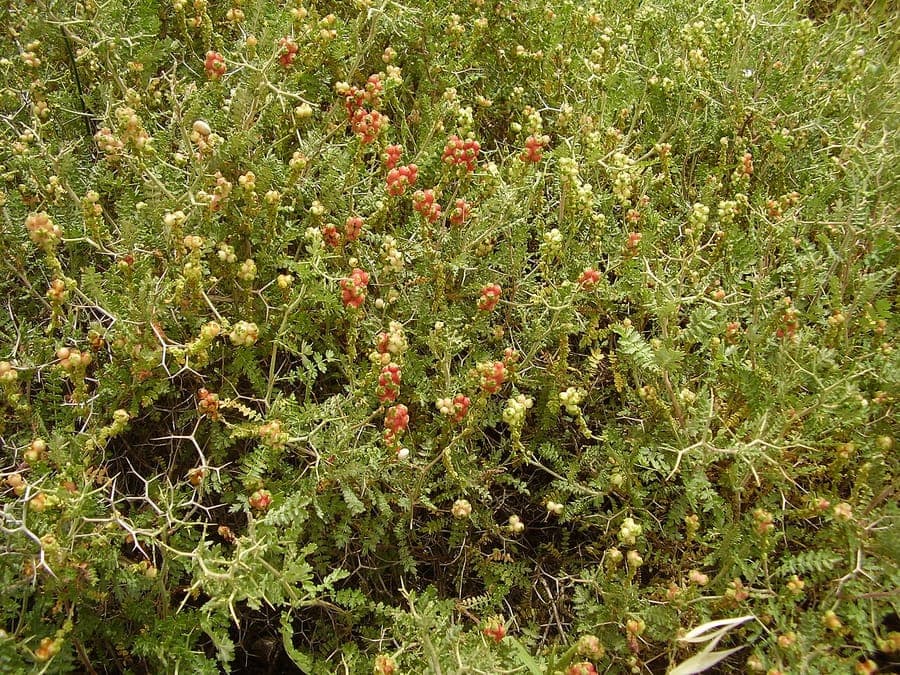
RickP / CC BY 2.5, via Wikimedia Commons
Thorny burnet: complete guide
Sarcopoterium spinosum
¿Quieres ver Thorny burnet: complete guide en tu jardín?
1 minuto, sin tarjeta de crédito
Overview
Sarcopoterium spinosum, commonly called thorny burnet, is an extremely spiny shrub from the Rosaceae family. This species occurs naturally throughout the Mediterranean basin, with distribution ranging from North Africa to southeastern Europe. It represents an important landscape component in Mediterranean habitats and offers value for xeric garden designs.
First described in 1846, thorny burnet is now classified as an accepted rosaceous species. Its range extends across approximately fifteen countries bordering the Mediterranean Sea.
Appearance & bloom
Thorny burnet forms an extremely dense, compact mound covered with formidable sharp spines. Plants typically reach 50 to 80 centimeters tall with equal spread. The leaves are very small, grey-green, and densely crowded along wickedly-armed branches.
Flowers appear in spring, typically April through June, on short stalks. They are quite small, whitish to greenish in color, and relatively inconspicuous. Small fruits follow the flowers, providing additional textural interest.
The plant retains its foliage year-round in Mediterranean regions.
Ideal location
Thorny burnet thrives in full sun on steep, barren slopes. A minimum of six hours of direct sunlight daily is essential. The plant tolerates no shade.
Given its aggressively spiny nature, position the plant strategically where it poses no hazard. It proves exceptionally valuable for screening and barrier applications.
This plant excels in Mediterranean rock gardens, arid slopes and xeric planting schemes.
Soil
Thorny burnet grows in extremely poor, infertile soil with perfect drainage. Soil pH should range from 6.5 to 8.5. The plant tolerates calcareous soils without difficulty.
Add minimal organic matter at planting - coarse sand and gravel are preferred. This plant thrives in lean, rocky soils and even marginal conditions. Excess fertility promotes excessive growth at the expense of hardiness.
The plant demonstrates exceptional tolerance of rocky, leached soils.
Watering
Once established, thorny burnet is extremely drought-tolerant. During the first season, water moderately until deep rooting occurs, approximately once weekly.
After establishment, supplemental irrigation is rarely needed. The plant naturally survives on regional rainfall alone. Avoid overwatering at all costs.
During exceptional drought, occasional watering may provide benefit, but is not essential.
Diseño gratis
¿Quieres ver Thorny burnet: complete guide en tu jardín? Crea un diseño gratis ahora.
Pruning
Thorny burnet requires minimal pruning or maintenance. Allow it to develop its natural, dense form. Remove only severely damaged or dead branches.
Given the formidable spines, safe pruning requires appropriate protective equipment. Wear gloves and long sleeves when working with this plant.
Following severe frost damage, the plant will typically respout from the root crown.
Maintenance calendar
Spring: Site preparation, transplanting in early spring. May-June: Observe growth and bloom, water rarely. July-August: No maintenance needed, arid conditions accepted. Autumn: Growth slows, no intervention required. Winter: No maintenance, plant dormant in cold climates.
Winter hardiness
Thorny burnet is hardy to approximately USDA zone 7, tolerating temperatures around -17 degrees Celsius. This limits it to Mediterranean regions and warmer parts of temperate zones.
In most northern regions, especially above 50 degrees north latitude, the plant is not reliably hardy and will likely succumb in hard winters. In warm microclimates in zones 6 and higher, occasional survival is possible.
Companion plants
Combine thorny burnet with other Mediterranean, ultra-drought-tolerant plants:
- Cistus spp (rockrose): Similar bloom period and water requirements
- Phyllirea spp (evergreen shrub): Comparable growth habit
- Rosmarinus officinalis (rosemary): Aromatic, similar conditions
- Helichrysum spp (straw flower): Silver foliage contrast
- Lavandula stoechas (French lavender): Spring bloom
Plant in rock gardens for maximum visual effect.
Closing
Sarcopoterium spinosum offers distinctive Mediterranean character for dry gardens. While its aggressive spines require careful placement, its exceptional drought tolerance and natural architectural form make it valuable for xeric designs.
This plant requires patience during establishment and provides decades of minimal maintenance. Discover thorny burnet in Mediterranean nurseries and specialized native plant suppliers. For more Mediterranean plants and xeric design inspiration, visit gardenworld.app.
¿Quieres ver Thorny burnet: complete guide en tu jardín? Crea un diseño gratis ahora.
Sube una foto, elige un estilo y obtén un diseño fotorrealista con lista de plantas en menos de un minuto.
Más de 10.000 jardines diseñados
Sin tarjeta de crédito


Plantas similares
Siberian crab apple: complete guide
Malus x robusta
Complete guide to the Siberian crab apple (Malus x robusta): location, soil, pruning, winter hardiness and the best companion plants for your garden.
Chinese flowering crabapple (Malus x spectabilis): complete guide
Malus x spectabilis
Meet the Chinese flowering crabapple (Malus x spectabilis): a classic spring bloomer with carmine buds and pink blossom.
Potentilla crassinervia: complete guide
Potentilla crassinervia
Potentilla crassinervia, the Corsican cinquefoil, grows wild on Corsica and Sardinia's peaks. Discover how to grow this hardy alpine rock garden gem.