
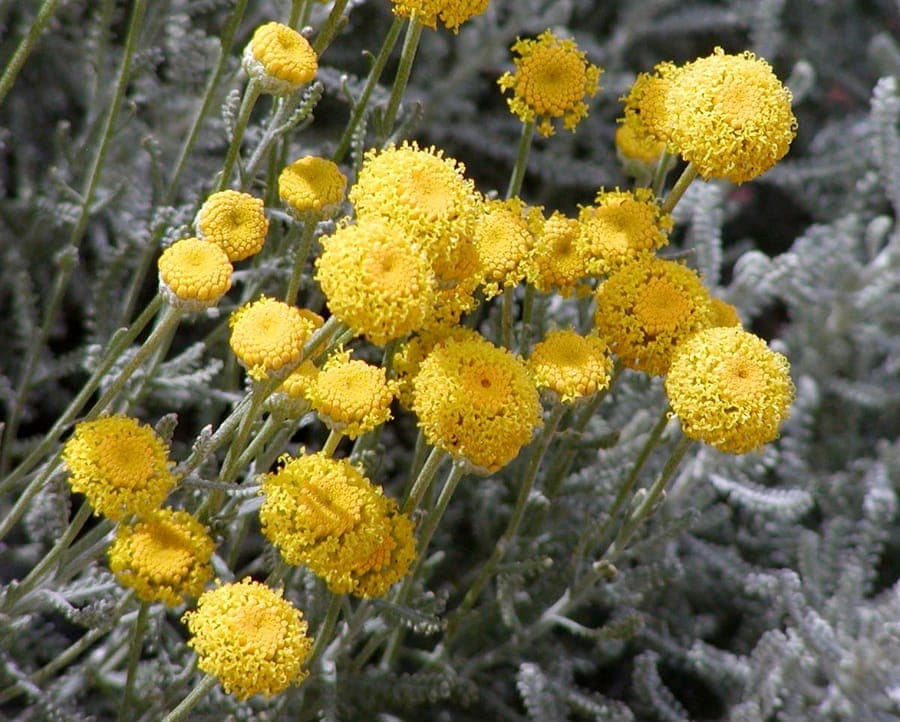
User:Stan Shebs / CC BY-SA 3.0, via Wikimedia Commons
Lavender cotton: complete guide
Santolina chamaecyparissus
¿Quieres ver Lavender cotton: complete guide en tu jardín?
1 minuto, sin tarjeta de crédito
Overview
Lavender cotton (Santolina chamaecyparissus), also known as Cyprus grass, is an evergreen shrub native to the Mediterranean region. The plant is known for its compact form, aromatic foliage, and striking round yellow flowers. Lavender cotton is a popular choice for hedge plantings and formal garden shaping, offering year-round structural interest.
Appearance and Bloom
Lavender cotton grows to approximately 50 to 80 centimeters height with a ball-shaped habit. The plant has fine, very delicate, gray-green foliage with a soft, woolly texture. The fragrance is lightly cypress-like and aromatic. The flowers appear from June to August as pompoms of pure yellow, approximately 1 to 1.5 centimeters in diameter, standing on long stems. These characteristic yellow button-like flower heads are highly striking and attract pollinators.
Ideal Location
Lavender cotton prefers warm, sunny, and dry terrain. The plant requires at least six hours of direct sunlight daily. The plant is excellent for Mediterranean gardens, color schemes, and hedges. Lavender cotton also thrives in pots and containers on terraces. The plant tolerates moderately windy microclimates well.
Soil
The plant prefers well-drained, poor to moderately nutrient-rich soil. Lavender cotton grows better on sand or gravel-based substrates than on heavy clay soils. The plant tolerates very dry terrain well and lasts long without supplementary watering. Very calcareous soils are tolerated.
Diseño gratis
¿Quieres ver Lavender cotton: complete guide en tu jardín? Crea un diseño gratis ahora.
Watering
Lavender cotton is very drought-tolerant. After planting, regular watering is required for the first four to six weeks, but once the plant is established, minimal hydration is needed. Excess water leads to rot. In regions with normal rainfall, supplementary watering is rarely needed.
Pruning
Lavender cotton responds well to pruning and shaping. The plant can be cut back annually in early spring to maintain form and stimulate new growth. After blooming, faded flowers can be pinched off. Severe cutting can be applied every three to four years.
Maintenance Calendar
- Spring: Perform shaping pruning; check drainage
- June-August: Enjoy flowering season
- Summer: Minimal water requirement; deadhead spent flowers
- Autumn: Prepare for winter; check structure
- Winter: Protect against severe frost; minimal maintenance needs
Winter Hardiness
Lavender cotton is well winter-hardy in temperate to warm European regions. The plant tolerates temperatures down to about -5 to -7 degrees Celsius, depending on varieties. In cold climates, winter protection should be considered. Snow and ice accumulation can damage branches.
Companion Plants
Lavender cotton combines excellently with other Mediterranean and drought-tolerant plants such as lavender, rosemary, gaura, and gray-foliaged sage. The plant forms beautiful contrasts with dark-foliaged structural plants. Grouping with other yellow-flowering plants creates vibrant displays.
Closing Remarks
Lavender cotton offers gardeners a versatile choice for dry, sunny spots with migration and shaping potential. The aromatic foliage and yellow flowers bring long enjoyment. Find more information and planting ideas at gardenworld.app/nl or gardenworld.app/en.
¿Quieres ver Lavender cotton: complete guide en tu jardín? Crea un diseño gratis ahora.
Sube una foto, elige un estilo y obtén un diseño fotorrealista con lista de plantas en menos de un minuto.
Más de 10.000 jardines diseñados
Sin tarjeta de crédito


Plantas similares
Calendula stellata: complete guide
Calendula stellata
Complete guide to Calendula stellata, the star-flowered marigold from Sicily: location, soil, watering and companion planting tips.
Korean chrysanthemum: complete guide
Chrysanthemum x rubellum
Chrysanthemum x rubellum is a hardy autumn perennial with single pink to copper flowers from August to November. Care and combinations.
Helianthus divaricatus: complete guide
Helianthus divaricatus
Helianthus divaricatus is a North American woodland sunflower with yellow summer blooms, ideal for naturalistic borders and shady edges.