
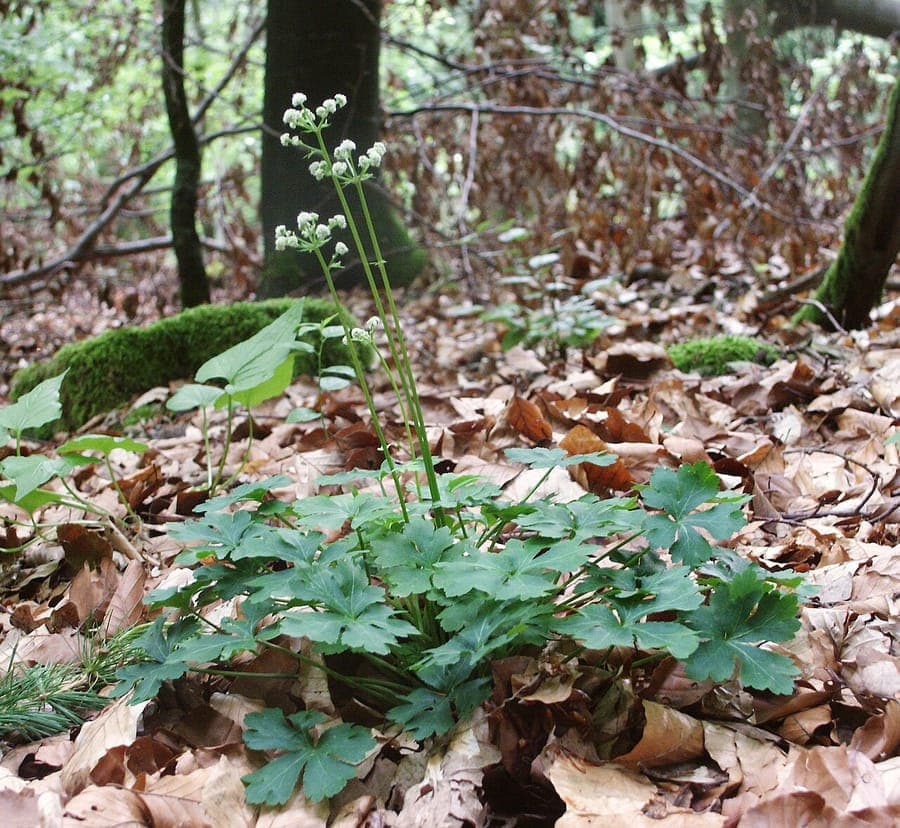
Bernd Haynold / CC BY 2.5, via Wikimedia Commons
Sanicle: complete guide
Sanicula europaea
¿Quieres ver Sanicle: complete guide en tu jardín?
1 minuto, sin tarjeta de crédito
Overview
Sanicle (Sanicula europaea) is a versatile plant naturally found in woodland areas from Europe through Siberia to North African regions. The plant is known for its traditional medicinal properties and has been used in herbal medicine for centuries. Sanicle is a preferred plant for shaded terrain and offers ecological value to garden ecosystems.
Appearance and Bloom
Sanicle grows to a moderate height with characteristic trifoliate leaves. The leaves feature a distinctive aspect with fine, irregularly toothed margins that give the plant a unique texture. The plant produces small flowers arranged in clusters in purple to pink tones. The blooming period extends from May to June, presenting the plant with subtle elegance in woodland environments.
Ideal Location
Sanicle thrives optimally in shaded environments typical of forest floor conditions. The plant adapts well to locations with weak to moderate light exposure. Planting in partial shade beneath trees or on the north side of buildings offers ideal conditions. Sanicle fits well in naturalistic garden designs and ecological restoration programs.
Soil
The plant prefers neutral to slightly alkaline soil (pH 6.5-7.0) with good drainage. Sanicle grows better in well-structured soil types with moderate nutrient content. Heavy clay soils can be improved by adding humus-rich organic matter. The plant is not exceptionally fussy about soil conditions but appreciates stable moisture availability.
Diseño gratis
¿Quieres ver Sanicle: complete guide en tu jardín? Crea un diseño gratis ahora.
Watering
Although Sanicle prefers adequate moisture, the plant adapts well to normal rainfall in temperate climates. Regular watering during dry periods helps the plant thrive. In natural woodland settings, supplementary watering is usually not needed once the plant is established.
Pruning
Sanicle requires minimal pruning work. The plant has a naturally compact growth habit. Faded flower clusters can be removed to limit seed production, though this is not a strict requirement for plant health.
Maintenance Calendar
- Spring: Check plant moisture as the growing season begins
- May-June: Enjoy the flowering period
- Summer: Provide supplementary water during pronounced dry spells
- Autumn: Plant slowly establishes itself in dormancy
- Winter: Minimal maintenance needs
Winter Hardiness
Sanicle is very winter hardy and adapted to temperate European climates. The plant tolerates temperatures well below freezing. Winter protection is not needed in standard European garden settings. The plant completely disappears above ground in winter and regrows naturally in spring.
Companion Plants
Sanicle works excellently with shade-loving species such as forest moss, European wild ginger, and ferns. The plant combines well with other Apiaceae family members and forest floor inhabitants. Group planting with Helleborus and Astilbe creates natural woodland landscapes.
Closing Remarks
Sanicle offers gardeners a valuable way to fill shaded spots with traditional European character. The plant supports local ecosystems and provides historical and medicinal intrinsic value. Find more information about placement options at gardenworld.app/nl or gardenworld.app/en where experts will help you further with selection and planting.
¿Quieres ver Sanicle: complete guide en tu jardín? Crea un diseño gratis ahora.
Sube una foto, elige un estilo y obtén un diseño fotorrealista con lista de plantas en menos de un minuto.
Más de 10.000 jardines diseñados
Sin tarjeta de crédito


Plantas similares
Whorled carrot: complete guide
Daucus involucratus
Daucus involucratus is a Mediterranean umbellifer with white flower heads framed by lacy bracts. Growing this gravel garden gem.
Daucus muricatus: complete guide
Daucus muricatus
Daucus muricatus, the spiny wild carrot, grows wild on Mediterranean coasts. Discover sowing, June-July bloom, and wildflower meadow use.
Daucus pumilus: complete guide
Daucus pumilus
Daucus pumilus is a dwarf wild carrot relative with white lacy umbels, thriving on dunes and coastal rock in poor, fast-draining soil.