
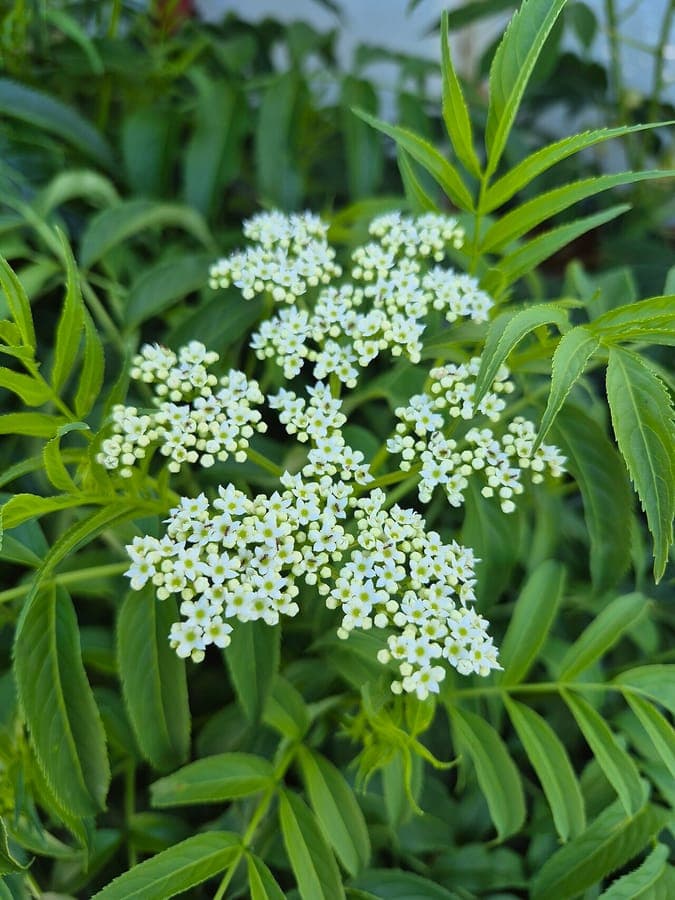
Bageense / CC BY 4.0, via Wikimedia Commons
Sambucus australis: complete guide
Sambucus australis
¿Quieres ver Sambucus australis: complete guide en tu jardín?
1 minuto, sin tarjeta de crédito
Overview
Sambucus australis, known as Southern elder, is a fast-growing, semi-woody shrub from South America. Though geographically named "australis" (southern), the plant originates from southern Brazil, Paraguay, and Argentina.
This is a remarkable shrub for those wishing to experiment with semi-exotic plants in temperate gardens. The plant offers rapid growth, striking flowers, and bird-attracting fruits within a single season.
However, the plant is not fully winter hardy in northern regions and requires protected placement or winter storage in containers. For southern gardeners and protected gardens, the plant is genuinely worthwhile.
Appearance and bloom
Sambucus australis rapidly reaches 2-4 meters height and forms a light, branching shrub with large, pinnate leaves. The leaves are long (to 30 cm), bright green, and highly ascending. This gives the plant a tropical appearance.
The plant blooms very profusely with large, cream-white flower plumes in April through May. These flowers are very striking and attract insects. Following bloom, dark red to nearly black fruits form, highly attractive to birds.
The entire plant silhouette is very elegant, with an open, airy growth habit. The plant forms no dense shrub, but rather creates a gauze-like structure in the landscape.
Ideal location
Southern elder grows best in sunny to partially shaded locations. The plant tolerates more shade, though flowering diminishes. For optimal results: at least 5-6 hours direct daily sun.
Plant in a location protected from strong cold winds - late spring or early autumn frost can damage young shoots. In northern regions: container cultivation for winter storage is recommended.
In warm areas: position against a south-facing wall for extra protection. The plant also grows effectively in large containers, facilitating winter storage.
Soil
Sambucus australis thrives on both acidic and neutral to weakly alkaline soils (pH 5.5-7.5). The plant is not picky about nutrients. Good drainage is however essential - stagnation damages roots.
Add generous organic material (compost, weathered manure) at planting time. This accelerates growth in early years. The plant is a fast grower, so nutrient availability enhances performance.
For container culture: use frost-safe, high-draining potting mix. Add feeding throughout the season.
Diseño gratis
¿Quieres ver Sambucus australis: complete guide en tu jardín? Crea un diseño gratis ahora.
Watering
Provide regular water, especially during the growing period (April-September). The plant is water-loving but tolerates short drought once established. Water 3-4 times weekly during growing season.
In winter, when the plant is dormant, reduce watering frequency drastically. Container plants require somewhat more water attention than in-ground specimens. Avoid waterlogging.
Pruning
Southern elder responds well to pruning and requires no mandatory pruning. Remove dead branches after frost. For shaping: lightly prune in early spring to encourage density formation.
The plant grows fast, so young shoots can be shortened as needed. Hard spring cutback stimulates new, flower-bearing wood. Always use sharp tools.
Maintenance calendar
March: Check for frost damage. Perform pruning. Add feeding. April-May: Water regularly. Observe bloom. Monitor young shoots. June-July: Water as needed. Insects attract. Follow fruit formation. August: Continue watering. Track birds eating fruits. September-October: Reduce watering. Enjoy autumn color. November-February: For containers: relocate to protected location for winter. For in-ground: provide frost protection.
Winter hardiness
Sambucus australis is hardy only to -3 to -5 degrees Celsius. In northern regions, outdoor winter survival is impossible. In southern areas: position against warm walls or provide protection.
Container cultivation is necessary for most temperate gardens. Overwinter in unheated greenhouse or protected shed. Cold, dry, and dark are ideal winter conditions.
Companion plants
Southern elder combines well with other sun-lovers. Pair with other South American plants in protected gardens. For contrast: fine grasses, silver-foliaged plants.
In Mediterranean settings: combine with laurel, myrtle, lemon tree. For underplanting: tender winter-growing species.
Closing thoughts
Sambucus australis is an ambitious choice for gardeners willing to experiment with semi-exotic growth. The rapid growth, striking flowers, and bird-attracting fruits within a single season make this plant appealing for warm gardens.
For southern gardeners and container enthusiasts, Southern elder deserves a place in protected garden corners on gardenworld.app.
¿Quieres ver Sambucus australis: complete guide en tu jardín? Crea un diseño gratis ahora.
Sube una foto, elige un estilo y obtén un diseño fotorrealista con lista de plantas en menos de un minuto.
Más de 10.000 jardines diseñados
Sin tarjeta de crédito


Plantas similares
Squashberry: complete guide
Viburnum edule
Grow mooseberry (Viburnum edule): ultra-hardy North American shrub with fragrant white flowers and red autumn berries. Perfect for boreal gardens. Zone 3.
Witherod: complete guide to this elegant North American shrub
Viburnum cassinoides
Discover Viburnum cassinoides: an elegant North American shrub with white flowers, yellow fall foliage, and blue berries. Perfect for temperate garden zones.
Buddlejaleaf viburnum: complete guide
Viburnum buddleifolium
Elegant evergreen shrub with delicate foliage and white spring flowers. Perfect for sheltered borders in temperate gardens.