
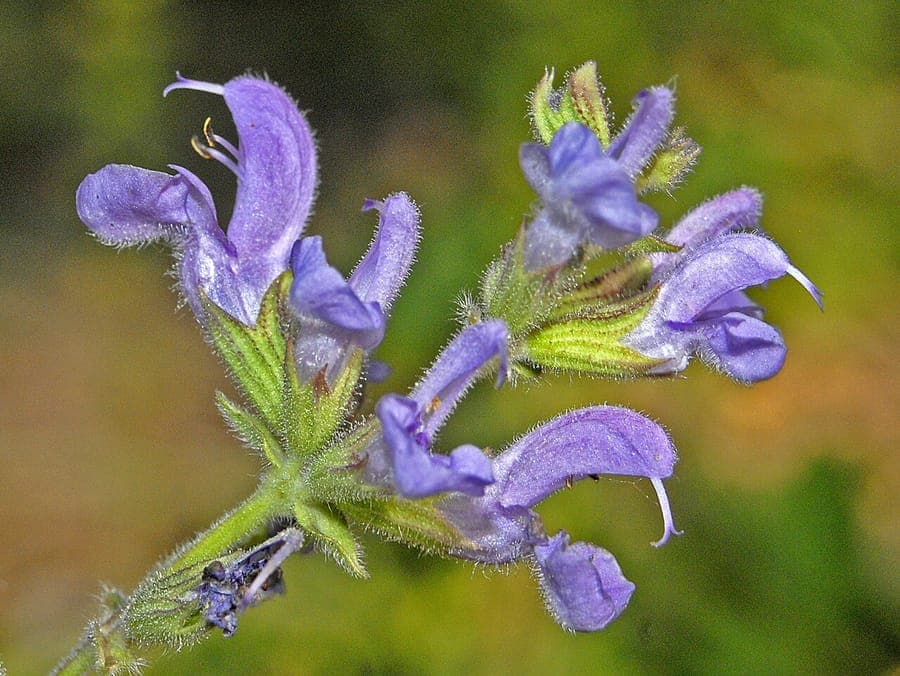
Hectonichus / CC BY-SA 3.0, via Wikimedia Commons
Meadow sage: complete guide
Salvia virgata
¿Quieres ver Meadow sage: complete guide en tu jardín?
1 minuto, sin tarjeta de crédito
Overview
Meadow sage (Salvia virgata), also known as wand sage, is an elegant perennial native to South-Eastern Europe and Central Asia. This refined herbaceous plant is celebrated for its slender, rod-like flower spikes in pink to purple, flowering for months on end.
Meadow sage is perfect for dry borders, Mediterranean gardens, and low-maintenance planting schemes. With its drought tolerance, extended blooming period, and elegant form, it meets all criteria for contemporary garden design.
Appearance and bloom
Meadow sage grows as an upright perennial with ascending stems reaching approximately 60-80 cm tall. The plant has linear to lance-shaped leaves that are grey-green. The stems are sparsely hairy and carry an air of refinement.
The flowers are small, pink to pale lavender in color, organized in long, thin flower spikes at the stem tips. These racemose blooms extend from May through September, providing very long flowering displays.
The plant is remarkably efficient regarding resource use and demands minimal feeding. Its open growth habit allows light to filter through the garden.
Ideal location
Meadow sage thrives best in full sun with at least 6+ hours of direct sunlight daily. Sunshine is essential for compact growth, floriferous blooms, and optimal color development.
Position on a dry site with good drainage. Perfect for sunny borders, Mediterranean gardens, or against south/west-facing walls. The plant tolerates no shade and stagnant moisture.
Soil
Meadow sage demands well-draining, not-rich soil. In fact, excessive soil richness can cause the plant to grow lush and bloom less. Sandy to stony soils with moderate nutrition are ideal.
PH may be neutral to slightly acidic (pH 6.0-7.5). Heavy clay must be improved with grit, sand, and turf. No extra feeding required.
Diseño gratis
¿Quieres ver Meadow sage: complete guide en tu jardín? Crea un diseño gratis ahora.
Watering
Once established, meadow sage is very drought-tolerant and requires minimal water. Regular water helps during establishment and blooming, but once established supplemental water is unnecessary.
Give deep water 2-3 times weekly during the first season. Mature plants tolerate drought well. Excess water, especially in winter, can be harmful and cause decline.
Pruning
Meadow sage requires pruning in late summer or autumn, immediately after blooming. Remove the flower spikes. Optionally, you can cut the plant back halfway in early summer to stimulate more compact growth and encourage additional side blooms.
In late winter, remove damaged or dead stems. Much pruning is not needed for this easy-to-maintain specimen.
Maintenance calendar
Spring: Plant out or divide. Prune dead material. Summer: Enjoy flowers. Tip-pruning for compact growth optional. Autumn: Prune after blooming. Reduce watering. Winter: Minimal activity. Protect in severe frost.
Winter hardiness
Meadow sage is moderately winter hardy and tolerates temperatures down to approximately -12 to -15 degrees Celsius. In Central Europe it is suitable, but in cold regions shelter may be needed.
In temperate zones it grows outdoors without protection. In northern regions, prefer to mulch with dry material or provide foot shelter in winter.
Companion plants
Meadow sage combines beautifully with other Mediterranean plants such as Lavender, Santolina, and Artemisia. Also good with Rosemary, Phlomis, and other drought-tolerant shrubs.
Ground covers such as thyme (Acinos) or Dianthus fill understory spaces. In larger compositions, add texture variation with grasses such as Festuca or Stipa.
Closing
Meadow sage is an elegant, reliable specimen for gardeners seeking extended flowering with minimal maintenance. With its refined form, durable blooms, and drought tolerance, it is ideal for contemporary gardens.
Perfect for sunny dry borders, Mediterranean-themed gardens, and low-maintenance planting schemes. Visit OBI or Hornbach in Germany for healthy plant material. More information at gardenworld.app/en and gardenworld.app/de.
¿Quieres ver Meadow sage: complete guide en tu jardín? Crea un diseño gratis ahora.
Sube una foto, elige un estilo y obtén un diseño fotorrealista con lista de plantas en menos de un minuto.
Sin tarjeta de crédito


Plantas similares
Apple mint (Mentha x villosa): complete guide
Mentha x villosa
Meet apple mint (Mentha x villosa): a fruity-scented kitchen herb with woolly leaves, perfect for tea and mojitos.
Salvia peyronii: complete guide
Salvia peyronii
Discover Salvia peyronii, a rare Lebanese mountain sage. Growing tips, hardiness, and companion planting for a Mediterranean gravel garden.
Bigleaf mint (Mentha x rotundifolia): complete guide
Mentha x rotundifolia
Discover bigleaf mint: cultivation, care tips, and garden uses. Learn how to grow this aromatic herb with soft, hairy leaves.