
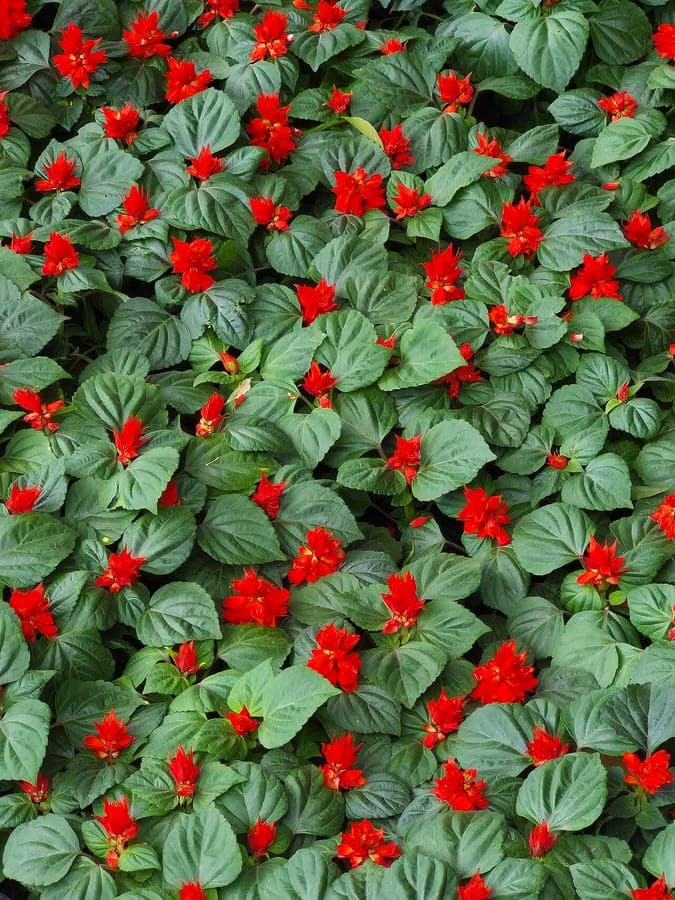
Gabriel Collares / CC BY 4.0, via Wikimedia Commons
Scarlet sage: complete guide
Salvia splendens
¿Quieres ver Scarlet sage: complete guide en tu jardín?
1 minuto, sin tarjeta de crédito
Overview
Scarlet sage (Salvia splendens) is a spectacular plant native to Brazil that has proved itself globally as a reliable, long-flowering summer annual. The plant is renowned for its intensely red to scarlet flowers that appear virtually continuously from June through October. In gardens across Netherlands, Belgium, and Germany, it's used as an essential color plant that brightens the garden for three seasons.
Appearance & bloom cycle
Scarlet sage grows as a compact, well-branched shrublet, typically 30-80 cm tall depending on cultivar. Leaves are ovate, dark green, approximately 5-10 cm long, with finely serrated edges, aromatic when touched.
Flowers are the most striking feature: brilliant red to scarlet, intensely colored. They appear in dense, upright flower spikes (racemes) approximately 15-20 cm long. Individual flowers measure about 2-3 cm, tubular, with distinct two-lipped form (bilabiate). Blooming begins in June and continues to first frost.
The plant is a hummingbird flower: the intense red color and tubular shape are perfect adaptations for hummingbirds. In Europe, the flowers primarily attract bees.
Ideal location
Plant Scarlet sage in full sun (at least 6-8 hours of direct sunlight daily). In full sun, the plant blooms abundantly and remains compact. In partial shade, it becomes leggy and blooms less.
The plant is not winter hardy in northern Europe (dead below -3°C), so it's typically grown as an annual. However, in warm regions (southern France, southern Spain, Portugal) it can persist for multiple years.
Spacing: plant approximately 30-40 cm apart for good form.
Soil requirements
Scarlet sage grows best in well-draining, nutrient-rich soil. A pH of 6.0-7.5 is ideal. In poor soils, plant growth suffers - amend with compost or well-rotted leaf mold for better development.
The plant cannot tolerate waterlogging. In wet soils, improve drainage by working in sand or grit. In containers: use standard potting soil with extra perlite for drainage.
Regular feeding promotes flowering. Simple organic bloom-promoting fertilizer applied weekly or bi-weekly ensures optimal flowers.
Diseño gratis
¿Quieres ver Scarlet sage: complete guide en tu jardín? Crea un diseño gratis ahora.
Watering
Once established, Scarlet sage requires regular water. Especially during growth and bloom (June-October), soil should be kept consistently moist - not waterlogged, but not dry.
In hot summers, daily watering may be necessary, especially in containers. Water early morning to prevent leaf diseases.
In dry periods, average 2-3 times weekly in open ground, more frequently in pots.
Pinching & deadheading
When seedlings reach 15-20 cm height, pinch out the growing tips to stimulate bushier growth. This substantially increases the number of flower spikes.
Dead-heading - removing spent flower spikes - promotes continuous blooming. Remove faded spikes to encourage new formation.
Late August/September: light pruning to maintain form. Don't prune too aggressively or you'll reduce flowering.
Maintenance calendar
May: Sow seed or transplant seedlings after last frost.
June-October: Growth and blooming period. Water regularly, deadhead, apply organic fertilizer.
July-August: Peak bloom period - the plant works at full capacity.
September-October: Blooming continues; plant can tolerate mild frost to about -1°C.
November: First hard frost kills the plant in most climates.
Propagation
Scarlet sage grows very easily from seed. Seed can be started indoors in March (germination approximately 10-14 days at 20°C warmth). Seedlings are stronger and flower earlier.
Cuttings can also be taken June-July from strong growth and rooted in carefully managed conditions. This is handy for preserving favorite cultivars.
Winter hardiness
Scarlet sage tolerates no true frost. The plant is killed at -3°C or lower. In all but the very southernmost European locations, it's therefore an annual crop.
Companion plants
Plant near:
- Silver-foliage plants: Senecio, artemisia - contrast with red.
- Blue flowers: Agapanthus, delphinium - classic color combination.
- White flowers: Gaura, white cosmos - refines the red.
- Other red bloomers: Red petunia, red begonia - unified effect.
Conclusion
Scarlet sage is an indispensable summer annual in many European gardens. The intensely red flowers appear for months, attract pollinators, and add continuity and dramatic color. Easy to grow, frost-sensitive, a true workhorse of the summer garden.
Want to create a summer garden plan with continuous color objectives? Discover on gardenworld.app how summer annuals can be optimally deployed. Find inspiration on gardenworld.app.
¿Quieres ver Scarlet sage: complete guide en tu jardín? Crea un diseño gratis ahora.
Sube una foto, elige un estilo y obtén un diseño fotorrealista con lista de plantas en menos de un minuto.
Más de 10.000 jardines diseñados
Sin tarjeta de crédito


Plantas similares
Apple mint (Mentha x villosa): complete guide
Mentha x villosa
Meet apple mint (Mentha x villosa): a fruity-scented kitchen herb with woolly leaves, perfect for tea and mojitos.
Salvia peyronii: complete guide
Salvia peyronii
Discover Salvia peyronii, a rare Lebanese mountain sage. Growing tips, hardiness, and companion planting for a Mediterranean gravel garden.
Bigleaf mint (Mentha x rotundifolia): complete guide
Mentha x rotundifolia
Discover bigleaf mint: cultivation, care tips, and garden uses. Learn how to grow this aromatic herb with soft, hairy leaves.