
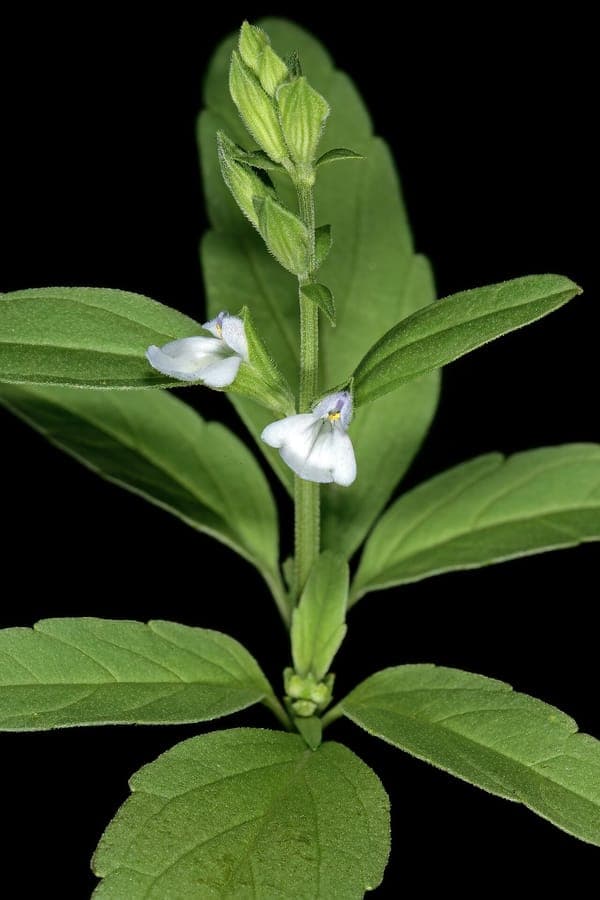
SAplants / CC BY-SA 4.0, via Wikimedia Commons
Rocky Mountain Sage: complete guide
Salvia reflexa
¿Quieres ver Rocky Mountain Sage: complete guide en tu jardín?
1 minuto, sin tarjeta de crédito
Overview
Salvia reflexa, known as Rocky Mountain Sage or Mintweed, is a native North American plant from the mint family (Lamiaceae). This resilient species grows from the Rocky Mountains through Mexico and is renowned for its adaptation to dry conditions. In gardens, it thrives in sunny, dry locations where other flowers struggle.
The plant reaches 30-60 cm in height and maintains a compact, bushy form. Despite its preference for dry soils, it generously produces blue flowers from June through October. Rocky Mountain Sage is ideal for xeriscape gardens, rock gardens, and drought-resistant plantings.
Appearance and bloom cycle
Rocky Mountain Sage has narrow, lance-shaped leaves that emit a pleasant scent when brushed. The foliage ranges from green to grey-green, giving the plant a soft appearance. The flowers are the real eye-catchers: violet-blue to deep blue, arranged in compact clusters along the stems.
The bloom period extends from June to October, providing steady color. Each flower is small but profuse, attracting native pollinators and bees. The plant remains compact without requiring pruning.
Ideal location
Rocky Mountain Sage is undemanding: full sun (6+ hours daily), warm, and dry. The plant dislikes shade or waterlogged situations. It excels in hot, sunny spots or south-facing positions against buildings.
Plant it among rocks, in rock gardens, along gravel paths, or in native plantings. It fits well in xeriscape and Mediterranean compositions. Wind is not a concern due to its compact form.
Soil requirements
Rocky Mountain Sage demands very well-draining, sandy or gravelly soil. Heavy clay almost guarantees failure. Work in minerals: gravel, sand, and grit. A pH of 6.0-8.0 is acceptable.
For container culture, use fast-draining potting mix (garden soil 30%, sand 40%, gravel 30%). Avoid heavy garden soil alone. Add compost sparingly if at all (5% maximum).
Diseño gratis
¿Quieres ver Rocky Mountain Sage: complete guide en tu jardín? Crea un diseño gratis ahora.
Watering
Rocky Mountain Sage is drought-tolerant once established. Water regularly during the first year (once weekly) until roots develop (3-6 months). Thereafter, water minimally: only during extreme drought.
In containers, water sparingly and only when soil feels dry 3+ cm down. Overwatering is fatal. In winter, no watering is needed unless actively growing.
Pruning
Rocky Mountain Sage requires minimal pruning. Remove spent flower clusters to stimulate compactness. In spring, cut back to 15-20 cm to encourage full growth.
Container plants can be kept compact through regular pinching. After flowering (October-November), cut back to 10-15 cm for overwintering.
Maintenance calendar
APRIL-MAY: Plant and water initially. JUNE-OCTOBER: Minimal maintenance, deadhead flowers. NOVEMBER-MARCH: No watering, frost protection for containers. No fertilizer needed.
Winter hardiness
Rocky Mountain Sage is reasonably frost hardy (USDA zones 5-9). In most regions, it survives outdoors on well-drained sites. In very wet winters, losses are possible. Protect with gravel or mulch against standing water.
For containers, frost protection is recommended: move indoors to a cool place (0-5 degrees Celsius) or place outside against a house wall with straw protection.
Companion plants
Combine with other drought-tolerant plants: Echinacea, Rudbeckia, lavender, Penstemon, grey Artemisia, Festuca, and Sedum. They create stunning color combinations in dry gardens.
Final thoughts
Rocky Mountain Sage is perfect for those wanting drought resistance, sun, and minimal maintenance. No watering worries, no fertilizer needed, reliable color. Available at garden centers and online retailers. Explore more xeriscape ideas at gardenworld.app.
¿Quieres ver Rocky Mountain Sage: complete guide en tu jardín? Crea un diseño gratis ahora.
Sube una foto, elige un estilo y obtén un diseño fotorrealista con lista de plantas en menos de un minuto.
Más de 10.000 jardines diseñados
Sin tarjeta de crédito


Plantas similares
Apple mint (Mentha x villosa): complete guide
Mentha x villosa
Meet apple mint (Mentha x villosa): a fruity-scented kitchen herb with woolly leaves, perfect for tea and mojitos.
Salvia peyronii: complete guide
Salvia peyronii
Discover Salvia peyronii, a rare Lebanese mountain sage. Growing tips, hardiness, and companion planting for a Mediterranean gravel garden.
Bigleaf mint (Mentha x rotundifolia): complete guide
Mentha x rotundifolia
Discover bigleaf mint: cultivation, care tips, and garden uses. Learn how to grow this aromatic herb with soft, hairy leaves.