
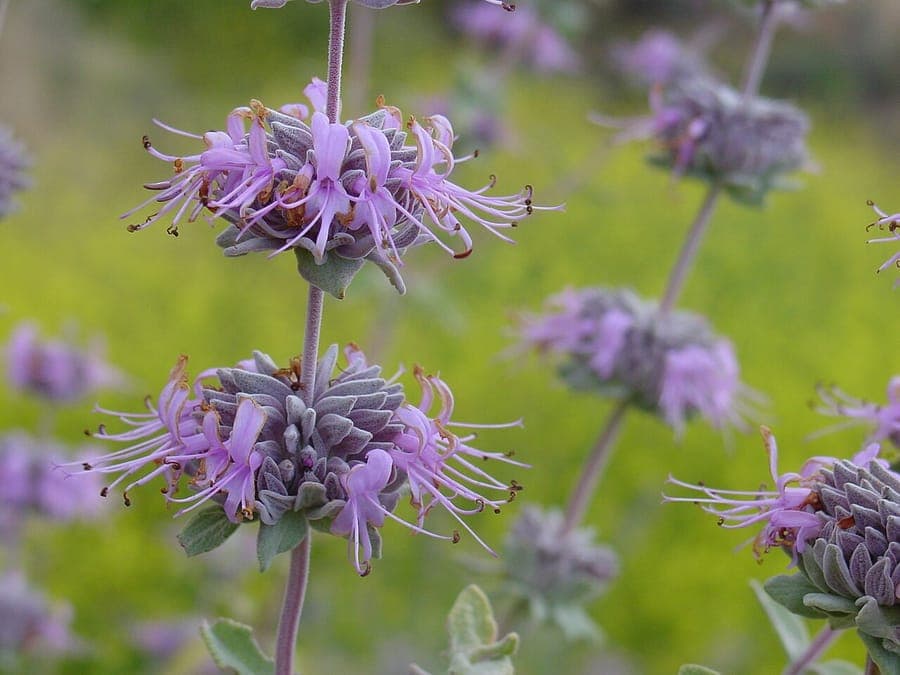
No machine-readable author provided. NoahElhardt assumed (based on copyright claims). / CC BY-SA 2.5, via Wikimedia Commons
Purple Sage: complete guide
Salvia leucophylla
¿Quieres ver Purple Sage: complete guide en tu jardín?
1 minuto, sin tarjeta de crédito
Overview
Purple Sage (Salvia leucophylla), also known as San Luis Purple Sage, is an elegant subshrub native to southwestern California and northeastern Mexico. Celebrated for its distinctive silvery foliage and delicate lavender-purple flowers, this plant is a true drought warrior that fits perfectly into modern, water-wise gardens.
In its native habitat, Purple Sage grows in dry, rocky mountain terrain where it has evolved to thrive with minimal water. In cultivation, it delivers both visual beauty and ecological benefit, attracting bees, butterflies, and other pollinators to your garden.
Appearance & bloom
Purple Sage grows as a compact, mounding subshrub reaching 60-90 cm in height and similar width. Its most striking feature is the silvery-gray, fine-textured foliage that releases a subtle aromatic fragrance when brushed.
Flowers emerge from late spring through summer in loose, airy spikes. They range from soft lavender-purple to near-white, creating beautiful contrast against the silver foliage. Each flower exhibits the characteristic asymmetrical form typical of Salvia.
Following bloom, small seeds develop and self-sow readily in favorable conditions, allowing the plant to naturally propagate throughout your garden.
Ideal location
Purple Sage thrives in full sun. Aim for at least 6 hours of direct sunlight daily; more sun encourages denser, more compact growth and abundant flowering. In partial shade, plants become leggy and bloom less profusely.
This plant excels in:
- Rooftop and container gardens
- Mediterranean and xeriscape designs
- Rock gardens and shrub borders
- Coastal settings with salt and wind exposure
Note: Avoid overly sheltered locations in coastal areas, as wind protection leads to weak, leggy growth.
Soil
The foundation for Purple Sage success is excellent drainage. This plant cannot tolerate waterlogged conditions and will quickly rot in heavy clay soils.
Ideal soil composition:
- Well-draining garden soil (avoid heavy clay)
- Addition of sand and gravel (30-40% by volume)
- Optional: perlite or volcanic ash for enhanced drainage
- pH range: neutral to slightly acidic (6-7)
Avoid: Rich, organic soils without drainage amendments, which weaken the plant.
Diseño gratis
¿Quieres ver Purple Sage: complete guide en tu jardín? Crea un diseño gratis ahora.
Watering
One of Purple Sage's major advantages is extreme drought tolerance once established.
At planting (spring or fall):
- Water thoroughly at planting
- Keep consistently moist (not waterlogged) for 4-6 weeks
Established plant (after first year):
- In average rainfall regions, supplemental water is rarely needed
- Water only during dry spells exceeding 2 weeks without rain
- In Mediterranean climates, occasional summer watering helps
Caution: This plant survives drought far better than excess moisture.
Pruning
Purple Sage responds beautifully to regular light pruning, creating a fuller, more compact form and encouraging abundant flowers.
Pruning techniques:
- Late winter/early spring (preferred): cut back to approximately one-third for vigorous new growth
- Post-bloom: remove spent flower spikes for neater appearance
- Summer: lightly reduce wayward stems
Tip: Heavy pruning during active growth may delay flowering, so prune heavily in dormancy.
Maintenance calendar
Spring (March-April)
- Perform light pruning
- Check for winter damage
- Remove dead wood
Summer (June-August)
- Monitor for drought stress (water only during extreme heat)
- Lightly prune after flowering
- No fertilizer needed
Fall (September-October)
- Prepare for winter
- Avoid pruning (strengthens plant for cold)
Winter (November-February)
- Dormant period; minimal care required
- In wet climates, verify drainage function
Winter hardiness
Purple Sage is reasonably hardy in temperate climates:
- Survives to approximately -8 to -10 degrees Celsius
- In most of northern Europe, remains evergreen
- In colder regions, twig damage likely but plant recovers
Winter protection is typically unnecessary except in far northern areas. In regions with very wet winters, mulch protection helps combat waterlogging.
Companion plants
Purple Sage works beautifully in minimalist and Mediterranean plantings:
- Rosemary (various cultivars)
- Lavender (Lavandula angustifolia)
- Santolina (Santolina chamaecyparissus)
- Oleander (in mild climates)
- Artemisia 'Powis Castle'
- Drought-tolerant sedums
Together, they create a cohesive silvery-gray palette that is water-wise and low-maintenance.
Closing
Purple Sage is an ideal choice for gardeners seeking a beautiful, frugal plant that demands minimal care. With its delicate flowers, attractive foliage, and drought resilience, it belongs in every water-conscious garden.
For more inspiration and to explore Mediterranean plant combinations, visit gardenworld.app and discover how to create a stunning, low-maintenance landscape.
¿Quieres ver Purple Sage: complete guide en tu jardín? Crea un diseño gratis ahora.
Sube una foto, elige un estilo y obtén un diseño fotorrealista con lista de plantas en menos de un minuto.
Más de 10.000 jardines diseñados
Sin tarjeta de crédito


Plantas similares
Cedar Sage: complete guide
Salvia roemeriana
Salvia roemeriana, the Cedar Sage, produces striking scarlet-red flowers that hummingbirds adore. This compact, hardy shrub blooms generously from spring through fall with minimal care, making it perfect for sunny gardens and wildlife borders.
Scullcap: complete guide
Scutellaria lateriflora
Scutellaria lateriflora, the Side-Flowering Skullcap, is a hardy North American herb with delicate purple flowers. Drought-tolerant once established and attractive to pollinators, this versatile plant thrives in both sun and partial shade gardens.