
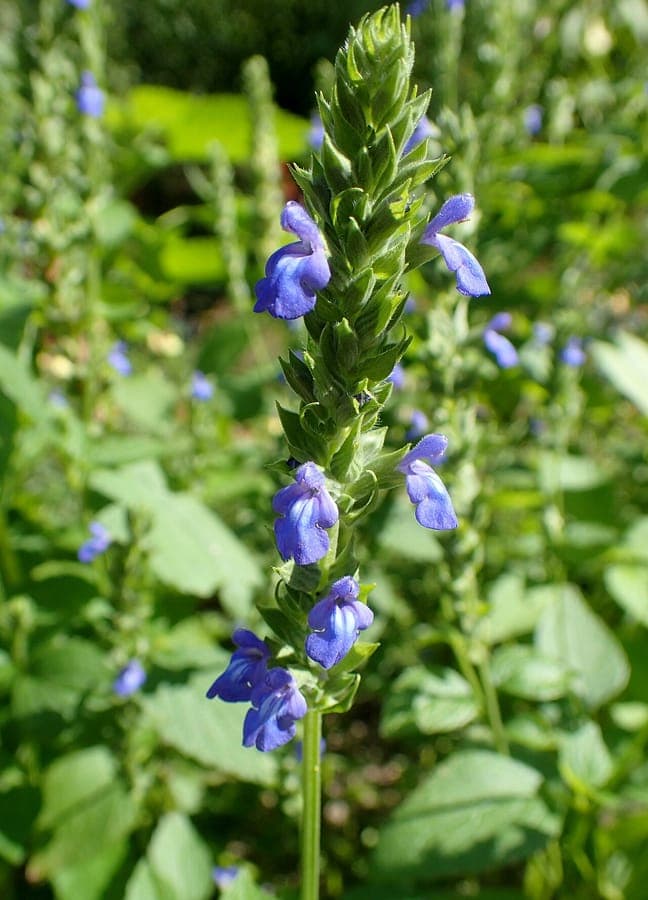
Krzysztof Ziarnek, Kenraiz / CC BY-SA 4.0, via Wikimedia Commons
Chia: complete guide
Salvia hispanica
¿Quieres ver Chia: complete guide en tu jardín?
1 minuto, sin tarjeta de crédito
Overview
Chia (Salvia hispanica) is an annual plant from Mexico and Central America that has been cultivated for centuries for its nutritious seeds. In recent years it has become popular as a 'superfood' due to its high content of omega-3 fatty acids, proteins, and minerals. Beyond nutritional value, chia also produces attractive blue or purple flowers and can be grown as an ornamental shrub in temperate climates.
Appearance & bloom cycle
Chia grows as an upright, somewhat branched plant reaching approximately 60-90 cm tall. Stems are green, lightly hairy. Leaves are ovate to lanceolate, approximately 5-10 cm long, with coarsely serrated edges, highly aromatic when touched (typical salvia scent with hints of citrus and mint).
Flowers appear July-October in dense, upright flower spikes (racemes). They are tiny, approximately 5 mm, in shades of blue, purple, or sometimes white. These blooms are highly attractive to bees and other pollinators.
After flowering, seed capsules (nutlets) form with two seeds per compartment. Seeds are small (approximately 2 mm), glossy black or gray.
Ideal location
Plant chia in full sun (at least 6-8 hours of direct sunlight daily). The plant grows rapidly and vigorously in warm, sunny conditions. In cooler climates, growth may be slower and flowering later in the season.
Chia is not winter hardy in most European winters (marginally to zone 9), so it's typically grown as an annual crop. In very mild regions (southern France, southern Spain) it may survive to spring.
Spacing: plant approximately 30-45 cm apart for good air circulation.
Soil requirements
Chia is not particularly fussy about soil type and grows on many different soils. It performs best, however, on well-draining, dry to moderately moist soil. A pH of 6.0-7.5 is ideal.
For optimal growth: amend with compost or organic material for better moisture retention in sandy soils. In very wet soils, drainage must be improved (it dislikes wet feet).
Chia prefers nutrient-rich soils but not excessively - excess nitrogen leads to too much foliage and fewer flowers.
Diseño gratis
¿Quieres ver Chia: complete guide en tu jardín? Crea un diseño gratis ahora.
Watering
Once established, chia requires relatively little water in temperate climates. Regular watering is essential for the first 4-6 weeks after planting. Once rooted, water when soil is dry 5 cm deep.
From July-October, when the plant flowers and produces seeds, water more regularly, but avoid waterlogging - drainage must always be good.
Pinching & training
When plants reach 15-20 cm height, pinch out the growing tips to stimulate bushier growth. This increases the number of flower spikes and seed yield.
Further pruning is typically not needed. Dead or damaged parts can simply be removed.
Maintenance calendar
May: Sow seed or transplant seedlings after last frost.
June: Growth accelerates; pinch tips for bushier form.
July-October: Flowering period; water regularly, allow pollinators.
October-November: Seeds ripen; plant withdraws nutrients from leaves.
November: Harvest seed when dry; remove plant after first frost.
Seed harvest
Seeds can be harvested when flower spikes turn tan and the plant weakens. Seed capsules dry out. Seed can be rubbed from dried flower spikes and sifted.
Roughly 1-1.5 kg seed per plant is typically harvested under good conditions.
Winter hardiness
Chia tolerates no true frost. The plant is killed at -2°C or lower. In all but the southernmost European locations, it's therefore an annual crop. However, seeds can be saved over winter for the next season.
Companion plants
Plant near:
- Other herbs: Marjoram, oregano - same sunny preference.
- Dry-soil gardens: Lavender, sage, rosemary.
- Flower gardens: Zinnia, cosmos - both love sun and heat.
Conclusion
Chia offers a unique combination of practical nutritional value - flavorful, nourishing seeds - and ornamental appeal. The plant is easy to grow and rewards the gardener with abundant flowers and seed in autumn. For gardeners in temperate climates, it offers an enjoyable way to produce their own superfoods.
Want to integrate medicinal and food plants into your garden? Discover how gardenworld.app helps you plan a herb and food garden. Find inspiration on gardenworld.app.
¿Quieres ver Chia: complete guide en tu jardín? Crea un diseño gratis ahora.
Sube una foto, elige un estilo y obtén un diseño fotorrealista con lista de plantas en menos de un minuto.
Más de 10.000 jardines diseñados
Sin tarjeta de crédito


Plantas similares
Apple mint (Mentha x villosa): complete guide
Mentha x villosa
Meet apple mint (Mentha x villosa): a fruity-scented kitchen herb with woolly leaves, perfect for tea and mojitos.
Salvia peyronii: complete guide
Salvia peyronii
Discover Salvia peyronii, a rare Lebanese mountain sage. Growing tips, hardiness, and companion planting for a Mediterranean gravel garden.
Bigleaf mint (Mentha x rotundifolia): complete guide
Mentha x rotundifolia
Discover bigleaf mint: cultivation, care tips, and garden uses. Learn how to grow this aromatic herb with soft, hairy leaves.