
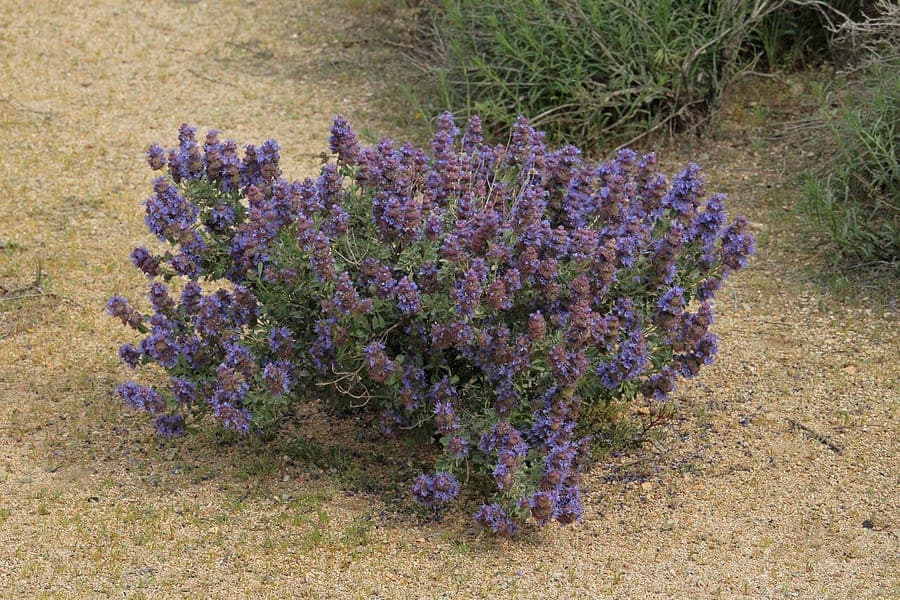
Walter Siegmund (talk) / CC BY-SA 4.0, via Wikimedia Commons
Purple sage: complete guide
Salvia dorrii
¿Quieres ver Purple sage: complete guide en tu jardín?
1 minuto, sin tarjeta de crédito
Overview
Salvia dorrii, commonly known as purple sage, is a native North American shrub from the Lamiaceae family. This grey-leaved subshrub occurs naturally in the arid mountains of Arizona, California, Idaho, Nevada, Oregon, Utah and Washington. It represents an excellent choice for xeric gardens and water-wise landscaping schemes.
Appearance & bloom
Purple sage forms a dense mound typically 30 to 45 centimeters tall and equally wide. The stems are woody at the base with numerous fine-hairy, grey-green leaves that give the plant its distinctive silvery appearance. Flowers emerge from late spring through early summer, typically April to June. They are purple to blue in color and arranged in slender spikes atop the stems.
Ideal location
Purple sage thrives in full sun, requiring a minimum of six hours of direct sunlight daily. Select a location with good air circulation. Group multiple specimens for maximum landscape impact. This shrub excels in Mediterranean gardens, slopes with limited water, and rock gardens.
Soil
Purple sage requires exceptionally well-draining soil. Heavy clay soils should be amended with coarse sand, gravel before planting. The optimal soil pH ranges from 6.5 to 8.0. The plant performs best in lean, rocky soil with minimal organic matter.
Diseño gratis
¿Quieres ver Purple sage: complete guide en tu jardín? Crea un diseño gratis ahora.
Watering
Once established, purple sage is extremely drought-tolerant. During the first growing season, water regularly to encourage root establishment. After establishment, water is rarely needed except during extreme drought. Monitor soil moisture during spring and early summer.
Pruning
Prune lightly in late winter or early spring to maintain shape. Cut back by approximately half to encourage fuller branching. If the plant becomes overgrown, cut back to basal wood. This promotes vigorous new growth in the growing season.
Maintenance calendar
Spring: Prepare site, amend soil, plant early. May-June: Weed regularly, water weekly. July-August: Apply light mulch, water as needed. Autumn: Light pruning. Winter: Minimal care needed.
Winter hardiness
Purple sage is hardy to USDA zone 5, tolerating -29 degrees Celsius. Young plants may benefit from winter mulch. Established plants are quite hardy and will resprout from the root crown.
Companion plants
Combine with other drought-tolerant plants: Lavandula (lavender), Festuca glauca (blue fescue), Santolina chamaecyparissus, Phlomis fruticosa, Helichrysum italicum. Plant in groups of three to five for visual impact.
Closing
Salvia dorrii offers both practical and aesthetic value for water-conscious gardeners. Its low maintenance requirements, extreme drought tolerance and distinctive silvery texture make it excellent for sustainable landscape design. Discover purple sage at gardenworld.app for water-efficient gardens.
¿Quieres ver Purple sage: complete guide en tu jardín? Crea un diseño gratis ahora.
Sube una foto, elige un estilo y obtén un diseño fotorrealista con lista de plantas en menos de un minuto.
Más de 10.000 jardines diseñados
Sin tarjeta de crédito


Plantas similares
Apple mint (Mentha x villosa): complete guide
Mentha x villosa
Meet apple mint (Mentha x villosa): a fruity-scented kitchen herb with woolly leaves, perfect for tea and mojitos.
Salvia peyronii: complete guide
Salvia peyronii
Discover Salvia peyronii, a rare Lebanese mountain sage. Growing tips, hardiness, and companion planting for a Mediterranean gravel garden.
Bigleaf mint (Mentha x rotundifolia): complete guide
Mentha x rotundifolia
Discover bigleaf mint: cultivation, care tips, and garden uses. Learn how to grow this aromatic herb with soft, hairy leaves.