
Ernie Wasson / CC BY 3.0, via Wikimedia Commons
Sabra-spike Sage: complete guide
Salvia confertiflora
¿Quieres ver Sabra-spike Sage: complete guide en tu jardín?
1 minuto, sin tarjeta de crédito
Overview
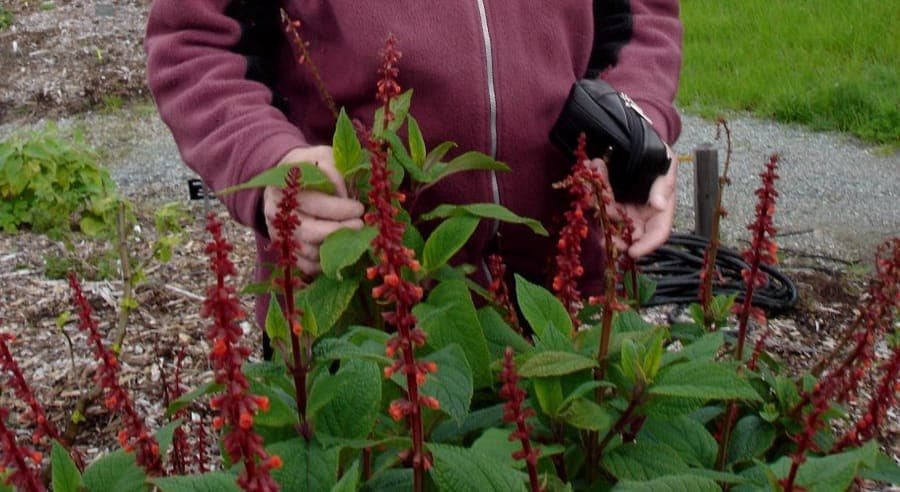
Salvia confertiflora, known as Sabra-spike sage or Gedrängter Salbei in German, is a frost-tender sage native to southeast Brazil. This intriguing shrub is renowned for its dense, stacked flower spikes in warm reddish-brown to rusty-orange tones. Unlike many North American salvias, confertiflora thrives best in warm climates and cannot overwinter outdoors in temperate zones. That said, it grows beautifully as a container plant that can be brought indoors seasonally, making it accessible even to northern gardeners.
Appearance and Bloom
The Sabra-spike sage grows as a compact shrublet, typically 60-100 cm tall, with narrow, dark green foliage. The true character lies in the flowers: densely packed, two-lipped spikes in reddish-brown to rusty-orange hues. The name "confertiflora" literally means "crowded flower," referring to how tightly individual flowers pack into dense spikes. This gives a unique, almost sculptural appearance compared to more open salvias.
Flowers appear throughout the warm season (June-October in temperate climates, nearly year-round in tropics). They are attractive to hummingbirds and nectar-feeding birds.
Ideal Location
Warm location, ideally 20-25 C or warmer. Full sun to part-shade in very hot climates. Outside suitable outdoor zones: grow as a container plant in a greenhouse, conservatory, or on a warm terrace during summer and autumn. In southern France (Cote d'Azur region), it can grow outdoors with winter protection in mild winters.
Diseño gratis
¿Quieres ver Sabra-spike Sage: complete guide en tu jardín? Crea un diseño gratis ahora.
Soil
Well-draining, slightly richer potting or garden soil with 30% organic matter. This Brazilian sage enjoys consistent moisture without waterlogging. pH 6-7. For container cultivation: use standard multi-purpose compost.
Watering
From spring through autumn, water regularly to keep soil evenly moist (not waterlogged). In winter, as the plant enters dormancy, significantly reduce watering. Container plants need more frequent watering than in-ground specimens.
Pruning
Prune compactly in spring to maintain a full shape. Excessive pruning can delay flowering. Lightly cut back after bloom ends.
Maintenance Calendar
May: Place outside (in temperate zones) or begin full growth in warmth. Water regularly. June-October: Full bloom. Water consistently. Feed monthly. November: Reduce water. Move indoors (in temperate zones). December-April: Winter dormancy indoors (10-15 C). Light watering.
Winter Hardiness
Zone 9b-11. Not winter-hardy in the UK, northern France, Germany, or similar climates. Must be brought indoors in winter or treated as an annual and replaced yearly. This makes it less suitable for temperate gardens unless you are prepared to overwinter it indoors.
Companion Plants
As a container plant: Verbena, Calibrachoa, Helichrysum (silvery foliage). In warm gardens: other tropical salvias, cannas, dahlias.
Find stock at specialized online nurseries or tropical plant suppliers.
Closing
Salvia confertiflora is a unique, tropical sage for those who love warm tones and exotic appeal. Treat it as a summer container specimen or plant it in very warm, southern regions. For temperate climates, plan to overwinter it indoors.
¿Quieres ver Sabra-spike Sage: complete guide en tu jardín? Crea un diseño gratis ahora.
Sube una foto, elige un estilo y obtén un diseño fotorrealista con lista de plantas en menos de un minuto.
Más de 10.000 jardines diseñados
Sin tarjeta de crédito


Plantas similares
Apple mint (Mentha x villosa): complete guide
Mentha x villosa
Meet apple mint (Mentha x villosa): a fruity-scented kitchen herb with woolly leaves, perfect for tea and mojitos.
Salvia peyronii: complete guide
Salvia peyronii
Discover Salvia peyronii, a rare Lebanese mountain sage. Growing tips, hardiness, and companion planting for a Mediterranean gravel garden.
Bigleaf mint (Mentha x rotundifolia): complete guide
Mentha x rotundifolia
Discover bigleaf mint: cultivation, care tips, and garden uses. Learn how to grow this aromatic herb with soft, hairy leaves.