
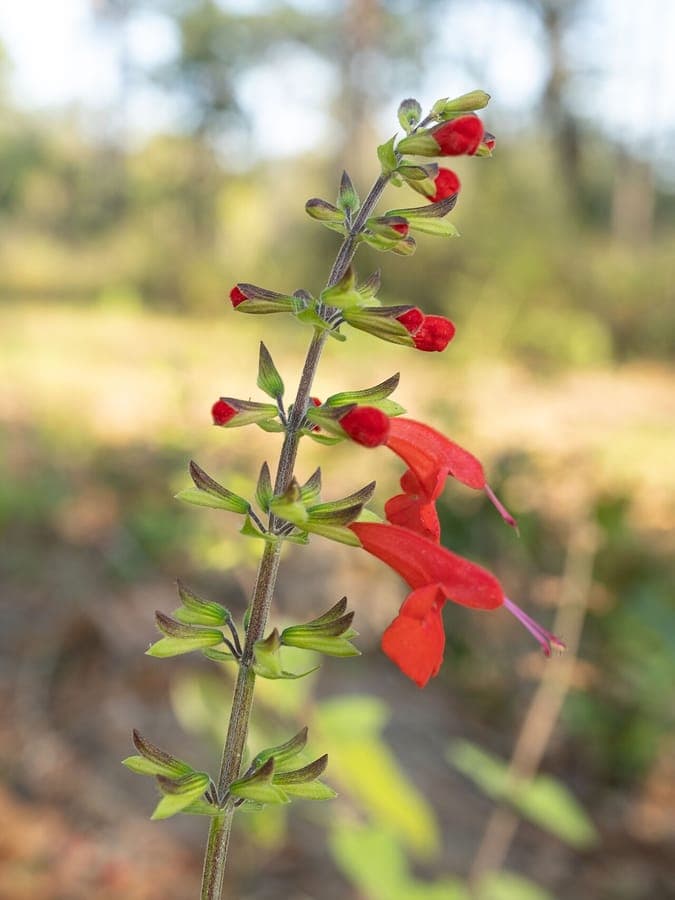
Alex Abair / CC BY 4.0, via Wikimedia Commons
Texas Sage: complete guide
Salvia coccinea
¿Quieres ver Texas Sage: complete guide en tu jardín?
1 minuto, sin tarjeta de crédito
Overview
Salvia coccinea, commonly known as Texas Sage, is a vibrant flowering plant from the mint family (Lamiaceae). This North and South American native produces stunning scarlet-red flowers throughout the growing season. In temperate regions, it thrives as a summer annual or perennial in containers.
The plant reaches 60-90 cm tall and maintains a compact growth habit. With a long blooming period from June to October and hummingbird-attracting flowers, Texas Sage is ideal for wildlife gardens. Its easy care requirements make it perfect for both beginner and experienced gardeners.
Appearance and bloom cycle
Texas Sage displays narrow, lance-shaped leaves that densely clothe the stems. The foliage is soft-textured and aromatic when crushed. The flowers are the showstopper: brilliant scarlet to coral-red, arranged in loose terminal spikes.
Bloom time extends from June through October, providing reliable color during late summer and fall. Each flower reaches about 2 cm long and attracts hummingbirds and pollinators consistently. The plant's compact form means it never gets leggy or overgrown.
Ideal location
Texas Sage performs best in full sun positions receiving at least 6 hours of direct sunlight daily. More sun equals more prolific flowering. In cooler climates, afternoon shade is tolerated but reduces bloom output.
The plant suits front borders, mixed beds, and containers on patios or balconies. It handles wind exposure well due to its sturdy stems. Urban gardens and exposed seaside locations pose no problems.
Soil requirements
Texas Sage demands well-draining soil. Heavy clay or waterlogged sites cause root rot, so amend with sand, perlite, or grit if necessary. A pH between 6.0 and 7.5 is optimal.
For container growing, use a 1:1 mix of garden soil and potting compost with added perlite for drainage. Incorporate compost for nutrients. Avoid pure sand or pure peat mixes.
Diseño gratis
¿Quieres ver Texas Sage: complete guide en tu jardín? Crea un diseño gratis ahora.
Watering
Texas Sage is moderately thirsty. Water when the soil surface feels dry 2-3 cm down. During the growing season (May-October), water twice to three times weekly depending on weather and temperatures.
Overwatering is the primary killer. Check container plants daily during hot spells. In winter, reduce watering to minimal. Established plants tolerate short dry spells, especially if mulched.
Pruning
Texas Sage responds excellently to pruning. Cut back to 20 cm in spring (March-April) to encourage full, compact growth. During the season, deadhead spent flower spikes to stimulate continuous blooming.
Container-grown plants can overwinter indoors at temperatures above 10 degrees Celsius. Prune before winter dormancy to 30 cm height.
Maintenance calendar
FEBRUARY-MARCH: Prune and shape. Plant outdoors after frost danger passes. APRIL-MAY: Check irrigation setup, apply organic fertilizer. JUNE-OCTOBER: Water regularly, remove spent flowers. NOVEMBER-JANUARY: Reduce watering, protect from frost.
Winter hardiness
Texas Sage is not winter hardy in cold climates (USDA zones 9-11). In most temperate regions, plants are treated as annuals outdoors or overwintered indoors on a cool, bright shelf at 8-15 degrees Celsius. In containers, they can be brought inside after the first frost.
Companion plants
Pair Texas Sage with other summer bloomers: blue Salvia nemorosa, lavender, roses, purple Echinacea, golden Coreopsis, fine-textured Artemisia, and silvery-grey foliage plants. Works beautifully in mixed borders with sun-loving companions.
Final thoughts
Texas Sage delivers vibrant color with minimal effort. Perfect for gardeners wanting hummingbird-attracting plants without fuss. Find it at specialty garden centers and online retailers. Discover more garden design ideas at gardenworld.app.
¿Quieres ver Texas Sage: complete guide en tu jardín? Crea un diseño gratis ahora.
Sube una foto, elige un estilo y obtén un diseño fotorrealista con lista de plantas en menos de un minuto.
Más de 10.000 jardines diseñados
Sin tarjeta de crédito


Plantas similares
Apple mint (Mentha x villosa): complete guide
Mentha x villosa
Meet apple mint (Mentha x villosa): a fruity-scented kitchen herb with woolly leaves, perfect for tea and mojitos.
Salvia peyronii: complete guide
Salvia peyronii
Discover Salvia peyronii, a rare Lebanese mountain sage. Growing tips, hardiness, and companion planting for a Mediterranean gravel garden.
Bigleaf mint (Mentha x rotundifolia): complete guide
Mentha x rotundifolia
Discover bigleaf mint: cultivation, care tips, and garden uses. Learn how to grow this aromatic herb with soft, hairy leaves.