
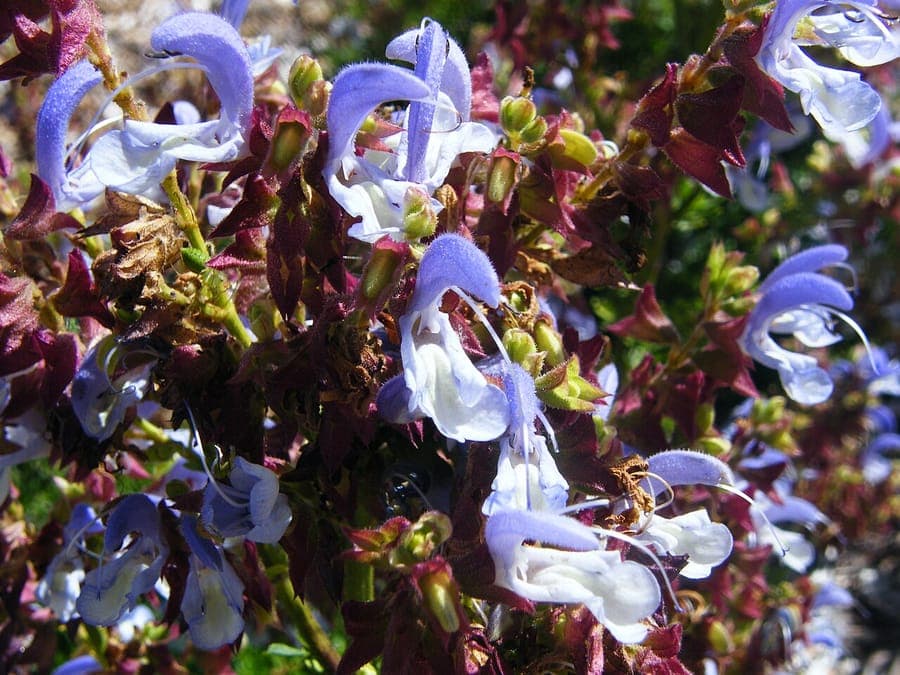
Andrew massyn / CC BY-SA 3.0, via Wikimedia Commons
False blue sage: complete guide
Salvia chamelaeagnea
¿Quieres ver False blue sage: complete guide en tu jardín?
1 minuto, sin tarjeta de crédito
Overview
Salvia chamelaeagnea, commonly known as false blue sage, is a fascinating shrub native to the Cape in South Africa. Despite its name, this plant produces primarily yellow to orange-red flowers with remarkable seasonal color variations. This southern hemisphere jewel is popular in Mediterranean gardens and in areas with Mediterranean climates.
As part of the Lamiaceae family, Salvia chamelaeagnea shares many characteristics with Mediterranean salvias. With a typical height of 60 to 90 centimeters and a spread that is sometimes equal to the height, this plant forms an attractive shrub for mid-sized gardens.
Appearance and bloom
The leaves of false blue sage are green to gray-green, smooth, and elongated, approximately 2 to 4 centimeters long. When touched or damaged, they emit a pleasant herbal fragrance, though less strong than white sage.
The flowers are the highlight of this plant. They appear in elongated, dense spikes in wonderful gradations from yellow to orange to orange-red. This is a sort of chameleon effect where individual flowers can change color as they age. Blooming extends from spring through autumn, with peak flowering in summer.
Each flower is approximately 1.5 centimeters long and features a distinctive two-lipped shape. After flowering, small seeds form. The entire plant retains green foliage throughout the year.
Ideal location
False blue sage thrives in full sun to light partial shade. For best flowering, ensure at least 5 to 6 hours of direct sunlight daily. In very hot climates, some afternoon or late-afternoon protection can help.
The plant is very drought-resistant and feels at home in well-drained, windy locations. In border and specimen plantings, some protection from very strong winds can be helpful. Avoid full shade.
False blue sage can also be successfully grown in pots, provided they are sufficiently large (at least 40 centimeters diameter). This makes this plant suitable for patios and terraces.
Soil
Salvia chamelaeagnea makes minimal demands on soil minerals. The plant grows on both clay and sandy soils, provided they drain well. This is one of its greatest advantages in Mediterranean planting schemes.
The ideal pH is neutral to slightly acidic (6.0-7.5). In very heavy clay soils, improve drainage by adding sand or gravel. Waterlogging is problematic.
Fertilization is minimally needed. Once per season, a light organic feeding can help, but this is not essential. In pot cultures, occasional feeding can be positive.
Diseño gratis
¿Quieres ver False blue sage: complete guide en tu jardín? Crea un diseño gratis ahora.
Watering
During the growing season, especially in very dry periods, apply moderate amounts of water. Once every two weeks is usually sufficient once the plant is established. Young planted specimens need more water until roots are deeply established.
In humid climates or during rainy periods, supplemental water may not be needed. The plant is very tolerant of drought once well-grown.
In autumn and winter, reduce drastically. Let the plant grow nearly dry. Excessive water leads to root rot.
Pruning
False blue sage tolerates regular pruning and responds well to cutting back. In early spring, the plant can be cut back to about two-thirds for a more compact growth habit.
After flowering, spent flower spikes can be carefully removed. This promotes secondary flowering. Old, woody stems can be carefully removed.
Summer pruning helps keep the plant fuller and bushier. Avoid heavy pruning in autumn.
Maintenance calendar
Winter: Minimal irrigation. Pruning and shaping in early spring. Spring: Water as growth begins. Light feeding. Check for damage. Summer: Regular, moderate watering. Remove spent flower spikes. Possibly provide light protection in very hot climates. Autumn: Reduce watering as the plant goes dormant. Winter preparation.
Winter hardiness
Salvia chamelaeagnea is winter-hardy in most subtropical to Mediterranean climates. In USDA zones 8-11, the plant can remain outside. In cold zones (warmer than -5 degrees Celsius), the plant can be heavily damaged.
In climates colder than -5 degrees Celsius, the plant deserves protection or must be grown in pots for overwintering capacity. Winter protection can also be provided through mulching and screening.
In very cold areas, container cultivation with winter relocation to a sheltered location is advisable.
Companion plants
False blue sage combines beautifully with:
- Other yellow or orange-flowering plants for color harmony
- Gray-foliaged plants like Artemisia or Senecio
- Lavender for purple accents
- Yellow roses or coreopsis
- Sedum and other succulents
- Mediterranean grasses
The warm flower tones pair well with silver-gray foliage colors.
Closing thoughts
False blue sage is an exotic choice for those seeking something different in their garden. The changing flower colors, long-lasting flower production, and minimal maintenance requirements make this a special specimen. Available at specialized garden centers that offer South African plantings.
With structural pruning and moderate watering, this South African jewel will shine in bloom for many seasons. Visit gardenworld.app for more inspiration about South African plant design. Make your garden a tropical oasis with Salvia chamelaeagnea.
¿Quieres ver False blue sage: complete guide en tu jardín? Crea un diseño gratis ahora.
Sube una foto, elige un estilo y obtén un diseño fotorrealista con lista de plantas en menos de un minuto.
Más de 10.000 jardines diseñados
Sin tarjeta de crédito


Plantas similares
Apple mint (Mentha x villosa): complete guide
Mentha x villosa
Meet apple mint (Mentha x villosa): a fruity-scented kitchen herb with woolly leaves, perfect for tea and mojitos.
Salvia peyronii: complete guide
Salvia peyronii
Discover Salvia peyronii, a rare Lebanese mountain sage. Growing tips, hardiness, and companion planting for a Mediterranean gravel garden.
Bigleaf mint (Mentha x rotundifolia): complete guide
Mentha x rotundifolia
Discover bigleaf mint: cultivation, care tips, and garden uses. Learn how to grow this aromatic herb with soft, hairy leaves.