
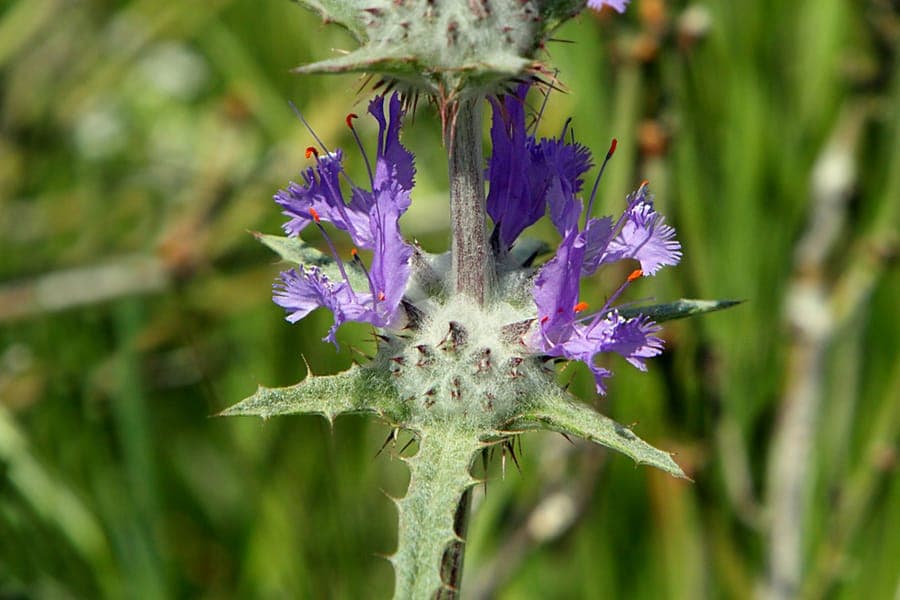
Alan Vernon / CC BY 2.0, via Wikimedia Commons
Salvia carduacea: complete guide
Salvia carduacea
¿Quieres ver Salvia carduacea: complete guide en tu jardín?
1 minuto, sin tarjeta de crédito
Overview
Salvia carduacea, the thistle sage, is a remarkable annual sage from California with striking purple-blue flowers and distinctive thistle-like spiny foliage. This fascinating plant reaches 30-60 cm in height and blooms from May through September. Thistle sage thrives in hot, dry conditions with minimal care. This unique specimen attracts hummingbirds and bees abundantly and forms an incomparable focal point in gravel gardens, Mediterranean-style borders, and drought-tolerant plantings. Thistle sage is truly a distinctive choice for adventurous gardeners.
Appearance & Bloom
The plant produces a dense rosette of grey-green, intricately lobed leaves resembling thistle foliage, with sharp prickles and wavy margins. Stems are sturdy and upright, with sparse leaf arrangement. The flowers are highly distinctive: they form dense, elongated spikes of approximately 8-10 cm composed of purple-blue-violet tubular flowers. Each bloom measures 1-1.5 cm, two-lipped, and exceptionally refined in structure. Flowering extends from May through September, particularly impressive in groups.
Ideal Location
Salvia carduacea thrives optimally in full sun (6-8+ hours daily), warm, sheltered locations with preference for south-southwest exposure. Partial shade drastically reduces blooms and encourages thin growth. Avoid wet, windy sites and select sheltered, warm corners where Mediterranean conditions prevail. Climates where average summer temperatures exceed 20 degrees Celsius are ideal.
Soil
Thistlesage grows best in very well-draining, preferably sandy or loamy soil. Heavy clay and waterlogged soils are completely unsuitable without significant amendment. Add generous sand (30-40%), gravel, and perlite for optimal drainage and aeration. pH may range from 6.5 to 8.0 (neutral to slightly alkaline). This plant accepts poor soil without difficulty; indeed, rich soils may encourage lush, less-flowering growth.
Watering
Sow or plant young specimens well-established and water thoroughly for the first 4-6 weeks until root development. Thereafter reduce significantly to sparse watering only during dry spells (exceeding 3 weeks without rain). Mature plants tolerate severe drought without visible damage. Overwatering promotes root rot and is fatal; ensure excellent drainage and minimal moisture input.
Diseño gratis
¿Quieres ver Salvia carduacea: complete guide en tu jardín? Crea un diseño gratis ahora.
Pruning
Pruning is minimally required. For more compact growth, pinch back the top 15-20 cm mid-June, stimulating lateral branching and more flowers. After frost damage, remove the plant; because it is an annual, it will spread seed for next season. Seed pods can be harvested for spring sowing.
Maintenance Calendar
April-May: Sow seeds directly or plant seedlings. May-June: Growth follows; pinch for compact form (optional). June-August: Full bloom; water sparingly. August-September: Continuous flowering; allow plant to set seed. October: Plant expires at first frost; remove or allow natural seeding. November-February: Rest; dormancy.
Winter Hardiness
Salvia carduacea is an annual plant and will not survive hard frost; it will expire at first freeze. This is normal and expected; seed from dead plants will germinate next spring. In very mild climates (coastal southern regions), the plant may sometimes overwinter. For continuity, sow in early spring or autumn (September-October) for next season.
Plant Combinations
Thistlesage forms enchanting pairings with: (1) silver Artemisia, Santolina, or grey Senecio for textural contrast; (2) low yellow Helianthemum or orange Eschscholzia for warmth; (3) other drought-tolerant plants like Eryngium, Echinops, and yellow Coreopsis; (4) purple-red Dianthus, Gaura, or white Gaura lindheimeri; (5) grey-green Ruta or Teucrium for classic Mediterranean appeal.
Closing Remarks
Salvia carduacea is a truly unique plant for those with dry, sunny garden ground and experimental spirit. This Californian beauty imparts an exotic, Mediterranean flair to any design. In drought gardens, gravel beds, or Mediterranean plantings, it is absolutely essential. Sow seeds readily in spring and enjoy this enchanting bloom. For seeds or young plants, consult local seed suppliers or garden centers; thistle sage is rapidly gaining popularity. Visit gardenworld.app for Mediterranean garden design inspiration featuring this distinctive sage.
¿Quieres ver Salvia carduacea: complete guide en tu jardín? Crea un diseño gratis ahora.
Sube una foto, elige un estilo y obtén un diseño fotorrealista con lista de plantas en menos de un minuto.
Más de 10.000 jardines diseñados
Sin tarjeta de crédito


Plantas similares
Apple mint (Mentha x villosa): complete guide
Mentha x villosa
Meet apple mint (Mentha x villosa): a fruity-scented kitchen herb with woolly leaves, perfect for tea and mojitos.
Salvia peyronii: complete guide
Salvia peyronii
Discover Salvia peyronii, a rare Lebanese mountain sage. Growing tips, hardiness, and companion planting for a Mediterranean gravel garden.
Bigleaf mint (Mentha x rotundifolia): complete guide
Mentha x rotundifolia
Discover bigleaf mint: cultivation, care tips, and garden uses. Learn how to grow this aromatic herb with soft, hairy leaves.