
Marco Schmidt [1] / CC BY-SA 2.5, via Wikimedia Commons
Salicornia europaea: complete guide
Salicornia europaea
¿Quieres ver Salicornia europaea: complete guide en tu jardín?
1 minuto, sin tarjeta de crédito
Salicornia europaea: Complete Guide
Overview
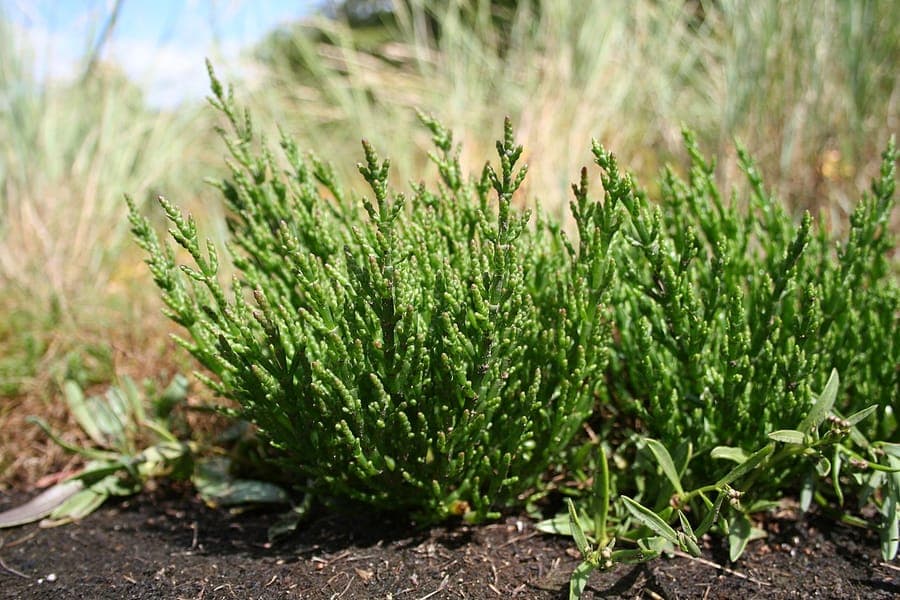
Salicornia europaea L., known as Common Glasswort or Marsh Samphire, is a fascinating halophytic plant from the Amaranthaceae family. This plant grows naturally in the Netherlands and other coastal areas of northern and western Europe. The plant is completely adapted to saltwater habitats and grows along salt marshes, seashores, and other saline environments. The plant has succulent, greenish-red colored stems that turn red in autumn.
Appearance and Bloom
Salicornia europaea is a small, upright-growing annual plant that usually reaches 15-50 cm in height. The plant has no true leaves, but instead has fleshy, triangular stem segments that are very characteristic. These stems are green in summer and greenish-red, yellow, or completely red in autumn, providing a beautiful ornamental effect. The flowers are small and inconspicuous, built into the stem. Blooming occurs from August to October. After flowering, small seeds develop that can be stored.
Ideal Location
Salicornia europaea grows best in completely sunny locations along saltwater or on salt-loving soils. The plant tolerates high salt concentrations well that other plants cannot tolerate. Place the plant on bare, salt-rich shores. In gardens or coastal areas, you can also place the plant on roofs or raised beds with saline soils. The plant should not be placed in shade.
Soil
Salicornia europaea actually thrives in saline, muddy soil such as along coasts and saline lakes. The plant has no soil preference except that it must be salty. Pure sand can be supplemented with mud and salt. A mixture of seawater or salt-saturated soil gives optimal growth. The plant cannot grow in fresh water. Regular water monitoring ensures salt balance.
Diseño gratis
¿Quieres ver Salicornia europaea: complete guide en tu jardín? Crea un diseño gratis ahora.
Watering
As a salt-loving plant, Salicornia europaea thrives under salt water. In a coastal garden, you can regularly spray or water with seawater. In artificial culture, you create salt water by adding salt to water. The plant requires a lot of water in the growing season but can tolerate drought somewhat better than many freshwater plants. A pH of 7-7.5 is ideal. In very dry periods, water may be given.
Pruning
Pruning Salicornia europaea is not necessary because the plant remains small and retains its natural form. The plant is annual, so after the season it dies off. Remove dead plant parts if they appear. Seeds can be collected for the next season. The plant cannot be overwintered in cold climates.
Maintenance Calendar
May-June: Plant seeds in saline soil. Water with seawater. July-August: Plant grows rapidly. Ensure saltwater availability. August-October: Flowering and seed formation. Collect seeds. November-April: Plant dies in cold. Store seeds for next year.
Winter Hardiness
Salicornia europaea is not winter-hardy in cold climates. The plant is annual and dies off after winter. In very warm areas, the plant can resow itself naturally. In temperate zones, you must collect seeds and resow next season. The plant tolerates some frost if the root zone is protected with snow.
Companion Plants
Salicornia europaea grows naturally with other salt-loving plants such as sea aster and glasswort. Together these plants form a true salt marsh vegetation. In artificial settings, you can combine the plant with other halophytes for authentic coastal ecosystem effect. Avoid combining with freshwater plants.
Closing Remarks
Salicornia europaea is a unique plant for special garden situations, especially coasts and saltwater environments. The plant requires salt to grow well. The beautiful seasonal color change from green to red is a natural spectacle. Visit gardenworld.app for more special plants for extreme garden situations. Or check gardenworld.app for more garden ideas!
¿Quieres ver Salicornia europaea: complete guide en tu jardín? Crea un diseño gratis ahora.
Sube una foto, elige un estilo y obtén un diseño fotorrealista con lista de plantas en menos de un minuto.
Más de 10.000 jardines diseñados
Sin tarjeta de crédito


Plantas similares
Bassia laniflora (woolly summer-cypress): complete guide
Bassia laniflora
Full guide to Bassia laniflora: origin, appearance, ideal location, soil, watering and care for this drought-tolerant annual.
Suaeda spicata: complete guide
Suaeda spicata
Everything about Suaeda spicata (spiked seablite): a rare salt-tolerant coastal succulent from the western Mediterranean and Macaronesia.
California amaranth: complete guide
Amaranthus californicus
Full guide to California amaranth (Amaranthus californicus): growing tips, ideal location, soil needs, watering, and garden design ideas.