
Jomegat / CC BY-SA 3.0, via Wikimedia Commons
Grassleaf arrowhead: complete guide
Sagittaria graminea
¿Quieres ver Grassleaf arrowhead: complete guide en tu jardín?
1 minuto, sin tarjeta de crédito
Overview
Grassleaf arrowhead (Sagittaria graminea) is an aquatic plant native to eastern North America. This fascinating plant owes its name to its elongated, grass-like leaves and characteristic flowers. Unlike many other Sagittaria species, which have arrow-shaped leaves, this species clearly possesses linear leaves.
This plant is ideal for ponds, water gardens, and other aquatic conditions. It forms a beautiful landscape element when planted in groups.
Appearance & bloom
Grassleaf arrowhead grows into a plant approximately 30 to 60 centimeters tall, depending on water depth. The leaves are long, thin, and grass-like, dark green in color. Some submerged leaves may have a somewhat different form.
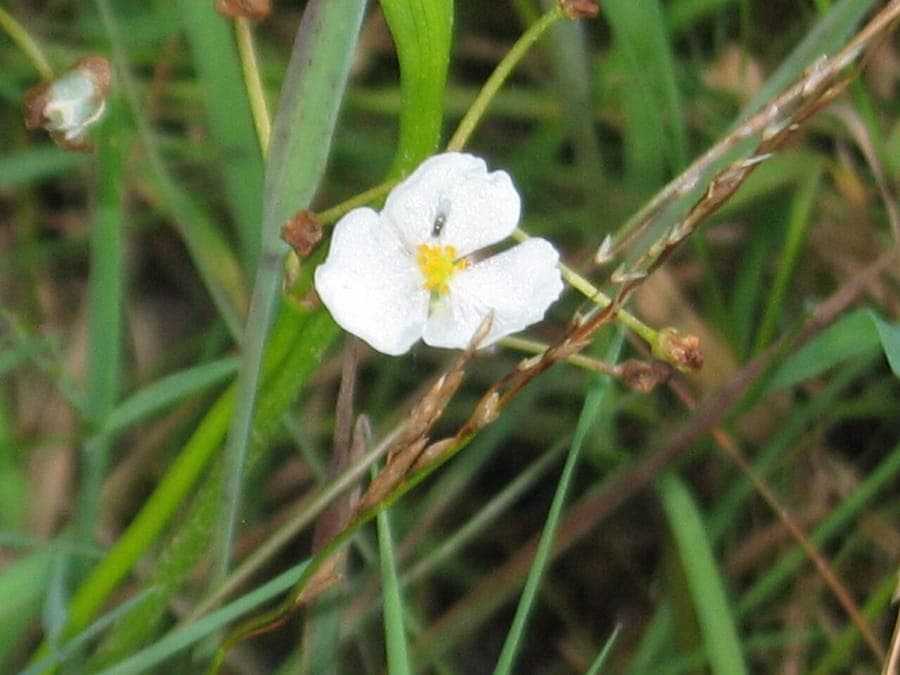
The blooming is one of the highlights of this plant. The flowers appear on striking, vertical stems from July to September. The flowers are white with yellow stamens, approximately 1.5 to 2 centimeters in diameter. They are very attractive to pollinators.
The plant also forms interesting seed capsules after flowering.
Ideal location
Grassleaf arrowhead thrives best in shallow ponds or water gardens, preferably at depths of 15 to 45 centimeters. The plant likes to be in sunny locations, although it also tolerates partial shade.
Perfect for pond margins and in permanent water bodies. Avoid strong currents.
Soil
The plant grows best in humus-rich, moist soils or aquatic substrates. In ponds, it can be planted directly in soft, muddy substrate. An organic-rich soil stimulates better growth.
The plant can also be grown in pots that are submerged in the pond.
Diseño gratis
¿Quieres ver Grassleaf arrowhead: complete guide en tu jardín? Crea un diseño gratis ahora.
Watering
As an aquatic plant, grassleaf arrowhead requires water as its growing medium. Keep it constantly submerged at appropriate water depth. The plant can grow in both shallow and deeper waters.
Ensure good water quality. Rising water temperature can promote growth.
Pruning
Pruning is usually not necessary. Only remove dead or damaged leaves when needed. After flowering, older plant parts can be removed to encourage new growth.
Maintenance calendar
April-May: Plant water plants and check for winter damage. June-July: Growth and preparation for blooming. August-September: Blooming period, enjoy! October-March: Rest period, plant may die back to roots.
Winter hardiness
Grassleaf arrowhead is winter-hardy down to approximately -15 degrees Celsius, depending on water depth. In deeper ponds, it can survive the winter. In shallow ponds, winter protection may be needed.
Companion plants
Combine grassleaf arrowhead with other aquatic plants such as water lilies, pondweed, and water iris. In groups, the effect is most striking.
Closing
Grassleaf arrowhead is an indispensable addition to water gardens. Its elegant leaves and beautiful flowers make it a top candidate. You can find this plant at specialized aquatic plant suppliers.
For a more naturalistic pond, this is an essential plant. Visit gardenworld.app for more ideas on water gardens.
Want more aquatic plant combinations? See gardenworld.app for complete water garden designs.
¿Quieres ver Grassleaf arrowhead: complete guide en tu jardín? Crea un diseño gratis ahora.
Sube una foto, elige un estilo y obtén un diseño fotorrealista con lista de plantas en menos de un minuto.
Más de 10.000 jardines diseñados
Sin tarjeta de crédito


Plantas similares
California damsonium: complete guide
Damasonium californicum
Full guide to Damasonium californicum (California damsonium): shallow water, bog soil, care and companion plants for this rare western aquatic.
Yellow water lily: complete guide
Limnocharis flava
Discover the yellow water lily. Everything you need to know about cultivation, care and water placement.
Sagittaria subulata: complete guide
Sagittaria subulata
Discover narrow-leaf arrowhead (Sagittaria subulata), an aquatic plant for ponds and water gardens. Complete cultivation and care guide.