
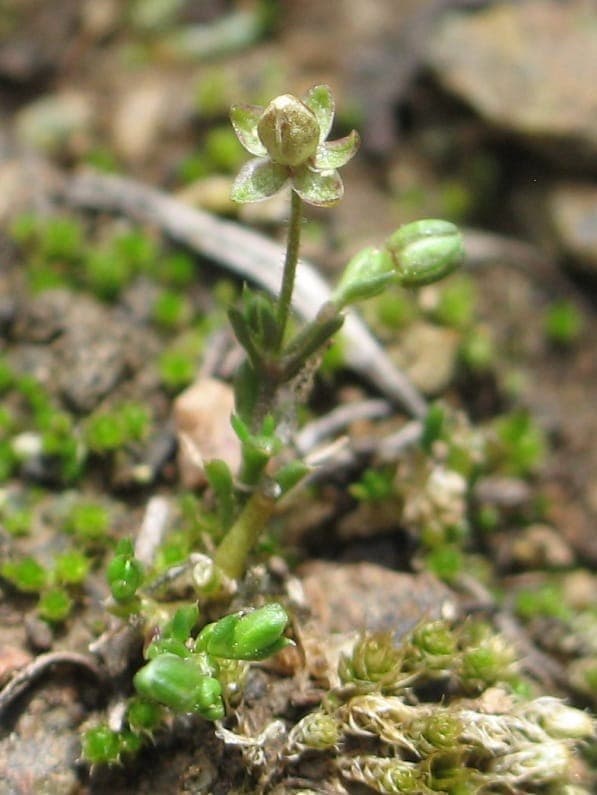
Robert Steers/NPS / CC0, via Wikimedia Commons
Annual pearlwort: complete guide
Sagina apetala
¿Quieres ver Annual pearlwort: complete guide en tu jardín?
1 minuto, sin tarjeta de crédito
Overview
Annual pearlwort (Sagina apetala) is a small annual or winter-annual herb from the Sagina genus (pearlworts). Though unremarkable to the casual observer, this compact plant plays an important role in natural garden management and rock garden ecology. The species is native to Europe and extends to North Pakistan, North Africa, and Ethiopia. Despite its modest stature - usually 5-15 cm tall - it provides valuable nutrition and microhabitat for countless tiny insects.
Appearance & bloom cycle
Annual pearlwort grows in dense, compact rosettes or spreading mats 5-15 cm tall. The leaves are extremely fine, needle-like, usually pale green, arranged in irregular clusters. What distinguishes this species from related pearlworts is the absence of visible petals (apetala = without petals).
Flowers appear April-September, especially early season. They are minute - approximately 2-3 mm - with four greenish sepals but no conspicuous petals. This makes them inconspicuous yet botanically fascinating.
After flowering, tiny seed capsules form containing thousands of minuscule seeds.
Ideal location
Annual pearlwort thrives in moisture-poor, sunny sites. Plant it in:
- Rock gardens, paving crevices
- Gravel beds, scree gardens
- Meadow gardens, wild areas
- Path and patio joints
The plant is hardy to USDA zone 3 and grows in virtually all European climates. It tolerates partial shade but dislikes deep shade.
Soil requirements
Annual pearlwort thrives on poor, sandy or gravelly soils. A well-draining, moisture-poor substrate is essential - this plant absolutely dislikes waterlogging. In gardens with heavy clay, grit or sand must be worked in.
The plant is adapted to nutrient-poor soils and rarely requires feeding. Excess nutrition can actually cause overgrowth.
A pH of 6.0-7.5 is suitable.
Diseño gratis
¿Quieres ver Annual pearlwort: complete guide en tu jardín? Crea un diseño gratis ahora.
Watering
Once established, Annual pearlwort requires minimal supplemental water. Under natural moisture conditions, no additional watering is needed. Only in very dry periods (more than 3 weeks without rain) might light misting help.
Always ensure good drainage: waterlogging is lethal to this plant.
Pruning & maintenance
Pruning is not necessary. The plant manages itself via self-seeding. After flowering, very overgrown mats can be gently raked or cleared, but usually this is unnecessary.
The plant will naturally appear where moisture conditions suit it and disappear where they don't - let the system work.
Maintenance calendar
February-March: Seedlings emerge from previous season's seed.
April-May: Flowering period - tiny, inconspicuous blooms.
June-September: Seed-set and dispersal; plants may decline in hot, dry spells and regenerate in autumn.
October-January: Dormancy; plants may remain green if mild.
Winter hardiness
Annual pearlwort is extremely hardy to -30°C. This is an opportunistic plant: annual populations can occur, but some plants overwinter as rosettes. This adaptive behavior ensures continuity.
Companion plants
Annual pearlwort naturally grows alongside:
- Other rock garden plants: Swamp violet, thyme varieties
- Between pavers: Scotch mint, pepper saxifrage
- In crevices: Moss varieties, lichen
It supports small beetles, caterpillars, and other fauna.
Conclusion
Annual pearlwort is not a showy plant - that's precisely its strength. As an essential component of natural, low-maintenance gardens, it provides valuable habitat and nutrition for small creatures while propagating itself independently. For gardeners wanting to make their landscapes more naturally managed, this plant is an indispensable ally.
Want to design a rock garden or wild area plan? Discover on gardenworld.app how tiny plants play large roles in healthy garden ecosystems. See examples on gardenworld.app.
¿Quieres ver Annual pearlwort: complete guide en tu jardín? Crea un diseño gratis ahora.
Sube una foto, elige un estilo y obtén un diseño fotorrealista con lista de plantas en menos de un minuto.
Más de 10.000 jardines diseñados
Sin tarjeta de crédito


Plantas similares
Dianthus karami: complete guide
Dianthus karami
Dianthus karami is a rare Lebanese mountain pink with fringed pink blooms on limestone cliffs, ideal for rock gardens and troughs.
Sicilian pink: complete guide
Dianthus siculus
Discover Dianthus siculus, an elegant purple bloomer from Sicily. Cultivation, June-September flowering and garden combinations.
Alpine mouse-ear chickweed: complete guide
Cerastium pedunculatum
Full growing guide for Cerastium pedunculatum: ideal location, soil, watering, winter hardiness, and companion plants for rock gardens.