
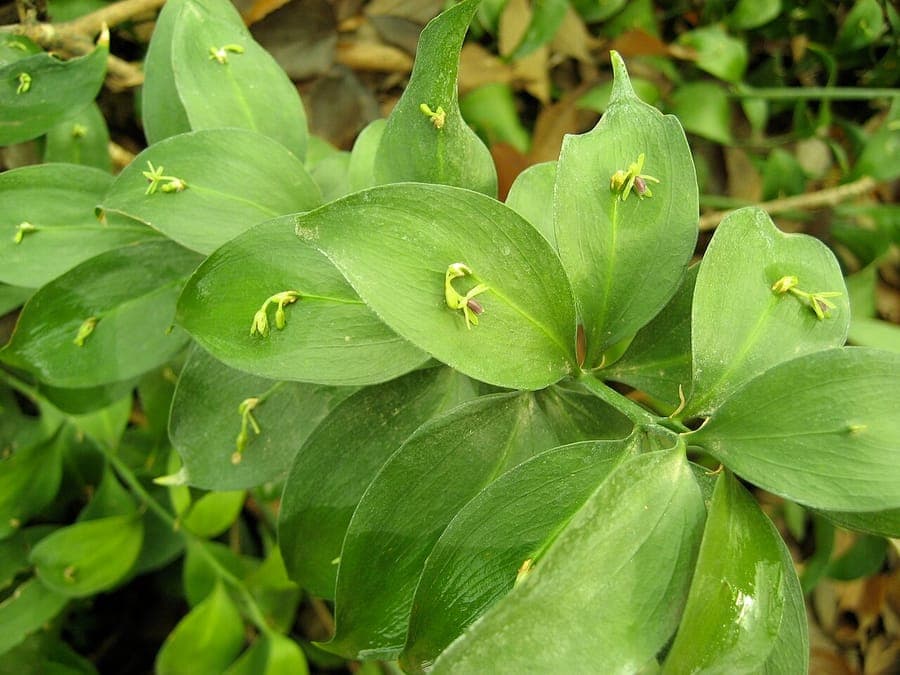
laurha from España / CC BY 2.0, via Wikimedia Commons
Ruscus hypophyllum: complete guide
Ruscus hypophyllum
¿Quieres ver Ruscus hypophyllum: complete guide en tu jardín?
1 minuto, sin tarjeta de crédito
Overview
Ruscus hypophyllum, commonly known as Spineless butcher's broom or Fragon, is a distinctive Mediterranean evergreen shrub that offers an elegant solution for challenging shady corners in gardens. This refined plant brings Mediterranean sophistication to temperate zones.
Unlike the common butcher's broom, this species lacks sharp spines, making it far more user-friendly. The plant displays a striking growth pattern with fine cladodes (flattened branches imitating leaves). This gives the plant an exceptionally elegant, light-footed appearance.
The plant is hardy to minimally -5 degrees Celsius and can overwinter well in protected locations in southern regions. In northern areas, planting against warm masonry offers best protection.
Appearance and bloom
Ruscus hypophyllum typically reaches 40-60 cm height and forms a compact, upright shrub. The plant's character derives from cladodes (modified shoots) that are leaf-like in form. These are dark green, glossy, and extremely fine.
True leaves are minuscule and situated beneath the cladodes (hence the name "hypophyllum"). This gives the plant an exceptionally refined appearance. In March and April, small white flowers appear, followed by bright red berries on female specimens.
The red berries are highly decorative and persist long on the plant. This provides extra ornamental value during autumn and winter seasons.
Ideal location
Fragon grows best in partial shade to full shade. The plant tolerates even deeply shaded corners without significant growth retardation. This makes the plant particularly valuable for north-facing walls and beneath deciduous trees.
In UK gardens, positioning against a warm south-facing wall is ideal for overwintering. In southern regions, open planting can function. Protect from strong cold winds.
The compact form makes the plant suitable for small gardens and container cultivation. In Mediterranean garden styles, the plant offers authentic authority.
Soil
Ruscus hypophyllum thrives on well-drained, neutral to weakly alkaline soils (pH 6.5-7.5). The plant tolerates acidic soils. Waterlogging poses a greater problem than drought.
Add drainage material (gravel, sand) when planting to prevent moisture stagnation. For clay soils: incorporate coco fiber or shell fragments. In containers: use premium potting mix with extra drainage.
The plant grows slowly - expect no more than 5-10 cm annual growth. This requires patience but creates ultimately luxuriant, mature specimens.
Diseño gratis
¿Quieres ver Ruscus hypophyllum: complete guide en tu jardín? Crea un diseño gratis ahora.
Watering
Provide regular watering in the first year, especially during dry spells. Once established, the plant tolerates moderate dryness. Avoid waterlogging - this causes root rot.
During rainy seasons, supplemental water is rarely needed. In dry summers, supplemental watering promotes growth. Shaded gardens: less water than sunny spots. Mulch helps moisture retention.
Pruning
Pruning is scarcely necessary due to the naturally compact form. Remove only dead or damaged shoots. In spring, long shoots can be slightly shortened for density formation.
Always use sharp secateurs. The plant regenerates slowly - be careful with radical pruning. Light shaping beats aggressive cutback.
Maintenance calendar
March: Check plant for winter damage. Add drainage mulch. April-May: Observe bloom. Light watering if dry. June-July: Continue moisture management. Track berry formation. August: Water as needed. Observe red berries. September-October: Enjoy bright berry color. Reduce watering. November-January: Protect from extreme frost (-5 C or lower). February: Prepare for new growing season. Add compost.
Winter hardiness
Ruscus hypophyllum is hardy to -5 to -7 degrees Celsius. In northern regions it requires frost protection. Positioning against warm masonry is essential. Use burlap wrap or straw mulch during extreme frost periods.
Once well established, the plant tolerates colder conditions better. Newly planted specimens must be protected.
Companion plants
Fragon combines well with other shade-tolerant Mediterranean plants. Combine with Helleborus, Acer palmatum, or ivy. For contrast: ferns, hostas in north-facing walls.
In Mediterranean settings: pair with laurel (Laurus nobilis) and myrtle (Myrtus communis). For underplanting: small evergreens or sedges.
Closing thoughts
Ruscus hypophyllum is an elegant, low-maintenance choice for shady garden corners. Though slow-growing, the plant rewards patience with refined beauty and decorative red berries.
For refined gardeners willing to experiment with Mediterranean plants, spineless butcher's broom deserves a place in protected gardens on gardenworld.app. Available through specialized nurseries.
¿Quieres ver Ruscus hypophyllum: complete guide en tu jardín? Crea un diseño gratis ahora.
Sube una foto, elige un estilo y obtén un diseño fotorrealista con lista de plantas en menos de un minuto.
Sin tarjeta de crédito


Plantas similares
Narrow-leaved dracaena: complete guide
Dracaena angustifolia
Everything about Dracaena angustifolia - the narrow-leaved dracaena: location, care, overwintering and use as a houseplant or patio plant.
Chaparral yucca: complete guide to Hesperoyucca whipplei
Hesperoyucca whipplei
Hesperoyucca whipplei (Our Lord's candle) is a dramatic rosette-forming plant from California that produces a towering flower spike, ideal for dry and gravel gardens.
False lily-of-the-valley: complete guide
Maianthemum dilatatum
Everything about Maianthemum dilatatum, the false lily-of-the-valley. Care, shade location, propagation and garden combinations for this popular shade ground cover.