
Wikimedia Commons / Public domain, via Wikimedia Commons
Butcher's broom: complete guide
Ruscus aculeatus
¿Quieres ver Butcher's broom: complete guide en tu jardín?
1 minuto, sin tarjeta de crédito
Overview
Butcher's broom (Ruscus aculeatus), also known as Box-holly or Kneeholme, is a compact, evergreen shrub native to the Mediterranean and surrounding regions. Distinguished by stiff, glossy foliage with characteristic spiny tips and attractive red berries persisting through winter, this plant brings year-round interest to shaded garden situations.
Butcher's broom proves exceptionally versatile, thriving in both sun and shade - making it invaluable for difficult garden locations. The plant combines practical benefits - bird food, winter interest, shade-suitability - with elegant appearance remaining attractive throughout the year. At gardenworld.app you can integrate butcher's broom into modern garden designs emphasizing four-season interest.
Appearance and bloom
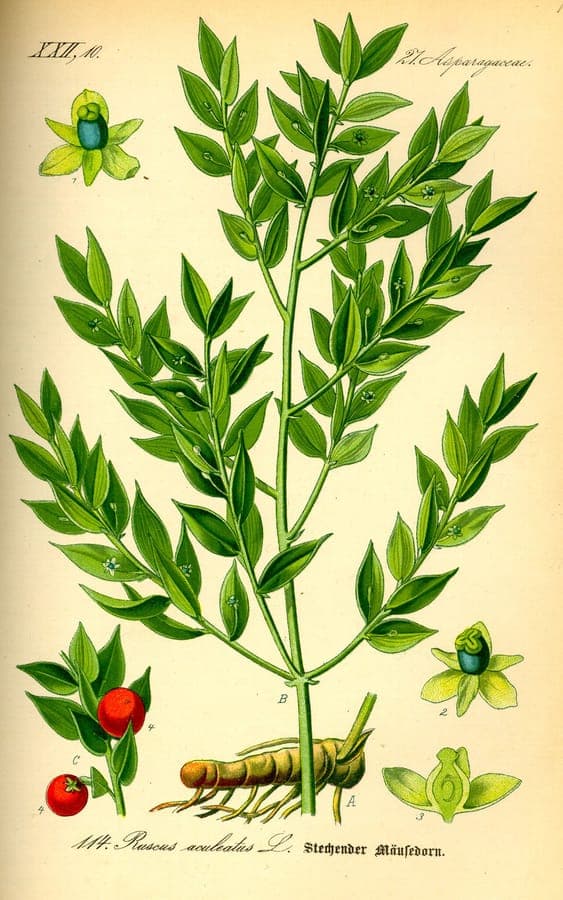
Butcher's broom forms a compact, upright shrublet typically 40-80 centimetres tall and 60-100 centimetres wide. The foliage proves most distinctive: stiff, glossy green, lance-shaped, 1-2 centimetres long, with sharp spiny tips. These 'needles' give the plant its name and render the foliage inedible to herbivores.
Flowering occurs inconspicuously in March-May: small greenish or purple flowers appear at leaf bases. Following bloom, brilliant red berries the size of peas appear, persisting until January-February. These berries provide winter food for thrushes and other birds.
The plant is dioecious, meaning male and female flowers grow on separate plants. You therefore need both male and female plants for berry production.
Ideal location
Butcher's broom ranks among the finest shade plants for temperate gardens. The plant thrives in full to dappled shade and happily grows beneath large trees. In full sun the plant also grows well but prefers sheltered, shadier corners.
The plant proves undemanding regarding wind exposure and forms an effective, impenetrable barrier or hedge. In modern gardens the plant combines beautifully in borders with other shade-lovers.
Soil and substrate
Butcher's broom grows in virtually all soils: neutral to acidic, poor to fertile, sandy, clay or mixtures. The plant tolerates even poor, dry soils exceptionally well, making it ideal for difficult garden locations. In heavy maintenance schedules compost addition proves beneficial but remains non-essential.
Incidentally, in moisture-loving soils the plant grows more weakly. Ensure good drainage in clay soils through sand or composted bark amendment.
Diseño gratis
¿Quieres ver Butcher's broom: complete guide en tu jardín? Crea un diseño gratis ahora.
Watering
Once established, butcher's broom proves remarkably drought-tolerant. During the first growing season (March through October), water assists root system establishment. Thereafter the plant tolerates extended dry periods.
In exceptionally dry summers supplemental water may prove necessary, but generally the plant proves self-maintaining. Mulching with 5 centimetres of composted bark assists moisture retention in dry soils.
Pruning and maintenance
Butcher's broom requires minimal pruning. The plant grows slowly and naturally maintains compact form. Only dead wood or damaged branches require removal.
For hedge use the plant tolerates light trimming after the berry season (March), but avoid excessive cutting that might inhibit next season's growth.
Maintenance calendar
March-April: Planting season. Initiate watering. Remove old fruits and dead wood.
May-June: Growth phase. Minimal water needed. Flowering structures visible.
July-September: Continued growth. Drought protection where needed. First berries colouring.
October-February: Berry season and winter. Minimal maintenance. Bird food available.
Winter hardiness
Butcher's broom proves extremely hardy to -15°C to -20°C, covering essentially all temperate European gardens. The plant remains evergreen and retains decorative value throughout winter.
Companion plants
Butcher's broom combines beautifully with other shade-loving, evergreen plants: Buxus sempervirens (box), Ilex aquifolium (holly), Hedera helix (ivy) and Sarcococca confusa. This combination creates strong winter structure.
In larger borders the plant works superbly with ornamental grasses and ferns offering form and texture contrast. The red berries provide striking contrast against dark green foliage.
Conclusion
Butcher's broom represents an exceptional plant for difficult garden locations, especially shade. With minimal maintenance, all-year-round interest and ecological benefits, this plant proves indispensable in sustainable, modern gardens. Purchase butcher's broom from quality nurseries and discover how this unassuming shrub transforms your garden space.
¿Quieres ver Butcher's broom: complete guide en tu jardín? Crea un diseño gratis ahora.
Sube una foto, elige un estilo y obtén un diseño fotorrealista con lista de plantas en menos de un minuto.
Más de 10.000 jardines diseñados
Sin tarjeta de crédito


Plantas similares
Holly: complete guide
Ilex aquifolium
Discover holly (Ilex aquifolium), the iconic evergreen with red berries. Growing, care tips, and decorative uses for your garden.
Common Boxwood: complete guide
Buxus sempervirens
Everything about Common Boxwood (Buxus sempervirens): planting, pruning, topiary and box moth control. Practical tips for healthy, green hedges and shapes.