
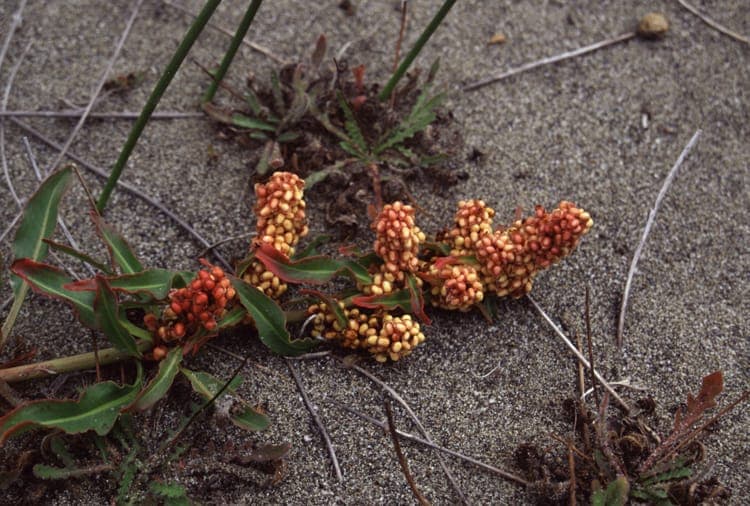
Gordon Leppig & Andrea J. Pickart / Public domain, via Wikimedia Commons
Rumex salicifolius: complete guide
Rumex salicifolius
¿Quieres ver Rumex salicifolius: complete guide en tu jardín?
1 minuto, sin tarjeta de crédito
Overview
The Willow Dock (Rumex salicifolius) is a herbaceous perennial from the Polygonaceae family, native to arid regions of North America from California to Nevada and northern Mexico. This distinctive sorrel distinguishes itself through finely-textured, slender leaves resembling willow foliage - hence its common and botanical names. In its natural habitat, the plant thrives in dry steppes and mountain slopes where regular water proves scarce.
As a garden specimen, Willow Dock demands minimal maintenance thanks to its adaptation to dry soils. With delicate leaf texture and subtle flowering characteristics, this plant offers interesting foliage interest for drought-themed garden designs. The growth habit proves graceful and never obtrusive.
Appearance & bloom
Willow Dock grows as a perennial herb reaching approximately 0.6 to 1.2 metres in height. The foliage constitutes the main ornamental feature: long, slender, linear leaves genuinely resembling willow twigs, hence 'salicifolius' meaning willow-leaved. Leaves display pale to grey-green colouration.
During summer (July-August), tiny flowers emerge in dense spikes, lacking showy petals but featuring interesting russet or brown sepals and fruit structures. These subsequently develop into highly decorative seed heads persisting through autumn, providing bird food well into winter.
Ideal location
This plant thrives best in intensely sunny sites: minimum 7 to 8 hours direct sun. The plant clearly prefers full light exposure and tolerates shade only minimally. A position with good air circulation prevents disease and supports its natural form.
Willow Dock excels in open landscapes and corners where other plants fail from aridity. This characteristic makes it ideal for xeriscaping designs or Mediterranean-themed gardens.
Soil
Dry soil poses no difficulty but rather represents a requirement for this species. Ideal soils are well-draining and inclined toward dryness. Modify heavy clay soils with sand and gravel. pH tolerance proves broad, from acidic through neutral to even slightly alkaline.
The poorer the soil, the better this plant performs. Excessive fertility promotes soft growth and reduces essential oil concentration. Planting hole preparation proves minimal: merely gravel or sand for drainage suffices.
Diseño gratis
¿Quieres ver Rumex salicifolius: complete guide en tu jardín? Crea un diseño gratis ahora.
Watering
Once established, Willow Dock proves exceptionally drought-tolerant. During the first growing season, provide moderate water without overwatering. Once settled after several months, water may be substantially reduced or eliminated.
The plant tolerates extremely arid conditions without supplemental irrigation. This makes it exceptionally suitable for water-conserving gardens. In regions with regular rainfall, it flourishes even during exceptional droughts.
Pruning
Willow Dock demands virtually no pruning. Allow the plant to develop its natural form. Remove only completely dead stems in early spring or late winter. Seed heads may remain longer for their decorative value and bird nutrition.
If shaping proves necessary, work with extreme lightness and selectivity. The plant recovers slowly from heavy interventions. The best approach involves simply allowing growth and enjoying its natural ornamental value.
Maintenance calendar
January-February: Winter inspection, remove completely dead material. March-April: Minimal pruning if needed, beginning growth period. May-June: Growth phase, minimal or no watering. July-August: Flowering and seed production, keep dry. September-October: Seed head enjoyment, seed dispersal. November-December: Autumn beauty, dormancy preparation.
Winter hardiness
Willow Dock proves very winter-hardy and suitable for USDA zone 5 (-29 to -23 degrees Celsius) and warmer. The plant withstands severe winters well, particularly in dry conditions. Very wet winters may promote fungal or bacterial issues, making good drainage essential.
Companion plants
The seed heads attract diverse seed-eating birds, particularly finches and sparrows. Some insects utilise it for shelter. It is not a butterfly magnet but contributes ecological value in dry habitats.
Closing remarks
Willow Dock suits experienced gardeners seeking to utilise dry soils productively. This low-maintenance plant demands minimal effort in exchange for years of ornamental value. Seek this species at specialist retailers like Intratuin and Gamma where sustainable choices are emphasised.
Learn more on gardenworld.app. Discover additional xerophytic plants for sustainable garden designs.
¿Quieres ver Rumex salicifolius: complete guide en tu jardín? Crea un diseño gratis ahora.
Sube una foto, elige un estilo y obtén un diseño fotorrealista con lista de plantas en menos de un minuto.
Más de 10.000 jardines diseñados
Sin tarjeta de crédito


Plantas similares
Crosby's wild buckwheat: complete guide
Eriogonum crosbyae
Full guide to growing Eriogonum crosbyae: ideal site, soil, watering, winter hardiness and companion plants for this rare western wild buckwheat.
Spreading buckwheat: complete guide
Eriogonum effusum
Full guide to growing Eriogonum effusum: ideal site, soil, watering, winter hardiness and companion plants for this prairie subshrub from the American West.
Tall woolly buckwheat: complete guide
Eriogonum elatum
Full guide to Eriogonum elatum: siting, soil, watering, pruning and companion plants for this elegant white-flowered buckwheat from the western United States.