
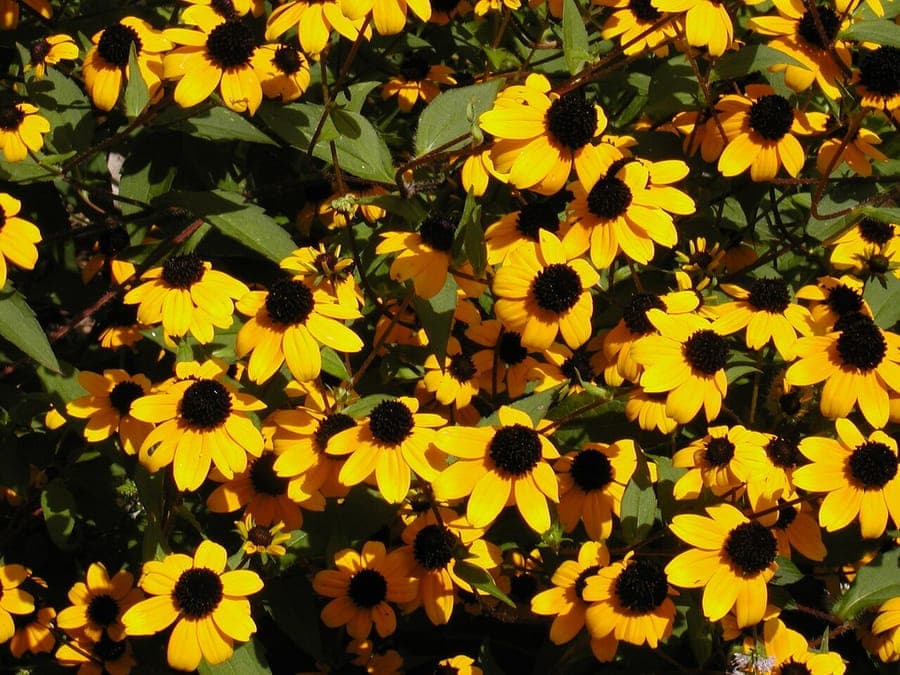
b:User:SBJohnny / Public domain, via Wikimedia Commons
Rudbeckia triloba: complete guide
Rudbeckia triloba
¿Quieres ver Rudbeckia triloba: complete guide en tu jardín?
1 minuto, sin tarjeta de crédito
Overview
Rudbeckia triloba, commonly known as the three-lobe coneflower or thin-leaf coneflower, is a North American perennial in the Asteraceae family. This plant is celebrated for its abundant yellow flowers with distinctive black, dome-shaped disk centers blooming July through October. The plant serves as a valuable addition to naturalized borders, summer gardens, and pollinator-friendly plant schemes.
Appearance and Bloom
The three-lobe coneflower is a dense, upright plant typically reaching 60-90 cm in height. The stems are sturdy and finely hairy, often reddish-tinted. Lower leaves are trilobate (accounting for its name) while upper leaves are simpler in form. The foliage is rough-textured and remains green deep into autumn.
Flowers are abundant, approximately 3-4 cm in diameter, with yellow disk and ray florets surrounding a glossy black dome-shaped center. The blooming period extends July through October, with peak blooming August-September. Flowers are exceptionally attractive to bees, butterflies, and other beneficial insects.
Ideal Location
Place Rudbeckia triloba in full sun (minimum 6-8 hours direct sunlight daily) for optimal growth and flowering. The plant tolerates light shade but blooms less profusely. Ensure good air circulation to minimize fungal diseases during humid periods.
Soil
The three-lobe coneflower grows well in average to moderately fertile soil. Heavy soils can be improved with sand and organic matter. The plant accepts pH 5.5-7.0 and is not particularly fussy. Most important is good drainage; the plant does not tolerate waterlogging.
When planting, incorporate organic matter or compost 2-3 cm deep into the planting hole. After planting, apply light mulch (2-3 cm), maintaining distance from the stem.
Diseño gratis
¿Quieres ver Rudbeckia triloba: complete guide en tu jardín? Crea un diseño gratis ahora.
Watering
Once established, Rudbeckia triloba is fairly drought-tolerant. During the first growing season, water when the top inch of soil feels dry. Regular watering promotes continuous blooming. During extreme drought, supplemental water may be needed, but overwatering causes root rot.
Drip irrigation or basal watering is ideal. Avoid overhead evening watering to prevent fungal diseases.
Pruning
Deadhead spent flowers regularly throughout the season to stimulate continuous blooming. At the end of October, as frost arrives, plants can be cut back near ground level or left standing into fall for seed-feeding birds.
Any weak or diseased stems can be removed anytime. Beyond deadheading, no pruning is necessary; the plant naturally maintains an attractive form.
Maintenance Calendar
April: Planting time in spring or seedling growth. May-June: Foliage growth; water as needed. July-August: Blooming begins; deadhead regularly. August-October: Peak blooming; insect activity. October-November: Autumn color; seed heads remain. November-March: Winter dormancy; minimal care.
Winter Hardiness
Rudbeckia triloba is winter-hardy to USDA zone 4 (-30°C to -23°C). The plant overwinters reliably in Netherlands, Belgium, Germany, and France. In harsher climates, late-autumn mulch provides additional protection.
Companion Plants
The three-lobe coneflower pairs beautifully with other summer bloomers such as purple coneflower (Echinacea), zinnias, coreopsis, and aromatic herbs. Mass in dense drifts for dramatic effect. Also pairs well with ornamental grasses for texture.
Closing
Rudbeckia triloba offers easy maintenance, continuous blooming, and value for beneficial insects. This North American treasure deserves place in more gardens. Learn more at gardenworld.app/en and gardenworld.app/nl.
¿Quieres ver Rudbeckia triloba: complete guide en tu jardín? Crea un diseño gratis ahora.
Sube una foto, elige un estilo y obtén un diseño fotorrealista con lista de plantas en menos de un minuto.
Sin tarjeta de crédito


Plantas similares
Calendula stellata: complete guide
Calendula stellata
Complete guide to Calendula stellata, the star-flowered marigold from Sicily: location, soil, watering and companion planting tips.
Korean chrysanthemum: complete guide
Chrysanthemum x rubellum
Chrysanthemum x rubellum is a hardy autumn perennial with single pink to copper flowers from August to November. Care and combinations.
Helianthus divaricatus: complete guide
Helianthus divaricatus
Helianthus divaricatus is a North American woodland sunflower with yellow summer blooms, ideal for naturalistic borders and shady edges.