
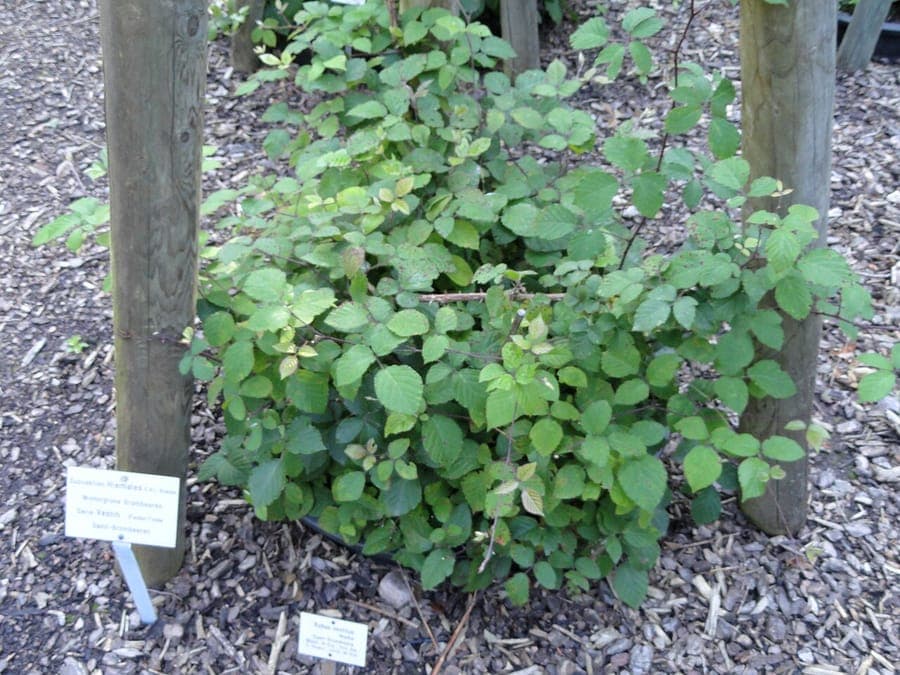
Daderot / CC0, via Wikimedia Commons
European blackberry: complete guide
Rubus vestitus
¿Quieres ver European blackberry: complete guide en tu jardín?
1 minuto, sin tarjeta de crédito
Overview
The European blackberry (Rubus vestitus) is a versatile bramble species native to much of Western, Central, and Southern Europe. Unlike many brambles that appear rough or invasive, this species is distinguished by its softly hairy, velvety stems - the feature that earned its name (vestitus = clothed). The plant offers not only aesthetic value with its white-pink flowers and glowing red ripening fruits, but also delicious, sweet blackberries for harvest.
Appearance & bloom cycle
The European blackberry grows as a perennial shrub reaching 2-2.5 meters tall, or higher if supported. The defining characteristic is the soft, velvety covering of the stems - this feels warm and smooth to the touch, unlike the harsh thorns of many other brambles.
Leaves are trifoliate, green with finely serrated edges. Flowers appear May-June: white-pink or pale pink blooms approximately 1.5-2 cm wide, with a fresh, herbal scent. They attract insects readily.
Fruits mature from green through red to glossy black. Ripe blackberries measure about 1-1.5 cm across, are soft, sweet, and aromatic - considerably superior to many commercial cultivars. They ripen July-September depending on weather.
Ideal location
Plant European blackberry where it receives at least 5-6 hours of sunlight daily. Full sun provides the best fruiting, but the plant tolerates light shade. This makes it suitable for semi-natural gardens and woodland edge planting.
The plant is hardy to USDA zone 5 (-25°C) and grows successfully in virtually all temperate European climates. In warm regions, it tolerates drought better than many other brambles.
Soil requirements
European blackberry is not demanding regarding soil type. It performs best, however, on well-draining soil with adequate organic matter. A soil pH of 5.5-7.0 is suitable. The plant is quite salt-tolerant, making it appropriate for coastal gardens.
Amend poor soils with compost or leaf mold for better growth. Heavy clay soils should be improved with sawdust and sand. Waterlogging should be avoided, though the plant tolerates wetter conditions better than American bramble cultivars.
Diseño gratis
¿Quieres ver European blackberry: complete guide en tu jardín? Crea un diseño gratis ahora.
Watering
Regular watering is essential upon planting, especially during the first dry weeks. Water newly planted specimens regularly until they establish firm roots (first year).
Once established, the plant can rely largely on natural rainfall in temperate climates. During dry periods - especially during fruiting - provide supplemental water. A good mulch layer aids moisture retention.
Pruning
European blackberry flowers and fruits on two-year-old canes. Maintenance pruning:
- Immediately after harvest (September): Remove all canes that bore fruit at ground level.
- Winter (December-January): Cut back lateral shoots to 40-60 cm.
- Early spring (March): Remove damaged or dead wood.
This plant can also be trained against a trellis if desired. Pinch back lateral shoots regularly.
Maintenance calendar
March: Spring pruning; check soil condition.
April: New growth emerges - no special measures.
May-June: Flowering period - ornamental and attracts insects.
July-September: Fruiting and harvest; maintain regular watering.
October-February: Quiet period; adjust pruning as needed.
Winter hardiness
European blackberry is extremely hardy to -25°C. In severe winters, young shoots may freeze, but the rootstock recovers quickly. Protection with mulch in very cold years (below -20°C) may benefit young plants.
Companion plants
European blackberry pairs well with:
- Native fruit plants: Hawthorn, blackthorn - same cultural requirements.
- Shrubs: Hazel, bird cherry - for a natural woodland edge.
- Ground covers: Ivy, beech hedge - plantable beneath the bramble.
Conclusion
The European blackberry is a wild, native bramble that has been valued for centuries for its fruits and natural charm. With its soft velvety stems, lovely flowers, and flavorful berries, it's a worthy addition to genuinely food-producing gardens.
Want to integrate brambles into your garden plan? Discover on gardenworld.app how to position fruit-bearing structures efficiently. View examples of productive gardens on gardenworld.app.
¿Quieres ver European blackberry: complete guide en tu jardín? Crea un diseño gratis ahora.
Sube una foto, elige un estilo y obtén un diseño fotorrealista con lista de plantas en menos de un minuto.
Más de 10.000 jardines diseñados
Sin tarjeta de crédito


Plantas similares
Siberian crab apple: complete guide
Malus x robusta
Complete guide to the Siberian crab apple (Malus x robusta): location, soil, pruning, winter hardiness and the best companion plants for your garden.
Chinese flowering crabapple (Malus x spectabilis): complete guide
Malus x spectabilis
Meet the Chinese flowering crabapple (Malus x spectabilis): a classic spring bloomer with carmine buds and pink blossom.
Potentilla crassinervia: complete guide
Potentilla crassinervia
Potentilla crassinervia, the Corsican cinquefoil, grows wild on Corsica and Sardinia's peaks. Discover how to grow this hardy alpine rock garden gem.