
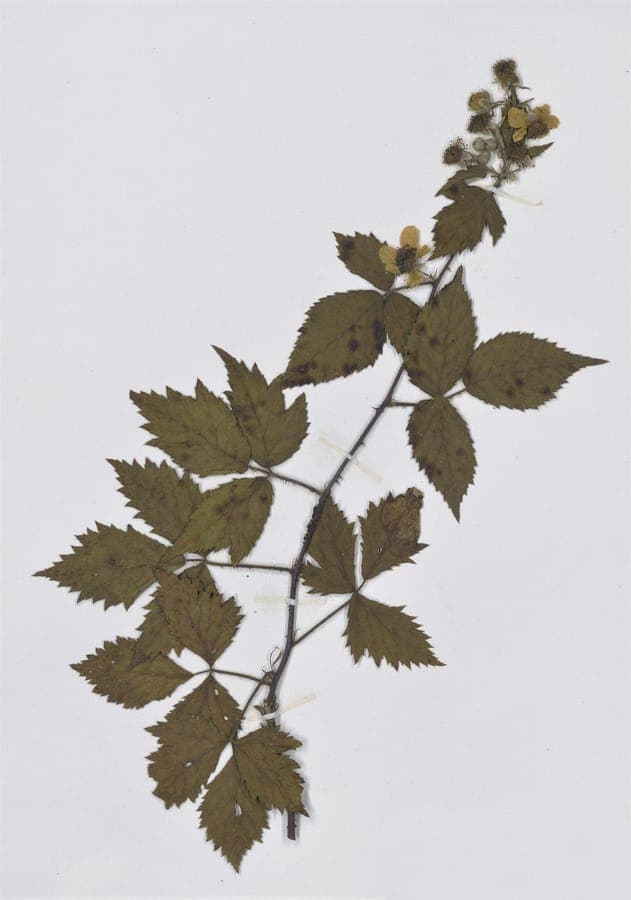
Naturalis Biodiversity Center, Netherlands / CC0, via Wikimedia Commons
Rubus pyramidalis: complete guide
Rubus pyramidalis
¿Quieres ver Rubus pyramidalis: complete guide en tu jardín?
1 minuto, sin tarjeta de crédito
Overview
Rubus pyramidalis, commonly known as Pyramid bramble, is a fascinating native shrub that excels in naturalistic garden designs. This lesser-known blackberry species offers a unique combination of ecological value and ornamental appeal. Originally from Central Europe, this plant has adapted to diverse growing conditions and thrives in Dutch gardens year after year.
The plant earns its name from its characteristic pyramid-shaped growth habit. This natural form makes it particularly suited to wild corners, hedgerows, and as underplanting in woodland-style garden sections. While not specifically cultivated for edible berries like some bramble varieties, the plant produces useful flowers that attract pollinators.
If you seek a low-maintenance shrub requiring minimal feeding and tolerating heavy soils, Pyramid bramble is an excellent choice. Its role in gardenworld.app designs makes it valuable for environmentally conscious landscapers.
Appearance and bloom
Rubus pyramidalis reaches average heights of 1.5 to 2.5 meters and forms densely branched growth with a natural pyramidal outline. Young shoots are covered with fine, reddish thorns that give the plant its characteristic appearance. Older wood shows grayish-brown bark that peels in strips.
The leaves are trifoliate (three-parted), with dark green upper surfaces and lighter, grayish-hairy undersides. The leaf margins are finely saw-edged, creating fine texture. During the growing season, leaves transform in autumn to beautiful yellow-orange hues.
Flowers appear in July and August in small white to light pink clusters. Though not dramatically large, these blooms attract hoverflies, bees, and other pollen dispersers. After flowering, dark red to blackish fruits form, accessible to birds and wildlife.
Ideal location
Pyramid bramble grows optimally in partial shade to full sun. However, the plant tolerates shadier spots well, with growth only slightly slower. For best results, choose a location with at least 4-5 hours of direct daily sunlight.
The plant suits heath and woodland gardens, along property boundaries where some wildness is acceptable, or as secondary planting in larger shrub borders. Its native character makes Pyramid bramble perfect for ecological garden designs.
Avoid placing directly beside pathways or play areas due to thorns. Conversely, as a defensive hedge or border planting, these thorns provide advantages. Protect young plants from strong winds in their first year.
Soil
Rubus pyramidalis is unfussy about soil composition. The plant grows best on slightly acidic to neutral soils (pH 6.0 to 7.0), but also accepts weakly alkaline earth well. More important than pH is sufficiently well-drained soil.
While the plant tolerates dry ground, specimens grow most vigorously on moister sites. Add generous compost or weathered mulch when planting to improve moisture retention. This also helps incorporate nutrients.
Heavy clay soils can be improved by incorporating peat or coconut fiber. Light soil preparation is adequate - no deep soil cultivation is necessary.
Watering
During the first growing season after planting, regular moisture is essential. Water two to three times weekly depending on weather and season. Ensure water penetrates well but doesn't stagnate.
Established specimens are much more drought-tolerant, especially if growing in partial shade. During dry summer periods, supplemental watering accelerates growth, but the plant survives without special attention.
For good results, a thick organic mulch layer (3-5 cm) proves very useful. This helps retain moisture and contributes to the gradual breakdown of organic matter. Use compost pieces, shredded bark, or fine ground-cover snippets.
Diseño gratis
¿Quieres ver Rubus pyramidalis: complete guide en tu jardín? Crea un diseño gratis ahora.
Pruning
Rubus pyramidalis responds well to pruning, though this isn't necessary from a shape-maintenance perspective. Perform main pruning in late autumn to early spring when the plant is dormant. Directly remove dead, damaged, or diseased wood.
For shape and compactness, cut back to about two-thirds of the previous year's growth in March. This promotes branching and creates a denser shrub. Avoid pruning after May to avoid cutting into bloom.
Long shoots can be slightly shortened throughout the growing season for tidiness. Always wear gloves - the thorns are sharp and can cause irritation. For severely overgrown plants, you can prune hard back to 30 cm height; they recover the following summer.
Maintenance calendar
March: Assess feeding needs. Add compost around the plant. Check for damage.
April-May: Water regularly if dry weather continues. Add mulch. Young shoots can be shortened.
June-July: Monitor water levels. Follow blooming. Observe early fruit setting.
August: Manage moisture during heat. Monitor birds and insects.
September: Beginning of autumn color change. Reduce watering slightly.
October-November: Prepare for pruning. Allow leaves to fall. Clean up withered parts.
December-February: Rest period. Frost protection for young plants if temperatures drop below -15 Celsius. Perform pruning on dry days.
Winter hardiness
Rubus pyramidalis is extremely winter hardy and thrives in Northern European climates. The plant tolerates temperatures to -20 Celsius without damage. Late winter frost-thaw cycles can cause some superficial wood damage, which isn't truly problematic.
Young plants in their first year may benefit from some snow protection or burlap wrap in extreme weather. Established specimens need no further protection.
Companion plants
Rubus pyramidalis works beautifully with other native shrubs and ground covers. Combine with wild brambles (Rubus fruticosus), hawthorn (Crataegus monogyna), and blackthorn (Prunus spinosa) for an authentic thorn scrub arrangement.
For underplanting, choose woodland species like German sage (Salvia glutinosa), male fern (Dryopteris filix-mas), or evergreen sedge (Carex caryophyllea). Spring bloomers like Bluebell (Hyacinthoides non-scripta) or Wild tulip (Tulipa sylvestris) provide striking contrasts.
Plants to avoid are aggressive rhizomatous spreaders that could overwhelm the bramble. Therefore, maintain some distance from Japanese knotweed or other invasive species.
Closing thoughts
Rubus pyramidalis deserves more attention in Dutch gardens. With minimal maintenance needs and maximum ecological value, this native bramble contributes to a lively garden ecosystem. Its characteristic pyramid form, robustness across soil variations, and tolerance for partial shade make it ideal for both small urban garden corners and larger natural garden projects on gardenworld.app.
Whether you need defensive planting, want to stimulate bird food, or simply seek a low-care shrub, Pyramid bramble fits perfectly into the household ecosystem.
Find Rubus pyramidalis at specialty garden retailers. Discover more plant combinations at gardenworld.app.
¿Quieres ver Rubus pyramidalis: complete guide en tu jardín? Crea un diseño gratis ahora.
Sube una foto, elige un estilo y obtén un diseño fotorrealista con lista de plantas en menos de un minuto.
Más de 10.000 jardines diseñados
Sin tarjeta de crédito


Plantas similares
Siberian crab apple: complete guide
Malus x robusta
Complete guide to the Siberian crab apple (Malus x robusta): location, soil, pruning, winter hardiness and the best companion plants for your garden.
Chinese flowering crabapple (Malus x spectabilis): complete guide
Malus x spectabilis
Meet the Chinese flowering crabapple (Malus x spectabilis): a classic spring bloomer with carmine buds and pink blossom.
Potentilla crassinervia: complete guide
Potentilla crassinervia
Potentilla crassinervia, the Corsican cinquefoil, grows wild on Corsica and Sardinia's peaks. Discover how to grow this hardy alpine rock garden gem.