
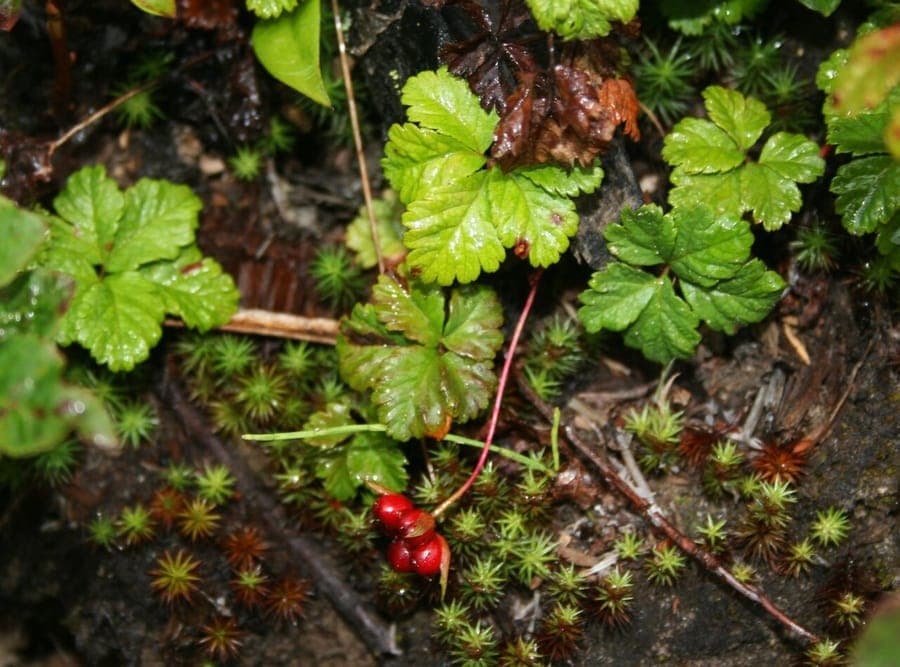
Franz Xaver / CC BY-SA 3.0, via Wikimedia Commons
Strawberry-leaf raspberry (Rubus pedatus): complete guide
Rubus pedatus
¿Quieres ver Strawberry-leaf raspberry (Rubus pedatus): complete guide en tu jardín?
1 minuto, sin tarjeta de crédito
Overview
Rubus pedatus, commonly called strawberry-leaf raspberry or five-leaved bramble, is a low herbaceous bramble from the Himalayas, Japan, and northwestern North America. The name refers to its distinctive five-leaflet foliage resembling strawberry leaves. This is not a commercial fruit-bearer, but an architecturally interesting groundcover with red, ripening-to-yellow berries. Perfect for alpine garden enthusiasts seeking something unusual.
Appearance and bloom
Reaches only 15-30 cm height, spreads 60-90 cm wide via shallow rhizomes. The most striking feature is five equally-arranged leaflets (pedatus = foot-like), distinguishing it from three-leafed Rubus species. Leaf span typically 5-8 cm. Flowers are small, white to pale yellow, appear May-June. Berries ripen July-August, initially red, then yellow or orange at full maturity.
Ideal location
Grows in half-shade to full shade, but blooms best at locations with 4-6 hours filtered sunlight. Mountain meadows, forest edges, rocky gardens, and alpine bed-backgrounds are ideal. These are native alpine plants feeling at home on slopes. Avoid lowland locations and intense afternoon heat.
Soil
Grows in acidic to neutral mountain soils (pH 5-7). Stone-rich, well-drained substrates preferred. Sandy loam mixed with 30-40% charcoal-based leaf mould creates ideal growing environment. Drainage essential.
Diseño gratis
¿Quieres ver Strawberry-leaf raspberry (Rubus pedatus): complete guide en tu jardín? Crea un diseño gratis ahora.
Watering
Moderate moisture need. Water regularly until established (first 2-3 months). Thereafter, water sufficiently during dry periods but avoid waterlogging. In alpine mountain gardens, natural moisture percolation usually suffices.
Pruning
Minimal pruning required. Remove dead material in March. Every 2-3 years, light thinning of overgrown rhizomes maintains shape. No formal shaping; allow natural growth. Guide this spread by cutting inappropriate runners.
Maintenance calendar
March: Dead-wood inspection, possible light pruning. April-May: Monitor flowering. June-July: Observe fruit colour progression. August: Check ripeness if harvesting. September-October: Allow seeds to fall naturally. November-March: Alpine winter dormancy.
Winter hardiness
Rubus pedatus withstands temperatures to -25 to -35C (USDA zones 3-5). Suitable for alpine gardens and Scandinavian regions. Snow cover provides protective insulation. Snowfall is beneficial.
Companion plants
Perfect in rock gardens with saxifrages, alpine thyme, dwarf sedums, and phlox. Combine with low-growing dwarf conifers (Juniperus, Picea) for texture contrast. Suitable for alpine settings near waterfalls or mountain streams. Birds appreciate both the berries and ground-level shelter.
Closing
Strawberry-leaf raspberry is a rare and intriguing choice for alpine and mountain garden enthusiasts. With its distinctive five-leafed foliage and colour-changing berry transformation, it adds architectural interest and biological diversity to specialist gardens.
¿Quieres ver Strawberry-leaf raspberry (Rubus pedatus): complete guide en tu jardín? Crea un diseño gratis ahora.
Sube una foto, elige un estilo y obtén un diseño fotorrealista con lista de plantas en menos de un minuto.
Más de 10.000 jardines diseñados
Sin tarjeta de crédito


Plantas similares
Running blackberry (Rubus hispidus): complete guide
Rubus hispidus
Discover running blackberry from eastern North America. A low trailing berry-bearer with hispid stems, thrives in swampy and acid soils - perfect for ecological understory planting.
Dwarf raspberry (Rubus pubescens): complete guide
Rubus pubescens
Discover dwarf raspberry from subarctic North America. A low herbaceous ground cover with red fruits and downy foliage - hardy to -30C, thrives in wet woodlands.
Pacific blackberry (Rubus ursinus): complete guide
Rubus ursinus
Discover Pacific blackberry from western North America. A vigorous trailer with large white flowers, black berries, and coarse foliage - perfect for wild coastal and mountain gardens.