
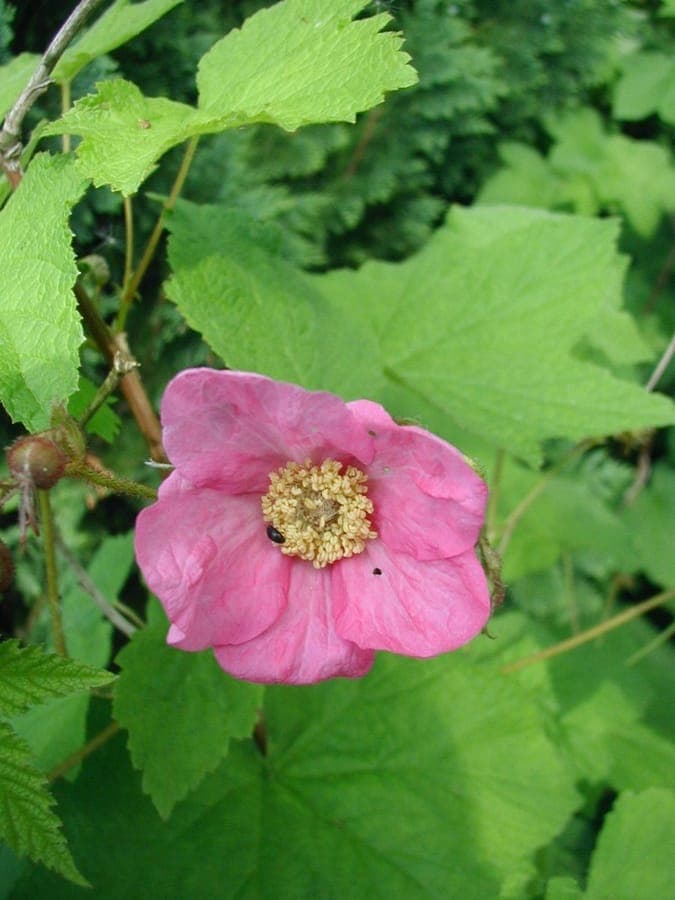
No machine-readable author provided. Sten assumed (based on copyright claims). / CC BY-SA 3.0, via Wikimedia Commons
Thimbleberry: complete guide
Rubus odoratus
¿Quieres ver Thimbleberry: complete guide en tu jardín?
1 minuto, sin tarjeta de crédito
Overview
The Thimbleberry (Rubus odoratus), also called Flowering Raspberry or Cinnamon Raspberry, is a North American wild bramble that differs dramatically from its European cousins. This lovely shrub from the Rosaceae family stands out primarily for its large, stunning red-pink flowers and fragrant leaves.
This is an ideal plant for shaded garden corners, woodland landscapes, and spots where other brambles struggle. The plant combines flower-garden beauty with wild bramble vigor and hardiness.
Appearance and bloom cycle
The Thimbleberry grows as a loosely branched, upright to semi-spreading shrub reaching 1–2 meters tall. The most striking feature is its large, soft-hairy leaves that smell of cinnamon when touched. They are broad, palmate with 5–7 lobes, green and velvety.
Large, showy flowers appear June to August: bright pink to purple-pink, about 3–5 cm across, in loose clusters. They have a pleasant fragrance and attract numerous pollinators. Fruits form July–September: red to orange berries about 1 cm across, soft and tasty but somewhat tart.
Ideal location
The Thimbleberry thrives in partial to full shade – quite different from most brambles. In full sun, leaves sometimes scorch. The plant feels at home in woodland situations with high humus content. Perfect for:
- Shaded corners
- Woodland gardens
- Waterside plantings
- Understory under trees
- Wildlife thickets
Soil requirements
The Thimbleberry prefers moist, well-draining soil rich in organic matter. Neutral to slightly acidic (pH 6.0–6.8) is ideal. The plant grows on clay and sand but feels most at home on humus-rich forest soil.
Feeding: Add compost or leaf mold when planting – lots of organic material greatly improves growth. A 5–8 cm mulch layer of leaf litter helps.
Watering
The Thimbleberry enjoys moist soil. Water regularly during the growing season, especially during dry spells. Mature plants tolerate some drought but produce better results with adequate moisture. Ensure the root zone doesn't dry out.
Summer: Water 2–3 times weekly during dry periods. Fall/Winter: Water only during prolonged drought.
Diseño gratis
¿Quieres ver Thimbleberry: complete guide en tu jardín? Crea un diseño gratis ahora.
Pruning
Pruning is optional. In February–March, remove dead wood and weak shoots. Cut out old fruiting canes after fruiting. The plant grows naturally compact without much pruning.
If desired, lightly cut back young shoots in June to stimulate more branching and compactness. But heavy pruning isn't needed and can reduce flower production.
Maintenance calendar
- January–February: Check moisture; pruning optional
- February–March: Remove dead wood
- April–May: Monitor disease; water
- May–June: First flowers; enjoy
- June–August: Flowering; provide water
- August–October: Harvest berries (optional); remove old canes
- October–December: Leaf drop; winter preparation
Winter hardiness
The Thimbleberry is winter-resistant to USDA zone 4 (down to –30°C). The plant endures frost but prefers locations somewhat protected from strong winds.
Companion plants
Pair beautifully with:
- English ivy (Hedera helix): Evergreen, silhouette
- Purple beech (Fagus sylvatica purpurea): Leaf color contrast
- False hellebore (Maianthemum dilatatum): Delicate understory
- Ferns (Polystichum setiferum): Textural contrast
- Christmas rose (Helleborus niger): Winter interest
Conclusion
The Thimbleberry proves that brambles don't have to be all thorn. With its large pink flowers, fragrant leaves, and shade tolerance, it fills a gap in many gardens.
Plant in spots where other brambles struggle – under trees, against walls, in corners. Flowers attract bees; birds feed on red fruits. For ideas on how this raspberry fits into your garden design, visit gardenworld.app. This American bramble deserves much more attention in European shade gardens. Find more inspiration on gardenworld.app for understory plantings.
¿Quieres ver Thimbleberry: complete guide en tu jardín? Crea un diseño gratis ahora.
Sube una foto, elige un estilo y obtén un diseño fotorrealista con lista de plantas en menos de un minuto.
Más de 10.000 jardines diseñados
Sin tarjeta de crédito


Plantas similares
Siberian crab apple: complete guide
Malus x robusta
Complete guide to the Siberian crab apple (Malus x robusta): location, soil, pruning, winter hardiness and the best companion plants for your garden.
Chinese flowering crabapple (Malus x spectabilis): complete guide
Malus x spectabilis
Meet the Chinese flowering crabapple (Malus x spectabilis): a classic spring bloomer with carmine buds and pink blossom.
Potentilla crassinervia: complete guide
Potentilla crassinervia
Potentilla crassinervia, the Corsican cinquefoil, grows wild on Corsica and Sardinia's peaks. Discover how to grow this hardy alpine rock garden gem.