
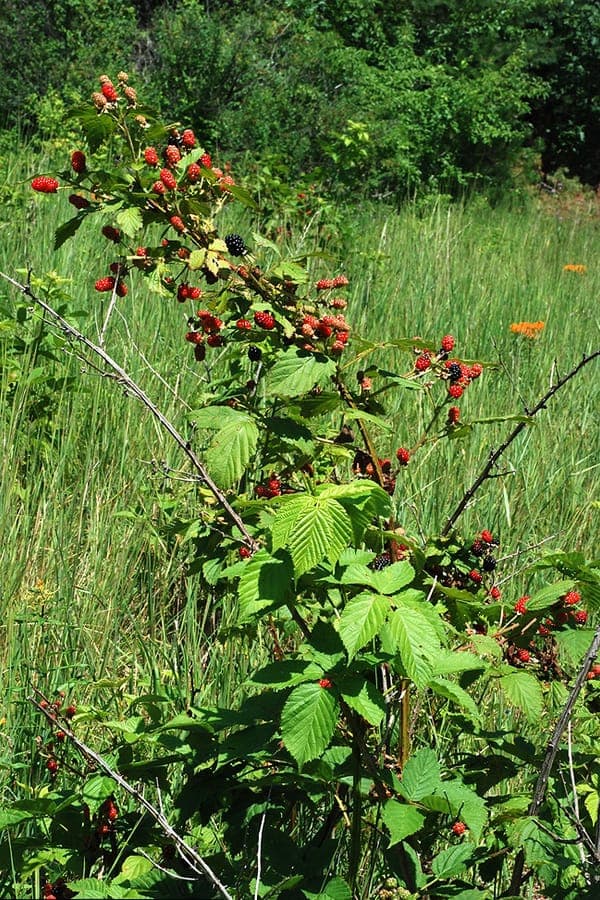
Doug Goldman. USDA-NRCS-NPDT United States, NY, Tompkins Co., Dryden. / Public domain, via Wikimedia Commons
Allegheny blackberry: complete guide
Rubus allegheniensis
¿Quieres ver Allegheny blackberry: complete guide en tu jardín?
1 minuto, sin tarjeta de crédito
Overview
The Allegheny blackberry (Rubus allegheniensis), also known as highbush blackberry or common blackberry, is a native wild bramble from North America, originating from eastern Canada and the United States. This robust shrub belongs to the Rosaceae family and has become naturalized in Europe.
The Allegheny blackberry differs notably from common European brambles through its larger, sweeter fruits, upright less-thorny growth habit, and preference for moist sites. This makes it interesting for wildlife gardens and natural plantings.
Appearance and bloom cycle
The Allegheny blackberry grows as an upright to semi-spreading shrub reaching 1–2 meters in height. Young stems are green to red, later becoming woody and brown, covered with straight, less numerous thorns and small bristles. This makes it considerably less aggressive than European brambles.
The leaves are trifoliate, glossy green, with coarse serrated margins. They color red-purple in autumn. In May and June, white to pink flowers appear, about 1–1.5 cm across, in clusters. Fruits ripen July–August: large, full black berries, sweet and juicy (15–20 mm diameter).
Ideal location
The Allegheny blackberry thrives in full sun to partial shade. Deep shade leads to few fruits. The plant feels at home on moist, semi-shaded woodland edges and along water. Perfect for:
- Bird food hedges
- Natural blackberry thickets
- Waterside plantings
- Landscape boundaries
- Woodland gardens
Soil requirements
The Allegheny blackberry prefers moist, well-draining soil. It grows on heavy clay to sand but thrives on soil with sufficient organic matter. Neutral to slightly acidic (pH 6.0–7.0) is ideal.
Feeding: The plant grows on nutrient-poor soil, but adding compost or leaf mold when planting significantly improves growth and fruiting.
Watering
The Allegheny blackberry enjoys moist soil. Water regularly during the growing season, especially during dry spells. Mature plants tolerate short dry periods but produce better fruit with adequate moisture. After planting, ensure the root zone doesn't dry out.
Summer: Water 2–3 times weekly during dry periods. Fall/Winter: Water only during prolonged drought.
Diseño gratis
¿Quieres ver Allegheny blackberry: complete guide en tu jardín? Crea un diseño gratis ahora.
Pruning
Pruning happens in two phases. In February–March, remove old fruiting canes that produced last year. Cut out dead shoots and weak branches. Cut young shoots back to about 150 cm to stimulate branching.
After harvest (August–September), you can do light selective pruning, but this is optional. The plant grows naturally compact enough.
Maintenance calendar
- January–February: Perform pruning
- February–March: Apply feeding (compost, animal manure)
- April–May: Monitor for disease; water
- May–June: Flowering; enjoy
- June–July: Fruits ripen; water
- July–August: Harvest; remove old canes
- August–October: New growth; install supports
- October–December: Leaf drop; winter preparation
Winter hardiness
The Allegheny blackberry is winter-resistant to USDA zone 4 (down to –30°C). In severe winters, stems may suffer frost damage, but the plant always regrows from root buds.
Companion plants
Pair beautifully with:
- American elderberry (Sambucus canadensis): White plumes
- European chestnut (Castanea sativa): Textural contrast
- Bramble (Rubus fructicosus): European parallel
- Cowslip (Primula veris): Understory
- Valerian (Valeriana officinalis): May flowers
Conclusion
The Allegheny blackberry is an excellent choice for wildlife gardens and natural landscape plantings. Sweet fruits feed birds and humans; white flowers attract pollinators. With its less thorny character than European brambles, it offers a friendlier alternative.
Plant in groups along edges or waterside. For ideas on how this bramble fits into your garden design, visit gardenworld.app. This American species deserves more attention in European wildlife gardens. Find more inspiration on gardenworld.app for plant combinations with wild fruit.
¿Quieres ver Allegheny blackberry: complete guide en tu jardín? Crea un diseño gratis ahora.
Sube una foto, elige un estilo y obtén un diseño fotorrealista con lista de plantas en menos de un minuto.
Más de 10.000 jardines diseñados
Sin tarjeta de crédito


Plantas similares
Siberian crab apple: complete guide
Malus x robusta
Complete guide to the Siberian crab apple (Malus x robusta): location, soil, pruning, winter hardiness and the best companion plants for your garden.
Chinese flowering crabapple (Malus x spectabilis): complete guide
Malus x spectabilis
Meet the Chinese flowering crabapple (Malus x spectabilis): a classic spring bloomer with carmine buds and pink blossom.
Potentilla crassinervia: complete guide
Potentilla crassinervia
Potentilla crassinervia, the Corsican cinquefoil, grows wild on Corsica and Sardinia's peaks. Discover how to grow this hardy alpine rock garden gem.