
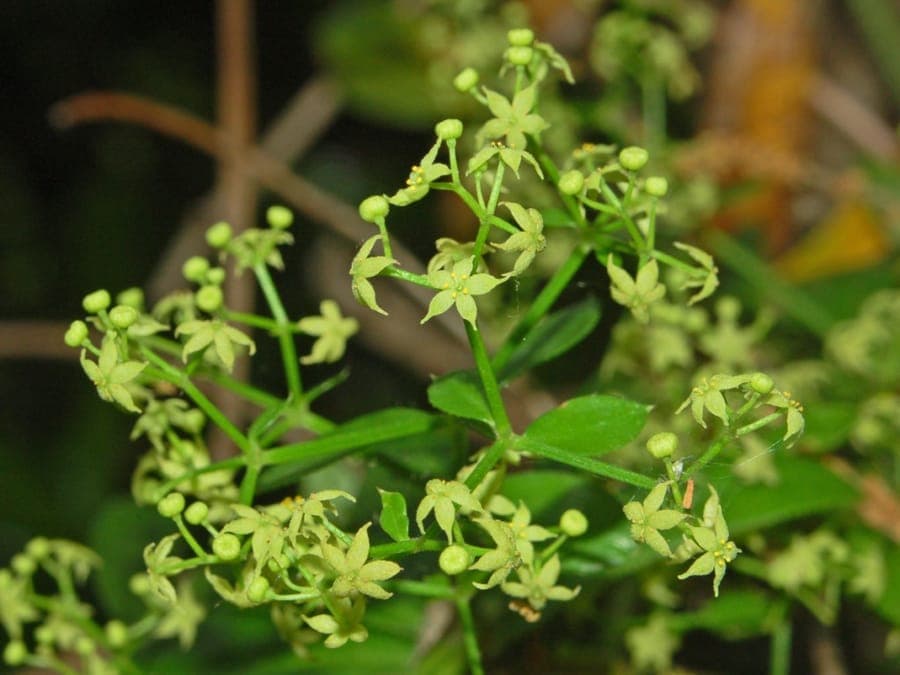
Hectonichus / CC BY-SA 3.0, via Wikimedia Commons
Rubia peregrina: complete guide
Rubia peregrina
¿Quieres ver Rubia peregrina: complete guide en tu jardín?
1 minuto, sin tarjeta de crédito
Overview
Rubia peregrina, also known as wild madder, is a fascinating evergreen climbing plant native to the Mediterranean region. This plant naturally thrives along coasts and in mountainous areas of southern Europe, from Portugal to Turkey. The plant was historically used to obtain red and purple dyes, although this use has largely been abandoned today.
In gardens, Rubia peregrina is an interesting choice for temperate climates where the plant attaches to support structures. The plant reaches heights of up to 1.5 meters and produces small yellow flowers followed by decorative dark fruits. This makes it a valuable plant for gardens seeking something different from the usual evergreen climbers.
Appearance and bloom
The leaves of Rubia peregrina are coarse-textured, unequal, lance-shaped, and evergreen, meaning they retain color throughout the year. The leaves have small hooks on the underside with which the plant can grip, although they do not always grip strongly. The plant feels somewhat rough to the touch due to fine hairs.
Flowers appear from May to August in small, yellowish-green clusters in the leaf axils. The flowers are small, only a few millimeters across, but numerous and attractive to bees. After flowering, dark blue to black spherical fruits form which are very decorative.
Ideal location
Rubia peregrina grows well in full sun to partial shade. The plant grows much better in warm, sunny locations. A south-facing wall or pergola is ideal.
Provide protection from cold winds. In very cold climates, winter protection may be needed. The plant prefers warm, well-drained locations.
Soil
Rubia peregrina grows in well-drained soil, preferably neutral to slightly alkaline. The plant tolerates poor soils and even grows in rocky conditions, making it ideal for slopes and difficult corners.
Heavy soils should be improved with sand and gravel for better drainage. The plant tolerates drought once established and needs no intensive fertilization.
Diseño gratis
¿Quieres ver Rubia peregrina: complete guide en tu jardín? Crea un diseño gratis ahora.
Watering
Rubia peregrina requires regular watering during the first growing season. Ensure the soil remains moist without becoming waterlogged.
Once established, the plant is relatively drought-tolerant and does not require regular extra watering. However, supplementary watering during dry summers can promote growth and flowering.
Pruning
Rubia peregrina requires minimal pruning. The plant naturally grows into a good form. To keep the plant in shape, one can carefully shorten overlong branches after flowering.
The plant should not be pruned too aggressively as this can result in fewer flowers the following season.
Maintenance calendar
Spring (March-April): Check for winter damage, begin regular watering, and add compost around the base.
Late spring (May-June): The plant flowers. Enjoy the small yellow blooms.
Summer (July-August): Fruits form and turn dark blue to black. Check for diseases.
Autumn (September-October): The dark fruits are very decorative. Reduce watering.
Winter (November-February): The plant remains evergreen. Minimal watering. Protect against severe frost.
Winter hardiness
Rubia peregrina is not fully winter-hardy in very cold climates. The plant can tolerate temperatures down to about minus 10 degrees Celsius, meaning it grows in temperate parts of Europe but requires caution in extremely cold winters.
In cold climates, protection with burlap and mulch is recommended. In milder climates and the south, it is very winter-hardy.
Companion plants
Rubia peregrina combines well with other Mediterranean climbing plants such as clematis, jasmine, and wisteria. For underplanting, aromatic herbs work well, such as lavender and rosemary.
The plant is bird-friendly because many birds eat the dark fruits.
Closing
Rubia peregrina is a special choice for garden owners seeking something different from the usual climbing plants. With its evergreen leaves, subtle yellow flowers, and decorative black fruits, it adds year-round interest to garden walls and pergolas. Although it is more sensitive to cold than other climbing plants, it rewards with unique beauty. Find your plant at specialized plant nurseries. Discover more interesting climbing plants on gardenworld.app.
¿Quieres ver Rubia peregrina: complete guide en tu jardín? Crea un diseño gratis ahora.
Sube una foto, elige un estilo y obtén un diseño fotorrealista con lista de plantas en menos de un minuto.
Sin tarjeta de crédito


Plantas similares
Oregon bedstraw: complete guide
Galium oreganum
Everything about Oregon bedstraw (Galium oreganum): shade planting, soil requirements, care and use as a low groundcover in woodland and shade gardens.
Awned woodruff: complete guide
Asperula aristata
Full guide to growing Asperula aristata, the awned woodruff: sunny location, alkaline soil, minimal watering, and companion plants for dry or rock gardens.
Purple woodruff: complete guide
Asperula purpurea
Full guide to Asperula purpurea, purple woodruff: sunny sites, chalky soil, watering, pruning, winter hardiness and companion plants for rock and dry gardens.