
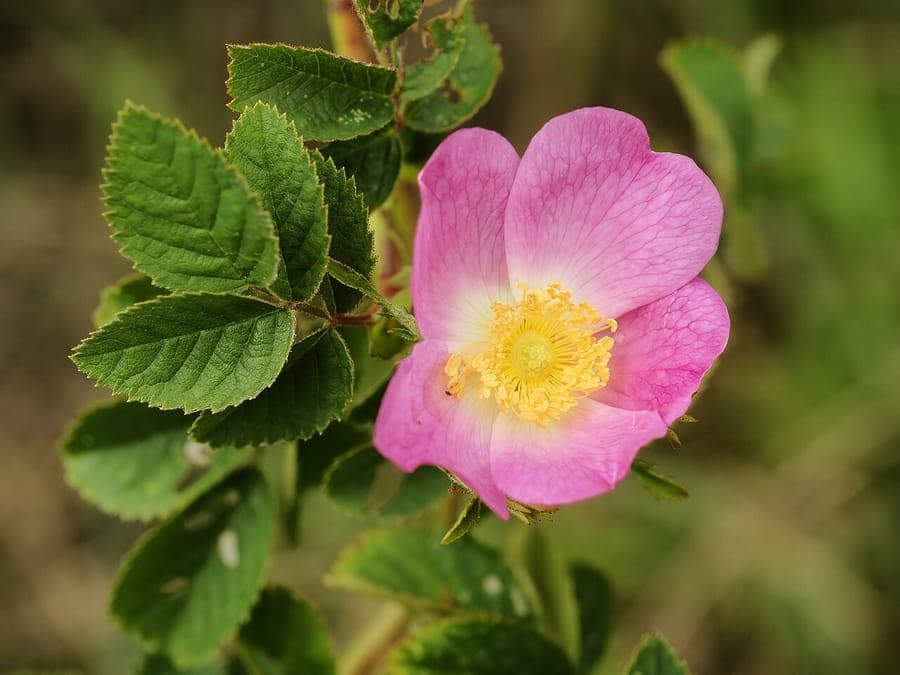
Hans Hillewaert / CC BY-SA 3.0, via Wikimedia Commons
Downy rose: complete guide
Rosa tomentosa
¿Quieres ver Downy rose: complete guide en tu jardín?
1 minuto, sin tarjeta de crédito
Overview
The Downy rose (Rosa tomentosa), also known as the Harsh Downy-rose or Woolly rose, is a native wild rose species from the Rosaceae family. This robust shrub occurs naturally throughout Europe and the Caucasus, particularly along hedgerows and woodland edges. The name 'tomentosa' refers to the striking velvety (tomentose) texture of the stems and leaves.
The Downy rose is an excellent choice for those seeking a natural, low-maintenance garden rich in wildlife activity. The plant is not only bird food but also an important insect magnet.
Appearance and bloom cycle
The Downy rose grows as a compact, dense shrub reaching 1–1.5 meters in height. The stems are dark purple to reddish-brown and covered with fine, evenly distributed thorns. The most striking feature is the velvety appearance of branches, leaves, and even sepals – a soft, grayish-hairy coating visible at close range.
The leaves are finely divided, green, and also softly hairy, giving a somewhat grayish sheen. In May and June, flowers appear: pink, single blooms about 2–3 cm across, subtly fragrant. By August, rosehips form – orange-red, fairly large (up to 1.5 cm long), with pale yellow bristles at the base.
Ideal location
The Downy rose thrives in full sun to light partial shade. It dislikes deep shade but accepts less favorable light conditions. Ensure good ventilation to prevent fungal issues. Perfect for:
- Natural hedgerows along boundaries
- Wild gardens and woodland plantings
- Bird food hedges
- Landscape borders
- Protected, fallow ground
Soil requirements
The Downy rose is flexible with soil type. It grows on heavy clay, sand, and everything in between. Neutral to slightly alkaline (pH 6.5–7.5) is ideal, but weakly acidic soils (down to pH 6) are tolerated.
Nutrition: The plant grows on poor soil too, but adding compost or leaf mold when planting improves root establishment. Slow organic feeding helps but isn't essential.
Diseño gratis
¿Quieres ver Downy rose: complete guide en tu jardín? Crea un diseño gratis ahora.
Watering
Once rooted, the Downy rose is drought-resistant. Provide regular water in the first season (twice weekly) until strong roots develop. Mature plants tolerate drought well.
The Downy rose tolerates wet feet, but prolonged waterlogging isn't ideal. After heavy rain, check that the root zone is well-drained.
Pruning
Prune in February or March once severe frost has passed. Remove dead branches and weak shoots. You can cut the plant back hard – to 40 cm above ground – without harm. This promotes full, compact growth.
Light formative pruning in June adds extra compactness but isn't necessary. The natural form is often most attractive.
Maintenance calendar
- January–February: Winter check; no action
- February–March: Perform pruning
- April–May: Monitor for disease; no feeding
- May–June: Flowering; enjoy
- July–August: Aphids and caterpillars possible; water spray
- August–October: Harvest rosehips (optional)
- October–December: Leaf drop; no action
Winter hardiness
The Downy rose is extremely winter-hardy (USDA zone 3, down to –40°C). It withstands snow, frost, and persistent cold without issue. Branches may suffer frost damage, but regrowth is assured.
Companion plants
Pair beautifully with:
- Rowan (Sorbus aucuparia): Orange berries
- Bird cherry (Prunus padus): White flowers, fragrance
- Hawthorn (Crataegus laevigata): Sweet blooms
- Bramble (Rubus fructicosus): Textural contrast
- Holly (Ilex aquifolium): Evergreen contrast
Conclusion
The Downy rose is a splendid choice for those wanting a wildlife and bird-friendly garden without much maintenance. Its velvety structure, pink flowers, and large red rosehips provide character year-round.
Plant in groups for strong visual impact. For ideas on how this rose fits into your garden design, visit gardenworld.app. This wild rose deserves a place in every natural garden. On gardenworld.app you'll find more inspiration on using wild roses in modern garden styles.
¿Quieres ver Downy rose: complete guide en tu jardín? Crea un diseño gratis ahora.
Sube una foto, elige un estilo y obtén un diseño fotorrealista con lista de plantas en menos de un minuto.
Más de 10.000 jardines diseñados
Sin tarjeta de crédito


Plantas similares
Siberian crab apple: complete guide
Malus x robusta
Complete guide to the Siberian crab apple (Malus x robusta): location, soil, pruning, winter hardiness and the best companion plants for your garden.
Chinese flowering crabapple (Malus x spectabilis): complete guide
Malus x spectabilis
Meet the Chinese flowering crabapple (Malus x spectabilis): a classic spring bloomer with carmine buds and pink blossom.
Potentilla crassinervia: complete guide
Potentilla crassinervia
Potentilla crassinervia, the Corsican cinquefoil, grows wild on Corsica and Sardinia's peaks. Discover how to grow this hardy alpine rock garden gem.